The event described below is part of a series of initiatives of the Anti-Racism Taskforce of the Northern Illinois Conference of the United Methodist Church. See below for details.
The color of concert music is white. Its gender: male. So goes the popular perception. To start a conversation on t.....continued>
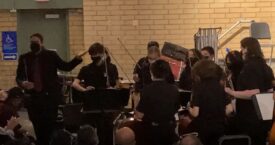
Below is a 3:30-minute video of a small but momentous occasion. My son Aaron—a wonderful musician and talented teacher and conductor—leading the Gage Middle School orchestra, Riverside, California. He’s been teaching there for 20 years and thousands of students. When he first got to Ri.....continued>
We celebrate the Church’s “birth” on Pentecost Sunday, the day the promised Holy Spirit arrived. This year we celebrated on May 20th, a Sunday where at my church—one of the most diverse in America—its large Filipino group took charge of the service. The VIDEO below sh.....continued>
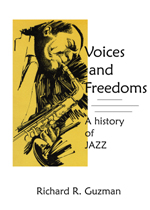
This is the first of 16 short excerpts from my radio series Voices and Freedoms: A History of Jazz. Based on my book of the same name, the series (and book) were produced at the University of Virginia in the nation’s Bicentennial Year. The show, syndicated by the Intercollegiate Broadcasting.....continued>
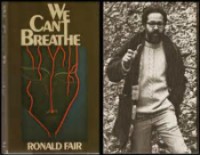
May 2020 Update: Another “I-Can’t-Breathe” incident. I could not watch the video of the police killing of George Floyd in Minneapolis on May 26, 2020. But I heard it while my wife described to me what she was seeing: a police man with his knee on the neck of an already-subdued bl.....continued>
“CBS” (COOL BLACK SICKNESS) a song DAN GUZMAN co-wrote and performs with Brad Hoskins. Fat Cats, Moses in the desert with the Great I Am, bleeding seas, and things tumbling from the sky. Apocalyptic dread. Cool grooves. It not only sounds good—it&#.....continued>
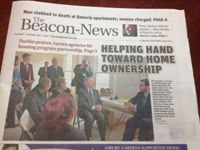
Update: IN APRIL 2018, EMMANUEL HOUSE MERGED WITH LONG-TIME PARTNER ORGANIZATION THE JOSEPH CORPORATION TO BECOME The Neighbor Project. THIS INCREASED THE NUMBER OF FAMILIES SERVED FROM AROUND 25 AT THE TIME OF SENATOR DURBIN’S VISIT TO NOW, IN 2020, A NUMBER APPROACHING 3000. WATCH A VIDEO.....continued>
Below is a VIDEO showing about 15 minutes of one of the most famous debates of the 20th century: James Baldwin vs William Buckley at the Cambridge Union in February 1965. The proposition up for debate: “The American Dream has been achieved at the expense of the American Negro.” Baldwin thrashes Buckley, the final audience vote being 544 to 164 in favor of the proposition.*
The VIDEO below begins with opening comments from the NET television host Norman St. John Stevas, a member of parliament. He exclaims about the audience’s size before setting out the proposition and program for the evening and introducing Baldwin and Buckley. Baldwin the famous novelist and essayist, author of Another Country, and Buckley the conservative—“in the American sense of conservative,” he hastens to add—author of Up from Liberalism and editor of The New Republic. I cut, then, to the end of Baldwin’s speech and the beginning of Buckley’s. Stevas also exclaims about the standing ovation Baldwin receives after his speech. It is truly extraordinary, and Baldwin seems at first shocked before we catch his smile of delight briefly amid the standing, cheering crowd. Then Buckley steps up to speak, and I fade out a few minutes later.
In his speech Baldwin brings out themes that anyone familiar with his writings—“copious writings,” Buckley says—will recognize, especially, perhaps, his insistence on treating the Negro as a real human being. “I am not a ward of the state,” “a missionary object.” Nor is the Negro a shining, pure innocent, as Harriet Beecher Stowe portrayed him with her Uncle Tom character. “We’re like anybody else,” he says. “We are mercenaries, dictators, murderers, liars.” Anyone familiar with William Buckley, Jr. will also see him as typically himself.
Here I want to focus on Baldwin’s voice and Buckley’s, as well as two things Buckley in particular says—the first being about Baldwin’s voice. Early in his remarks he mentions Baldwin’s The Fire Next Time, which had an electric effect on the United States when it first came out in 1963. He doesn’t much say what the book is about, just that in it Baldwin didn’t use the “English accent he spoke exclusively in tonight.” The crowd murmurs. TV host Stevas quietly says something about the murmuring, which is in fact drowned out by the murmuring. Buckley himself probably realizes that he’s made a mistake and seems trying to rush in some other thoughts to cover up the mistake because, of course, Baldwin has not been “using” a British accent at all. Upon hearing Buckley’s accusation Baldwin raises his eyebrows in surprise, seemingly the only time he is surprised during the entire debate.
Baldwin’s voice has as its base the rolling rhythms of the Harlem preacher he was as a teenager, but this has been overlayed with what some have called the “Black Atlantic voice”—that is, the accents of Black Americans who have lived or spent much time abroad, as Baldwin did, having left the United States for France the first time in 1948. He is also gay, which some imagine might also lend a certain tincture to his voice. But it is the Black Atlantic voice that fooled Buckley. You can hear it in many ex-patriot, near-expat, or widely-traveled Blacks—the one coming most to mind at this moment being Maya Angelou,** whom I was fortunate to get to know a little.
But perhaps it is Buckley’s voice that is even more extraordinary. He’s been parodied many times, most famously by Robin Williams and Joe Flaherty, with Williams also darting his tongue quickly in an out, snake-like, between typical Buckley phrases like, “If you catch my drift,” which he used to challenge his opponents to follow his nuance and cleverness. The gravitas—a favorite Buckley word—of his voice is harder to place than Baldwin’s, but I have always—perhaps unfairly—considered it to be the epitome of the smug, hyper-self-assured voice of white privilege. The cramped logical flow of his arguments is hard to follow after his mistake of accusing Baldwin of speaking exclusively with an English accent. I don’t, in fact, fully catch his drift. He says, I think, that he must answer Baldwin as if he were a white man because, he says, “I can assure you that your color has nothing whatsoever to do with your argument.” It’s the old color-blind ruse. When I led the committee that crafted a Diversity Plan*** for a premiere Illinois school district, that’s the bat I was hit over the head with again and again and again. I was even accused of contributing to the downfall of Western civilization because I dared to say that color did matter. And I get it. One of the foundational principles of white privilege is the assertion that color does not matter, though plainly it does. A couple of times, when people were swinging the bat of a “color-blind society” at me, I simply switched to gender. Do you think it doesn’t matter if you’re male or female? I asked. That got through to much of the audience most times, though not hardly all. I get that, too, because almost everyone has an instinctive sense of gender, but not of color. Color is blind to so many—which is, again, foundational to white privilege, or to people of color just aching to be white, which I also get most of the time. But Buckley assured Baldwin that color didn’t matter, and that assurance delivered with that ultra-smug voice has always grated on my ear and conscience.
That assurance is the first of Buckley’s assertions I wanted to focus on. The second, coming near the end of my excerpt, is that it wasn’t just Baldwin’s ancestors who worked to build the U.S.; his own ancestors did too. Here Buckley shows his naivete again, as he does throughout the debate, because he assumes that working hard is fairly compensated for all, which it is not. Obviously the vast majority of enslaved people profited not at all from their oppressors’ “work.” On top of that, there were laws and strongly enforced “customs” that prohibited Blacks from accumulating and handing down wealth and property, which has led to the astounding, shameful and growing racial wealth gap the U.S. experiences to this very day. I have written a lot about this—in “The Racial Wealth Gap and Home Ownership,” for example—so will let this go without further comment, except this: To hear this argument delivered by that smug Buckley voice always astounds me. In the first note below, I mention how the author of the piece I reference says that Buckley got “better” at seeing the realities of racism, but in the VIDEO below, his blindness, riding on the self-assurance of his smug voice, was on full display.
_______________ * A much fuller accounting of the 1965 debate, what led up to it and its aftermath, can be found in “When Buckley Met Baldwin” by Sam Tenenhaus in the June 2025 issue of The Atlantic. Of note is the author’s report that after his decisive defeat Buckley became less naive about racism and went on to greater prominence with his PBS show Firing Line, which became a platform for many important Black voices of the day, including several key members of the Black Panthers. ** This link takes you to an article entitled “Meeting Oprah.” But while she does make a show-stopping appearance, the article focuses on my meeting Maya Angelou, whom Oprah called Mother. *** This link takes you to comments I made after the Diversity Plan passed. There’s a link in this post that takes you to the plan itself. You can also read more about it by going to Diversity Initiatives.
Because of my wife’s sudden, life-threatening medical emergency in early August 2025, we were forced to cancel grand plans to celebrate our 25th anniversary. Instead, after she began to recover we took off on smaller, more local jaunts. That’s how we found ourselves in Madison, Wisconsin, in mid-October; and because she wasn’t recovered quite enough, that’s how we found ourselves opting to drop in to the No Kings protest in Janesville, Wisconsin, instead of going all the way to Chicago. An estimated 250,000 attended there, just a few hundred in Janesville, of course. All together, though, the 2700 separate protests throughout the U.S. on October 18, 2025, drew an estimated 7,000,000, making it the largest single day of protest in U.S. history. Even the largest anti-war protests and Civil Rights protests don’t compare because they were single events, not a coordinated series of events on the same day.
Way too much information for a protest sign? Still, I guess I read it all anyway.
The energy at the Janesville protest was high and convivial. One woman attended with a “Trump 2024” sign. I was about to go up to her and say, “Thank you for being here. You’re welcomed,” but a young woman, painted in white-face, began heranguing her, shouting, “You’re not a woman! You know what that predator has done to women!?” Still, even that was short-lived and they soon stood on the same corner quietly. This post contains some of the signs of the day, and BELOW IS A 1:30-MINUTE VIDEO capturing some of the sights and sounds.
Studies have shown that peaceful protests tend to motivate people to vote as opposed to violent ones, which only makes sense, I suppose. And these No Kings protests have been remarkably peaceful—convivial, as I said—no matter how the current administration tries to spin it. Still, I couldn’t help but be thinking almost all the time how many of the people there would be turning out to vote. I thought this especially of the young woman in white face, as young people have been notoriously famous for not voting. On the streets of my home city, which is nearly 50% Hispanic, I heard cries like, “We will fight you!” hurled at ICE agents during their raids, and at the Trump administration either directly or indirectly. Yet fully one-third of Hispanics eligible to vote didn’t even bother to register, and of those that did vote, 45% voted for Trump. 45%! At the hospital where my wife works there was an ICE raid, and they took someone out, and a Hispanic nurse is caught on camera saying to ICE agents, “Thank you for doing the Lord’s work.”
Poll numbers have not been kind to the Trump administration of late, and it appears that Hispanic support may be plummeting. But polls are just polls, and in politics a year’s worth of change can happen in a week, and the elections—even the mid-terms—are still a year away. President Trump is fond of hyperbole. Everything is the greatest, largest, most powerful in U.S. history, and he claims credit for it all. But, in fact, his political comeback has been the greatest in U.S. history. It has been absolutely stunning. “For better or worse,” wrote the journalist and political commentator Clarence Page, “effective politics is often nothing more than an effective appeal to the resentments of those who vote in large numbers, directed against a target group that doesn’t.” It’s more fun to attend a nice, convivial—that word again—protest. How these historically large protests turn into votes is still a very, very open question. And it seems like you’re being so much more active to shout, “We will fight you!” to ICE agents, rather than to just get yourself to the ballot box.



 Because of my wife’s sudden, life-threatening medical emergency in early August 2025, we were forced to cancel grand plans to celebrate our 25th anniversary. Instead, after she began to recover we took off on smaller, more local jaunts. That’s how we found ourselves in Madison, Wisconsin, in mid-October; and because she wasn’t recovered quite enough, that’s how we found ourselves opting to drop in to the No Kings protest in Janesville, Wisconsin, instead of going all the way to Chicago. An estimated 250,000 attended there, just a few hundred in Janesville, of course. All together, though, the 2700 separate protests throughout the U.S. on October 18, 2025, drew an estimated 7,000,000, making it the largest single day of protest in U.S. history. Even the largest anti-war protests and Civil Rights protests don’t compare because they were single events, not a coordinated series of events on the same day.
 Poll numbers have not been kind to the Trump administration of late, and it appears that Hispanic support may be plummeting. But polls are just polls, and in politics a year’s worth of change can happen in a week, and the elections—even the mid-terms—are still a year away. President Trump is fond of hyperbole. Everything is the greatest, largest, most powerful in U.S. history, and he claims credit for it all. But, in fact, his political comeback has been the greatest in U.S. history. It has been absolutely stunning. “For better or worse,” wrote the journalist and political commentator Clarence Page, “effective politics is often nothing more than an effective appeal to the resentments of those who vote in large numbers, directed against a target group that doesn’t.” It’s more fun to attend a nice, convivial—that word again—protest. How these historically large protests turn into votes is still a very, very open question. And it seems like you’re being so much more active to shout, “We will fight you!” to ICE agents, rather than to just get yourself to the ballot box.
Black Voice, White Voice: Baldwin vs Buckley
Below is a VIDEO showing about 15 minutes of one of the most famous debates of the 20th century: James Baldwin vs William Buckley at the Cambridge Union in February 1965. The proposition up for debate: “The American Dream has been achieved at the expense of the American Negro.” Baldwin thrashes Buckley, the final audience vote being 544 to 164 in favor of the proposition.*
In his speech Baldwin brings out themes that anyone familiar with his writings—“copious writings,” Buckley says—will recognize, especially, perhaps, his insistence on treating the Negro as a real human being. “I am not a ward of the state,” “a missionary object.” Nor is the Negro a shining, pure innocent, as Harriet Beecher Stowe portrayed him with her Uncle Tom character. “We’re like anybody else,” he says. “We are mercenaries, dictators, murderers, liars.” Anyone familiar with William Buckley, Jr. will also see him as typically himself.
Baldwin’s voice has as its base the rolling rhythms of the Harlem preacher he was as a teenager, but this has been overlayed with what some have called the “Black Atlantic voice”—that is, the accents of Black Americans who have lived or spent much time abroad, as Baldwin did, having left the United States for France the first time in 1948. He is also gay, which some imagine might also lend a certain tincture to his voice. But it is the Black Atlantic voice that fooled Buckley. You can hear it in many ex-patriot, near-expat, or widely-traveled Blacks—the one coming most to mind at this moment being Maya Angelou,** whom I was fortunate to get to know a little.
That assurance is the first of Buckley’s assertions I wanted to focus on. The second, coming near the end of my excerpt, is that it wasn’t just Baldwin’s ancestors who worked to build the U.S.; his own ancestors did too. Here Buckley shows his naivete again, as he does throughout the debate, because he assumes that working hard is fairly compensated for all, which it is not. Obviously the vast majority of enslaved people profited not at all from their oppressors’ “work.” On top of that, there were laws and strongly enforced “customs” that prohibited Blacks from accumulating and handing down wealth and property, which has led to the astounding, shameful and growing racial wealth gap the U.S. experiences to this very day. I have written a lot about this—in “The Racial Wealth Gap and Home Ownership,” for example—so will let this go without further comment, except this: To hear this argument delivered by that smug Buckley voice always astounds me. In the first note below, I mention how the author of the piece I reference says that Buckley got “better” at seeing the realities of racism, but in the VIDEO below, his blindness, riding on the self-assurance of his smug voice, was on full display.
_______________
* A much fuller accounting of the 1965 debate, what led up to it and its aftermath, can be found in “When Buckley Met Baldwin” by Sam Tenenhaus in the June 2025 issue of The Atlantic. Of note is the author’s report that after his decisive defeat Buckley became less naive about racism and went on to greater prominence with his PBS show Firing Line, which became a platform for many important Black voices of the day, including several key members of the Black Panthers.
** This link takes you to an article entitled “Meeting Oprah.” But while she does make a show-stopping appearance, the article focuses on my meeting Maya Angelou, whom Oprah called Mother.
*** This link takes you to comments I made after the Diversity Plan passed. There’s a link in this post that takes you to the plan itself. You can also read more about it by going to Diversity Initiatives.