This article is part of a long series on Chicago writers, most of which David Starkey and I put into our anthology of Chicago writing titled Smokestacks and Skyscrapers. The complete list of writers can be found Here. Also, go to a list of Black Writers, again mostly from Chicago, that were included in Smokestacks and my own book Black Writing from Chicago. These articles on Chicago writing constitute one of the best resources on the subject available anywhere.
To represent the work of one of the most famous Chicago writers in Smokestacks and Skyscrapers: An Anthology of Chicago Writing, David Starkey and I included the short story “Studs” from the collection The Short Stories of James T. Farrell, to which Farrell  himself appended a two-paragraph author’s note, saying, in part: “This, one of my first short stories, is the nucleus out of which the Studs Lonigan trilogy was conceived, imagined, and written…But for the accident of this story, and of the impressions recorded in it, I should never have written the Studs Lonigan series.”
In this spirit, I suppose, I present this “note” as well. One of the often tedious jobs of putting together any book, and especially an anthology, is getting permissions, but during this part of putting Smokestacks and Skyscrapers together I also had moments of delight and surprise. One of these moments was talking at length to Cleo Paturis, the executor of James T. Farrell’s work. While Farrell (1904-1979) was legally married to his second wife, Dorothy, until his death in 1979, they had separated in 1958, and in the mid-60’s he and Cleo moved in together in New York. She had been a long-time admirer of his work before they became romantic partners. In March 1974 the New Yorker wrote a story, “Farrell’s Party,” about her hosting his 70th birthday party, and after his death she became an even fiercer champion of his work. Our phone conversation ranged widely over his work and their life together. She asked, “Who’s going to be in your book?” I rattled off a long string of famous Chicago writers—Gwendolyn Brooks, Saul Bellow, Ernest Hemingway, etc.—to which she replied so fondly, “And there my Jimmy will be, right there with them.” As if we could put together a Chicago anthology without including James T. Farrell. But there’s not that much on Cleo Paturis herself. The picture I have included here is her—I think. I found a couple of childhood photos, and this picture looks like it’s of her older self, but I can’t say for sure. There are plenty of pictures of James T.
 In his American Fiction, 1920-1940, Joseph Warren Beach characterized Farrell’s work as “determined by his pity and loathing for all that was mean, ugly, and spiritually poverty-stricken in the mores and culture to which he was born.” That culture was Chicago’s South Side. Though most often associated with the naturalists and radical 1930’s novelists, Farrell’s pity and loathing fueled a style unparalleled among them for its headlong zest and its ability to render the grim atmospherics of city life.
Grim, indeed. These are the opening lines to the short story “Studs”: “It is raining; rain pouring like bullets from countless machine guns; rain spat-spattering on the wet earth and paving in endless silver crystals. Studs’ grave out at Mount Olivet will be soaked and soppy…And the members of Studs’ family will be looking out of the windows of their apartment on the South Side, thinking of the cold, damp grave and the gloomy, muddy cemetery….”
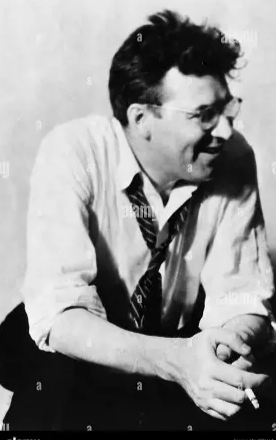 Farrell believed that literature could lead readers to a greater awareness of themselves and the conditions of their existence, and that this could result in great social change. This conviction drove him to produce an astonishingly large body of work: over sixty volumes of fiction, essays, and poetry, the most famous of which is, of course, Studs Lonigan: A Trilogy (1935). Often controversial, and, especially for his later works, berated by critics for a certain ponderousness and fatalism, Farrell has nonetheless created an unusual number of American literary characters that continue to have an extraordinay life. This may be said of Farrell himself, as it were. Even while criticizing Farrell’s 1966 prose poem When Time Was Born, the Time reviewer called Farrell “the most heroic figure in modern American letters.”