



This is Part 2 of 2008 excerpts from my the journal “Climbing Bryan’s Mountain.”
Read Part 1 of these 2008 excerpts. Read the Lead Post in this series.
August 9.
I just got a text message from Daniel telling me that he just swam with sea turtles. I texted him back saying that when I did that it was almost too thrilling for me. I could hardly catch my breath through the snorkle. But in the back of my mind, I kept saying, Take care, take care, take care. Those two words haunt me every minute of my life. Bryan drowned, and now here’s Daniel in Hawai’i for a friend’s wedding swimming in the ocean. I can’t do anything about it, nor should I. After Bryan died I tried to say goodbye to all my children in my heart, but it didn’t work. I don’t feel “fated,” but I live in 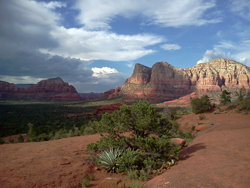 dread that any moment I will hear of some other tragedy. Daniel and Bryan were especially close. Sometimes I can’t imagine the one without the other.
Today I took a picture of one of those signs that says, “Healing in progress. Please stay on trail.” I hope that every time I go up the mountain I heal a little more, fear a little less, understand more deeply what it means to carry Bryan in my heart all the time. I miss him so much. I miss what he might have become. Every time I see Liam I can’t help but think I will never, ever see one of Bryan’s children. Some memories make me smile, but fear and regret still tinge everything.
Climbing up and down a mountain has long been an image of striving for spiritual strength and enlightenment. Coming down today, I thought more about trying not to talk to Bryan so much when I’m by his tree. That’s making a fetish of a place. Maybe Bryan House is also a fetish. I talk to him there, too, often saying, “My son, my son, this is what your death has brought.” I think I’ll always talk to him by his tree, though associating him too much with being there clashes with me carrying him in my heart. “It’s funny, him ending up here,” said Aaron when we climbed the mountain last summer. “Of course,” he added, “he’s really not here.” Kari told me later, though, that it really helped him to see the tree. Today I also took a picture of the small agave plant underneath his tree around which I spread his ashes. Some of those ashes are still there nearly 20 months later, white flecks against the red earth, pine needles, and stiff agaves. Today when I left the mountain I said very intentionally, “Bry, you’re always with me. Come on. We’ll see your tree again on Monday.” I almost believed it.
August 13.
Today I was startled by footsteps behind me as I sat by Bryan’s tree looking out. It was an Italian man. He said, “Grazie,” several times as we talked, and I knew I should be responding, “Prego,” but never did. He asked me where other spiritual places in Sedona were. “Well, this rock is a famous place.” He knew that, he said, and asked about the Chapel on the Rock, which I pointed out in the distance across the valley below. I also told him of a Buddhist site. “A monastery? I can stay there?” he asked, but I told him I thought you couldn’t. I also didn’t know exactly where it was. Here was a spiritual pilgrim, and I had little to give him. Worse yet, when he asked about a path to go farther up the mountain, I pointed him in the right general direction, but it soon became clear that I had pointed specifically to a steep path ending in a small trail that skirted under a huge, possibly impassible, rock ledge. I wasn’t sure, now, that it was a good path at all. I have worried about the Italian man ever since. He was thin and seemed very fit, but I never saw him again, even when I’d come all the way down and was looking up, scouring the mountain for his form. It occurred to me then that I had never been very many places on Bryan’s mountain except by his tree, so maybe there’s this clear moral: you can’t direct someone up higher if you haven’t been there yourself. I must also find out where that Buddhist site is.
A news story later that day added to my unease. A man, his wife, and four children had been walking somewhere in Oak Creek when a tree snapped and fell on him, breaking his back. He died in front of his children before help could arrive. They interviewed his wife. She held a tiny baby boy, while three young girls huddled close behind. This particular tree had fallen just as this one particular man was passing under it. “It just had to be his time to go,” she said. “There’s no other way to explain it.” Everyone seemed resigned. Her three girls cried softly.
August 16.
Today I turned and saw a Japanese girl come up over the large rock ledge a few yards behind Bryan’s tree. I heard that exhaled breath of wonder as she saw the vista 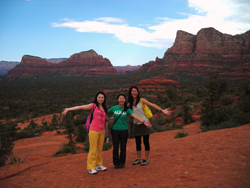 stretching below, then her straining for words to describe it. I wondered who she might be talking to, but then a second girl, then another came up. Though I was nearly hidden sitting so close to Bryan’s tree, they saw me, and I asked them if they would like me to take their picture. They giggled their Yes’s, and I took one with their camera and another with mine. “Do you live here?” they asked in wonder. “Yes,” I said, “for a month a year.” Then sweeping my hand slowly over this part of the mountain where Bryan’s tree sits, I said, “This place here is very important to my family.”
August 27.
On the way to Bryan’s mountain this morning, incredible sadness at his passing. No matter what I have learned this summer—and I have learned a lot that’s helped—there’s no getting around his absence, his loss, the way I miss him. He’s just gone.
August 29.
My last trip up the mountain this August was on Friday, August 29th, but I write this on September 4th, back home in Illinois. On August 30th we left early to pick up Josh on Third Mesa where he’d been staying a week with our Hopi friend Ramson. We saw some of the Butterfly Dance, ate a little at Ramson’s Mom’s old house, spoke with Stephanie, Horace, and some other relatives. Josh was so sick with some kind of stomach bug that he couldn’t watch that much of the dance, didn’t want to go to the Grand Canyon, and just lay down in the next room for much of the time. On the way home we had to stop once so he could throw up again, and when we got back he basically laid down and slept all night until I took him to the Sedona-Phoenix Shuttle for a 7:40 a.m. departure the next morning. With all that going on and us cleaning and getting ready to leave, the last day and a half were rushed once again. “Going up to Bryan’s mountain after you drop me off?” he said on the way to the La Quinta to catch the shuttle. “No, I’ve been up there enough,” I said, though I feel that’s not possible.
Still, leaving this time was easier because I felt I had learned a little more about what it meant to take Bryan with me and not leave him up on the mountain. A year earlier, I remember saying to him that if he got tired of being up there he could just go back to the condo for a while. I remembered the first time I left the tree. I cried and cried, saying, “I’ll see you again, Bry. Goodbye for now, my son, my baby.” This time I felt him more with me, and casually so, not with any great drama. As I turned to go back down the mountain the final time this summer, I just said in my heart, “We’ll come back together as often as we can to see your tree. Let’s go for now.” To the tree I just said, “Be well.” I also know, however, that just as his ashes are literally still under the tree, I’ll always feel him up there in a special way, somewhere far away from me no matter how closely I may feel him inside.
On my last time up the mountain this year I took some pruning shears to cut off a small branch of his tree with a pine cone on the end. That cone sits above me on a shelf as I write. It still oozes a fragrant sticky sap. Maybe I’ll learn how to start a tree from it so I can have a small version of Bryan’s tree back here in Illinois, some tangible reminder of that place where I still feel him to be so strongly. I hear you have to dry out the cone, get the seeds, soak them in salt water, etc. I’ll do the details later. I had thought about bringing back a fruit from one of the prickly pear cactuses growing around the tree’s base, but a garden man at the Village Ace said to forget about cutting one off. They don’t survive outside their element. If you want a cactus just break off an ear, he said, let it dry out a couple of days, then stick it in some moist ground. On the way down, I found an already broken off ear lying on the path, almost saying, Take me. It was plump and still soft. Last night, after four days of drying out, I stuck it in some left-over cactus potting soil and gave it some water. As soon as I finish this entry, I’m moving it to a bigger pot and filling it full with some new potting soil I just bought.
— Read Part 1 of 2008 excerpts, or go to Lead Post in series —
— Go to main pages for Sedona or for Emmanuel House —
In 2016 Emmanuel House was named one of the “Top 100” social change organizations in the world.



Reviews List
—Links go live when reviews become available.—
FILM, VIDEO, POETRY, ART:
…and the following—not reviews, but real “movie moments” for me:
*** Learn about THE FALL FESTIVAL OF INDEPENDENT FILM, where this film was shown in 2013.
MUSIC:
BOOKS: