This article is part of two large series, one on CHICAGO WRITERS, and one on BLACK WRITERS. Most of these come from two of my Chicago books—Smokestacks and Skyscrapers (with David Starkey) or Black Writing from Chicago, and there’s some overlap between the two. The writer below and his work are not, however, included in either of these books. He’s too young, and his first novel Defiant Acts just appeared in 2025. He’s a former student of mine, and I’m proud to add him to the long list of important Chicago writers listed at the first two links above.
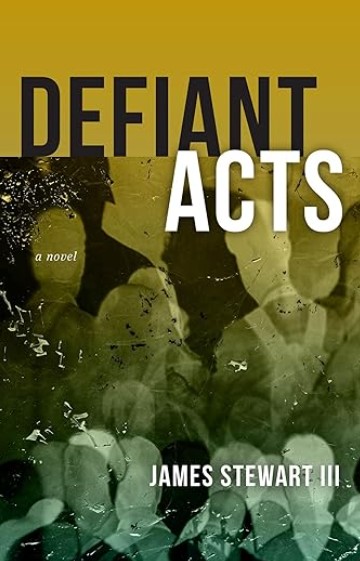 In a world where things don’t often add up, the short chapters in James Stewart III’s novel Defiant Acts do. The shortest chapters are only a page long, the longest barely past a dozen, and they read like vignettes, most from a multi-racial family’s life in 1992, though the earliest scenes range back to 1968. The book moves imaginatively back and forth between these years, but rather than choppiness there’s a building momentum that becomes more whole as the reader moves forward. You’re not very far into the novel before the characters almost miraculously gain substance and depth. One reviewer said she fell in love with them, and you do. The situations they navigate also begin to strike you more deeply as well.
Because Jim and Connie are a “mixed-race,” Black-White marriage some of the chapters have to do with the racism they face…or their kids do, Nathan and Shane especially, and especially since they move from the Chicago’s Southside to suburban Naperville. It was easier for Nathan to be the only white kid in his Southside elementary school, but now at a  Naperville middle school, Washington (the same one my own kids attended!), he’s called names not only because of his Black step dad, but because his mom likes Black men. “In his entire life, [Jim] never thought about the effects of racism on a white boy.” There’s those people who can’t believe her three children by Jim are hers, and the newspaper feature on their multi-racial family that strikes all those tones that infuriate Connie—though Jim himself can’t stop staring at the picture of their family. They’re beautiful. There’s so much everyday life, like the scene of joy picking corn and shucking and boiling it only to discover it’s cattle-feed corn, not great for a human dinner. And, as one reviewer said, there’s every day “work so palpable as to be memorable.”
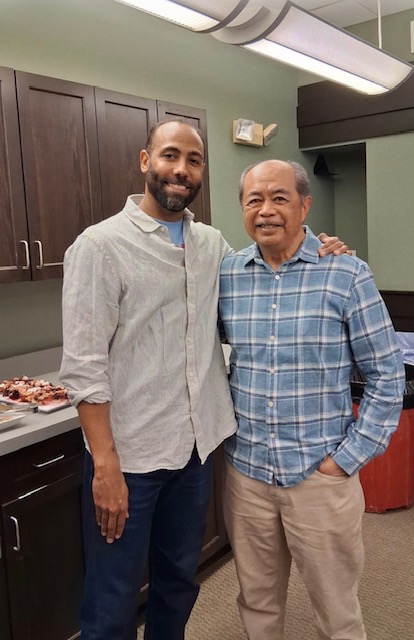
Me and James Stewart III
That reviewer is one of Chicago’s greatest, most iconic, writers—Stuart Dybeck (who is in Smokestacks and Skyscrapers). He speaks of James Stewart III’s realism as extending the work of some of Chicago’s greatest writers: Theodore Dreiser, James T. Farrell, Gwendolyn Brooks, Nelson Algren, and Richard Wright. What James also extends is our sense of what “defiant acts” are, and, even facing racism, they are not necessarily the headline defiances one might expect. I asked James about this, and this was his response: “I wrote a story titled Defiant Acts that didn’t make the novel but played a large role in inspiring it. This story followed a single father who had fallen on hard times and was living out of his car with his three children. The present action in this story is the father buying his children ice cream, eating it outside their car in a parking lot, and reflecting on the life they had together before their current circumstances. The thing is, he feels guilty about the ice cream; he knows that it would’ve made more sense to buy an actual meal with it, but he realized that the kids needed a break, they needed some joy, that this was essential to their well-being. So he chose, in a world/economy that is so anti-care in myriad ways, to make this small stand. It would take a sacrifice from him in the way of the money he spent, but also realizing that he’d be the one eating a little less over the next few days, so it’s this combination of care and sacrifice that we see in little acts throughout the book, Defiant Acts, that despite however tired the parents are or how little money is available, they realize that love and care is something to be prioritized, and in this world there’s usually a cost they pay for it (time, energy, money, opportunities, etc.) and in this context and against the odds, I see these many small acts as defiant.”
I was privileged to play a small part in the long road that saw James Stewart III bring his first novel to fruition.