

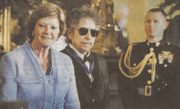
 In May (2012) President Obama awarded The Medal of Freedom, our nation’s highest civilian honor, to Bob Dylan. It’s his third, big, White House decoration—President Clinton having named him a Kennedy Center Honoree, and, in 2010, Obama having awarded him the National Medal of Arts. Could the Nobel be next? There’s been some big pushes for it.
In less lofty climes, I can report that my sons are such dedicated Dylanists that the oldest, Rick, has a copy of The Freewheelin’ Bob Dylan framed on his living-room wall. Another one, Daniel, got five Dylan tickets from friends for his 21st birthday and proceeded to see him five times in 13 days. One of his best friends, Paul, came flying into our basement after the Colorado concert shouting, “I can’t wait ’til that guy dies!” “What?” I asked incredulously. “Because then he’ll be seen for what he really is: the greatest poet of the 20th century!” I named several counter nominees, all of whom Paul pronounced pikers in comparison.
What’s your take on what makes Dylan’s music so great?
For me it’s his uncanny blend of wild humor, sticky pathos, poetry that doesn’t quite make sense—but then again does, aggression and bitterness careening towards tenderness (or vice versa), the surprising melodies, the great hooks…. Then there’s his voice. He’s one of the greatest, most influential American singers, I’ve always thought. At least he’s in the trinity of my favorite singers, the other two being Ray Charles and Billie Holiday. Anyone could go on and on with lists of reasons like this, but allow me just two more points. First, his profound truth and meaning. One day he’ll have to accept that he wasn’t just the “voice of a generation” (something he’s always vehemently denied), but a voice for the whole history of our country itself. But most likely he won’t accept this and just riff on how funny it is for him to be getting all these medals. Ian Duncan, the Chicago Tribune reporter who titled his article (too cleverly) “Wind blows Dylan’s way for Medal of Freedom,” describes him as standing “inscrutable in black sunglasses” during the ceremony. And look at the picture I used for this post (by Jason Reed, Reuters), showing that at one point he stood—inscrutable, indeed—next to basketball coach Pat Summit while a Marine stood guard over his shoulder. It’s too perfect. The sight collisions alone would make a great Dylan song some day.
My second point, also about collisions. I’ve always loved the way the sacred blows into his songs, so that things get suddenly spiritual, even Biblical, and I don’t mean just during his “Christian phase.” There the atmosphere was often so spiritual, except in songs like “Serve Somebody,” I missed the surprise and uplift that occurs when the sacred and profane collide. I mean like the way Abraham and Isaac wind up on Highway 61 somewhere between Clarkdale, Mississippi, and Chicago, or like in “Bob Dylan’s 115th Dream” where he asks a man for help, but “The man says, ‘Get out of here / I’ll tear you limb from limb / I said, ‘You know they refused Jesus too’ / And he said, ‘You’re not him.'” When Moses and the Great I Am suddenly show up in one of my son Daniel’s songs (check out Dan Guzman’s “CBS—Cool Black Sickness“), I know he’s got it as a song writer.
The Dylan article for one of Rolling Stone‘s many guides to rock ‘n’ roll says, “Like everyone else, Dylan sucked in the 80’s,” which I suppose he did, except that my favorite Dylan lyric has long been from an 80’s song, “Tight Connection to My Heart”—a little cheesy, yes, and, yes, from an album that somewhat sucked (Empire Burlesque). Still, this sudden blow up from a seemingly non-sense tangle of poetry and wild humor into spiritual images that lead to a stunning truth and a simple question about love always, always gets me:
There’s no stars tonight and they’re showing no moon
Just a hot-blooded singer singing “Memphis in June”
And outside they’re beating the hell out of a guy in a powder blue wig.
Later he’ll be shot for resisting arrest
I can still hear him crying in the wilderness
What looks large for a distance, up close ain’t never that big.
I never could learn to drink that blood and call it wine
I never could learn to hold you, love, and call you mine.
Has anybody seen my love? Has anybody seen my love?
I don’t know. Has anybody seen my love?
How did John the Baptist get in there? I don’t know. But anybody who’s ever suffered in love knows how exactly right it is to take the wine and blood of communion and switch them around. Nobel Prize? Based on this switch up alone, I’d sign the petition.
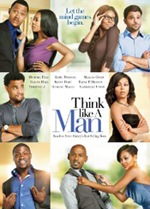

Fate and Style in The Godfather
Much of this pace comes from Marlon Brando himself. Even during the famous opening scene—so many scenes are famous it seems silly to pick just one—where Coppola swings back and forth between the dark interior of the Godfather’s office and the bright exterior with his daughter’s wedding celebration in full swing, Brando is so quiet, so deliberate, that he single-handedly slows everything down. Or back. Everyone’s excited: Sonny (his oldest son) itches for a tryst with one of the bride’s maids, the FBI poke around, a famous singer shows up. The formal wedding picture needs taking, but Brando rasps, “Where’s Michael?” and when informed his youngest hasn’t shown up yet he simply walks away, the whole forward-moving energy outside being held back by his insistence on doing things exactly right. He also demands this exactness in the business dealings he’s conducting in his dark office, the only real break coming when Robert Duvall (playing Tom Hagen) says Luca Brasi wants to come in to say thank you. As Luca pays his stumbling tribute to his Godfather, the look of tender, amused indulgence on Brando’s face is priceless. That moment, a tiny break from the film’s relentlessness, has become more important to me each time I watch it, as has the moment a few minutes later when Brando exhales against the door after shooing out his god son Johnny Fontane.
Back outside Michael finally does show up, and it’s soon clear that Brando-Pacino is one of the great pairings in movie history. Amid the wedding hubbub, Pacino, too, is quiet, deliberate, slow, Brando’s mirror image. Michael even says one of the movie’s first famous lines (again, so many great lines), “He made him an offer he couldn’t refuse,” so quietly and deliberately it might go right by the viewer the first time. Other great lines go by like this, too. For example, Clemenza’s “Leave the gun, take the cannolis” comes casually after a long, slow sequence building up to Paulie’s murder.
The Godfather is all about offers you can’t refuse—or consequences that refuse not to follow a character’s actions, a character’s character. Carlo is going to get beat up, Sonny is going to meet the end he does (as does Carlo), the Godfather—always preaching the importance of family—is going to die not by an assassin’s hand, but in a garden with his grandson. Most of all, there’s Michael. When he tells his girlfriend Kay about the offer his father makes Johnny Fontane’s band leader (the offer he couldn’t refuse: that is, release Johnny from his contract or we’ll blow your brains out), he says, “That’s my family, Kay. It isn’t me.” But with glacial certainty, his whole life, the life of the whole movie, leads inexorably to the offer he himself can’t refuse. There are, of course, explosions of violence throughout the film, but even when they surprise us they finally do not alter the film’s slow, steady style. The family finally is Michael. He will take his father’s place. The film’s pace makes us feel his certain, inescapable fate.
(1972, Dir. Francis Ford Coppola, 175m, R. 4 stars, of course.)
*** See a list of other reviews.