
With Liberty and Justice for All

Stephanie Lulay’s story below features the Hasan family, one of the “graduates” of Bryan House, an organization founded by Rick and Desiree Guzman and focused on breaking poverty cycles for refugee families.  The Hasan’s were also featured on an NBC news report.  As Bryan House grew and extended its programs to all the working poor, it became part of a larger organization, Emmanuel House.  In 2016 Emmanuel House was named one of the “Top 100 Most Innovative” social change organizations in the world. 


—By STEPHANIE LULAY, Sunday, July 3, 2011

THIS FOURTH OF JULY WEEKEND, WE SHARE STORIES OF PEOPLE WHO HAVE FLED THEIR HOMELANDS TO FIND REFUGE IN NORTHERN ILLINOIS

In post-2003 Baghdad, Imaad Hasan’s son’s name, Omar, wasn’t just a name anymore.  It was a target.

With liberty and justice for all

The Hasans in front of their Aurora home, purchased after a stay at Bryan House

“The militia tried to kidnap me and Omar several times,” Imaad said.  “We would move and then it would happen again.”

The biggest reason the family was targeted?  Religious differences.  The Hasans were Sunni, and the militia, Shiite.

The Shiite’s retribution for young Omar is linked to a division within Islam that stems from events some 1,300 yeasrs ago:  As a successor of Muhammad, Omar Bin al-Khattab is one of the most revered figures in Sunni history, but Shiites consider him illegitimate.

When Omar was 11 years old, masked men tried to kidnap him.  He was able to break free by running into a populated square in Baghdad.

“I thank God, because if they caught him, he was going to die,” Imaad said.

Omar, now 15, didn’t want to talk about it.

With father Imaad, the militia succeeded in its kidnapping attempts.  He spent several weeks in a prison, was beat with guns and “they did whatever they wanted to do to me,” he said.

Life wasn’t like this before 2003, when tension heated betwen the two groups following Sept. 11 attacks and democracy was introduced in Iraq, Imaad said.

“The Iraqi army was all Shiite and it is not good.  Here in America, you see white, black, Spanish people in the police and Army,” he said.

“We didn’t sleep for many years,” said 36-year-old Maysoon, Omar’s mom.

“So I left everything,” said Imaad, 43.

The family became refugees.  The Hasans—Maysoon, Imaad, and their children, Omar, Sarah, 14, and Hajer 10—left their home, a successful electronics business and family.  They arrived first in Syria, where Imaad spent two years working in a shoe store.  The family lived in a cheap apartment and it was a difficult two years, he said.  The kids missed one year of school.

In March 2008, they received clearance  from the United Nations to flee the Middle East and seek refuge in the United States.  The United States allows between 50,000 andc 70,000 refugees to enter the country every year.

On the plane ride to JFK Airport in New York, Imaad said he felt worried and nervous.

“It felt like a dark future for me,” Imaad said.  Once a respected business owner in Iraq, all he knew about America was what he had seen in John Wayne movies.

The Hasan family spent a week with a host family, then were placed in an apartment by World Relief Aurora.  The children received English lessons and both parents started working.  Imaad is now a machine operator and Maysoon is a cafeteria cashier at Jefferson Middle School in Aurora.

Through Bryan’s House [sic], a non-profit that helps refugees save and work their way out of poverty, the pair was able to save $12,000 toward the down payment on their first U.S. home on Aurora’s West Side.  That down payment was matched by various grant programs, according to Rick Guzman, co-founder of Bryan’s House [Read about Bryan House and Emmanuel House below].

“We are safe and very grateful,” said Imaad.  “We experienced not feeling safe for several years.  If you had to choose food or safety, you’d choose safety every time.”

Next year the family will apply for U.S. citizenship, although Maysoon said she missses her family dearly.

“When we first arrived here, we had this idea that we’d go back,” Imaad said.

But he isn’t sure it that place exists now.  Baghdad, an ancient city, is now “a garbage city,” Imaad said.

Now, they’ve rebuilt their lives here, Imaad said.  “We’ve grown roots.”

“Here, we have our freedom,” Omar said.

____________________
This article goes on to profile two other refugees: Sahr Kanjama from Sierra Leone, and Aloune Khotisene from Laos.

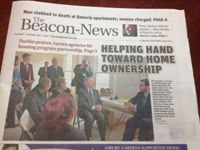
 Go to the Emmanuel House /Bryan House main page on this site.  Below, Lulay’s article as it looked in the paper on  July 3, 2011.  Go here for journalist/photographer Peter Hoffman’s portrait of Imaad.

Bryan House story by Stephanine Lulay featuring the Hasan family


Posted in Social Change | Tagged , , , , , , , , , | Leave a comment

Hear Us

Hear UsHear Us is a national organization whose mission is to bring voice and visibility to the homeless—especially homeless children and youth, and also their mothers.  Diane Nilan—who has spent a distinguished lifetime advocating for homeless people, starting or running shelters, and playing a major part in helping homeless children get the education they need— founded Hear Us in 2005.

More on the Hear Us main page

…where, among other things, you’ll find:

  • The Hear Us website
  • A Huffington Post article about Diane
  • A radio documentary on Diane
  • Thoughts about the PBS showing of her film on the edge—and more…

My wife, Linda Bonifas-Guzman, is on the Hear Us board of directors.  She and I volunteered at Hesed House (in Aurora, IL) when Diane ran it, and today still volunteer at Daybreak Shelter (Joliet, IL), which Diane started in the mid-80’s.  For us, it’s been around a 30-year adventure, “adventure” being a perfect word for anyone privileged to be involved with Diane and her mission.

I remember an afternoon around seven years ago when Diane called me up to announce that she was selling her town home and most everything she owned to buy and RV and travel around the country filming homelessness.  I must have been silent for a long time because the next thing I remember was her saying, “Richard, Richard, are you there?”  I think my first words were, “Do you have a movie camera?”  “No,” she said, “Do you know where I can get a good one cheap?”

Diane-Wander-Not-LostShe did buy the RV.  She did buy some movie equipment.  And now several documentaries later she travels the country coast-to-coast, a regular at Columbia University in New York, Duke University in North Carolina, and UCLA in California.  At the Hear Us website you can find out more about the films My Own Four Walls, on the edge, and The Littlest Nomads, among others.

Also find out about her book Crossing the Line: Taking Steps to End Homelessness.  I helped her with the book in 2004, and even sent a copy to my publisher at Loyola University Press.  He said he’d been very moved by the book, more so than many, many he’d read recently, but finally declined: a money decision, he said, feeling he wouldn’t be able to sell enough copies.  It was the best rejection letter I’d ever seen—and to this day I think he misjudged the book’s potential.  I wrote this about the book—a blurb which appears first in the book’s first printing:  “Read this book.  Diane Nilan has spent a distinguished lifetime helping the homeless.  She writes beautifully, from the heart, and will help you feel from your own heart not only the desperation of homeless persons but their particular strengths as well.  You might even start daring to hope that the plight of homelessness might someday be solved.”

 Return to the  SOCIAL CHANGE  main page.

Posted in Social Change | Tagged , , , , , , , , | Leave a comment

Seeds of Change

Seeds of Change

Rick Guzman joins Nahom at Bryan House (picture-Mary Compton-Sun Times Media)

—by Nancy Strunk Kirby—

FAMILY OF NCC PROFESSOR RICHARD GUZMAN AIMS TO BREAK CYCLE OF WORKING CLASS POVERTY

For the Guzman family of Naperville, helping the poor and homeless of the western suburbs has been a way of life for decades.

A passion for service has intertwined the family with the community of North Central College, where Dr. Richard Guzman has served on the faculty for the past 32 years. It has enveloped their church, Community Christian in Naperville, and inspired hundreds of volunteers ranging from students at NCC and Naperville North High School to congregation members from numerous churches.

“I’ve worked with issues of homelessness for more than 30 years now,” says family patriarch Richard, professor of English at North Central. Wife Linda serves on the board of directors for Hear Us, a national organization devoted to serving homeless women and children.

Through their church the Guzman’s have been involved for years with refugee resettlement, working with World Relief, an international organization that brings refugees from war-torn areas of the world to the United States. Richard’s son Rick, a North Central graduate, and Rick’s wife Desiree founded a not-for-profit organization to assist with refugee resettlement in 2002.

Rick remembers a seed that was planted years ago when his father took him and his brothers to Aurora’s Hesed House homeless shelter.

“When Hesed House was first founded, my dad took us to volunteer there, so it’s always been kind of cool to recognize my interest and awareness of homelessness from a very young age,” he said.

Tragedy struck the Guzman family in December 2006, when youngest son Bryan, a 21-year-old student at North Central, drowned in Lake Michigan while walking his girlfriend’s dog along the Chicago lakefront. Rather than retreat in grief, the Guzman’s redoubled their efforts to serve the refugee community.

When Bryan died, Rick was in law school at Northern Illinois University and Desiree was working as assistant director of ministry and service at North Central. Despite hectic schedules, their desire to honor Bryan’s spirit inspired them to purchase a five-unit brick apartment building on Aurora’s near West Side in 2007. After significant renovations, the apartment building would soon be transformed into a haven for refugee families.

Naming  the apartment complex in Bryan’s memory seemed like the right thing to do.

“At the age of 21, he did genuinely have this spirit of wanting to give back,” said Rick, who received his law degree in 2009.

He estimates that at many as 1000 individuals have been involved in Bryan House since its inception.

“We have a database of over 500 people who have given at one point or another,” Rick said.  “And then in terms of actually coming out and getting their hands dirty, it’s another several hundred on top of that.”

The first families began moving into Bryan House in late 2008, coming from war-torn countries including Iraq, Eritrea, Democratic Republic of Congo, Kenya, Mauritania, Togo, Burundi and Bhutan.  Each family’s story is unique, heart-rending and inspirational.

Eight refugee families have moved through Bryan House into independent housing.  A typical refugee family stays for a year to 18 months, saving their monthly rent and often qualifying for a matching grant of $4,000 from World Relief.  This allows them to leave with savings of around $15,000 to $16,000, which is used to purchase a home or rent an apartment.  For families with children, a portion of the money is set aside for a college savings program.

“What we’re about is breaking that cycle of working class poverty through home ownership or through college scholarship to make sure that the next generation has better opportunities,” Rick said.

Now the successful concept of Bryan House is expanding.  Through the support of Community Christian Church’s non-profit organization, Community 4:12, Rick has been hired to launch The Emmanuel House Project.  The project’s purpose is to replicate the Bryan House model to serve the Hispanic community on Aurora’s near East Side.

Bryan’s middle name, Emmanuel, which translates as “God with us,” serves as inspiration.  For 2011, The Emmanuel House Project has set an ambitious goal of opening three housing units that will put residents on a path toward home ownership.  The model relies on matching a church sponsor with an individual housing unit, so the project is actively recruiting church involvement.

“We feel like this is the work that God has called us to,” Rick said.  “We are not a faith-based organization, but we like to say that we are faith-motivated.”

 RETURN to the Emmanuel House / Bryan House main page.  In 2016, Emmanuel House was named one of the “Top 100 Most Innovative” social change organizations in the world.  In 2018, it merged with former partner The Joseph Corporation to become THE NEIGHBOR PROJECT.  Bryan house served 5 families, Emmanuel House 25, but now The Neighbor Project serves 3000 families and individuals…and counting.

____________________

The article as it looked in the paper on Thursday, February 17, 2011.

Seeds of Change


Posted in Family, Social Change | Tagged , , , , , , , , , , , , , , , | Leave a comment