
Audrey Petty: The Architecture of Race

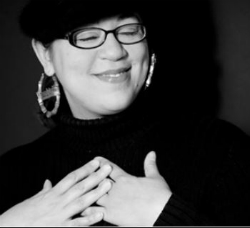
petty2a“I had to get away from Chicago to be able to really understand its hold on me,” says Audrey Petty, who spent her undergraduate years at Knox College in the largely white, far-western Illinois town of Galesburg.   Her stories have appeared in Gumbo: An Anthology of African American Writing, StoryQuarterly, African-American Review, and Painted Bride.  Her poetry has appeared in Crab Orchard Review, New Sister Voices, and Cimarron Review, and her essays in Saveur, ColorLinesThe Southern ReviewOxford American, Cornbread Nation 4Gravy, and the Best Food Writing anthology.   She has won the Tennessee Williams Fellowship from the Sewanee Writers Conference, and won fellowships and grants from the Ford and Mellon Foundations and the Illinois Arts Council.  In a special issue of Callaloo devoted to emerging black writers Trudier Harris wrote that Petty “makes language accessible,” but keeps “meaning complex and at times elusive.”  She has taught in the creative writing programs at the University of Illinois (Urbana-Champaign), Knox College, and was named the Simon Blattner Visiting Assistant Professor of Fiction at Northwestern.  Petty has also been an instructor for the Education Justice Project, Project FYSH (Foster Youth Seen and Heard), the Illinois Humanities’ Odyssey Project, the Prison + Neighborhood Arts Project and continuing studies programs at the University of Wisconsin–Madison and Northwestern. She lives with her family in Chicago.

I included her story “Gettysburg,” at the time unpublished, in my book Black Writing from Chicago.  It is the story of a black-white couple, Sharon and Liam, which follows an all-too-familiar pattern, an all too-familiar “architecture”: private joy, attraction, and dreams colliding with the structures of a racist society.  You almost wish they could just stay in the Boston hotel room where Liam, a budding architect, has gone for a job interview.   But there’s the inevitable apartment hunt, where Sharon admits,

“She was ready for scrutiny, but she was never prepared.   One long, pink landlady gawked the whole time they roamed across her hardwood floors.  It wasn’t until they’d walked down to her own roomy kitchen that she mentioned how someone had actually come late the night before.  A credit report was being checked.  She couldn’t say for sure, but the place might actually be taken.  Her thick accent was serrated: all cartoon.”

Still, Liam dutifully fills out an application, and, Petty writes, “Sometimes Sharon admired him for not seeing the reactions.”  There had been many before Boston.  “Back in Chicago, there were often white glances on the El, downtown, in his Northside neighborhood, but it was the brothers who gave disapproval with flair….”  Liam proposes they take a side trip when they return from Boston to Chicago.  He wants to visit Gettysburg.  They stop at a restaurant.

“Sharon could tell right away.  This one really cared: this one was going to be a bitch.  No greeting.  No words at all.  Just one-sided menus and iceless water in short, scratched glasses plunked in front of them.”

pettyThey never do make it to Gettysburg.  Liam gets violently, throw-up ill.  Perhaps non-accidental food poisoning from the restaurant?  But Sharon asks the bigger question: what if they had gone to Gettysburg?  The battle there decisively turned the tide of the Civil War, but it seems the U.S. has never yet fully faced the racial issues at the heart of that war.  Earlier in the story, Sharon had switched on CNN.  “The President was nominating a new black man for the Court.  The chosen one stood dark and alone before the cameras.  He wore the insecure smile of a definite Tom.”  A black Supreme Court Justice, a black President, and we eagerly tell ourselves we’ve become post-racial. We keep the architecture of race in tact by taking every opportunity to deny it exists and demeaning conversations about it—as, for example, in the way we’ve taken to making fun of, or co-opting #blacklivesmatter.  As a Filipino, I was dismayed to hear this recently: “#filipinolivesmatter—because who’s going to make the lumpia?”  Mildly funny, I guess, especially to Filipinos.  But it’s yet another another expression saying, really, that we don’t need to talk seriously about race.  I have written many times that Americans would rather talk about anything—anything—but  race.

Liam is an architect, of course, and, staying with that theme, Petty is also the editor of High Rise Stories: Voices from Chicago Public Housing, which includes the stories of twelve persons displaced when the Chicago, like many other cities across the U.S., finally realized what a disaster high density, high-rise housing has been.  The book begins:

“When the high rise buildings came down, footage of the demolition was posted on YouTube. There you can find—in montage, time-lapse, or real time—various stages of destruction of the Robert Taylor Homes, Stateway Gardens, Rockwell Gardens, Grace Abbott Homes, Cabrini-Green, Lakefront Properties…The vast majority of those directly impacted by wide-scale demolitions have been required to seek out housing in the private sector. For thousands, the outcomes have included displacement, multiple moves, and homelessness. In the current economy, the poverty rate is higher than ever in Chicago, as is the need for affordable housing.”

That has been another result of the architecture of race in America.


 Go to a list of Black Writers on this site, and to Black Writing from Chicago.
 Go to the Teaching Diversity page.

Posted in Black Writers, Chicago Writing | Tagged , , , | Leave a comment

A Very Short Film About Diversity

divvidpic2b

“A Very Short Film About Diversity,” below, is scheduled to be shown to all First Year students at North Central College in mid-October 2016.  A project of students, faculty, and staff, it’s part of a larger effort to make diversity more central to the college’s life and curriculum.

In Winter 2014 a group of faculty, staff, and students formed C.O.D.E.—Coalition On Diversity in Education—with the goals of improving coordination between curriculum, extra-curricular activities, and website to better reflect the already significant efforts at diversity already underway at the college…and to foster even more.  It’s C.O.D.E.’s goal to so infuse diversity throughout college life that every student, staff, and faculty will have to learn about diversity deeply, face issues of racism and inequality squarely, and learn what they can do to combat the deleterious effects of these.  I’ve written many times that Americans would rather talk about anything—anything—but race.  C.O.D.E. wants to force both conversation and action.

The short film below comes with a brochure that every first-year student in their First Year Experience class will get after they see the film.  It contains names and contact information for each “multicultural club” on campus, representatives of many of these clubs appearing on the film and inviting everyone to “Join Us!”  You don’t have to be black to be part of the Black Students Association, or Hispanic to be part of Raza Unida, etc.  The brochure also contains a small sample of courses now being offered where students can study diversity more deeply.  (See this brochure Here.)

I was asked to make a short statement on Why Diversity Matters for the brochure and wrote this:

IT’S GOOD BUSINESS:  Corporations know diversity results in greater innovation and productivity. They invest heavily in diversity programs and look to hire people knowledgeable and comfortable with diversity.  IT’S HUMAN: The world grows more global and interconnected every day.  Without understanding and respecting our differences more deeply, it’s harder to connect to our common humanity.  IT’S AMERICAN:  So much of the culture and economy of the U.S.A. has been created by racial and ethnic minorities, yet racism and ethnic strife so often disrupt our social life.  Your generation could be pivotal in lessening racism and helping our country fulfill democracy’s promise.

“A Short Video on Diversity” and the brochure will be the first time every first-year student gets such a concentrated presentation on diversity.  Thanks to all who participated.  It’s a great first step to have everyone understand how important diversity is.

  Go to a post giving more history and detail on the C.O.D.E. initiative.

  Go to the TEACHING DIVERSITY main page of this site.

Posted in Diversity & Multiculturalism | Leave a comment

Light The Band

The Video below shows Dan Guzman’s band Light The Band playing this past August at the iconic Boom Boom Room in San Francisco (John Lee Hooker’s club) and at Bocci’s Cellar, its weekly gig in Santa Cruz.  Though Dan’s bands have always had a jam vibe, Light The Band amps this up and commits to a funkier, bluesier, more New Orleans feel. Honest, real, immediate—its grooves build to exciting, high-energy jams, or just stay in the pocket—or both—and there’s more dancing than ever at Light The Band shows.

ltband-boccis2

The band began as a trio—drummer Logan Tyler, bassist James Tashnick, and Dan on guitar—in late 2013, with guitarist and singer/song writer Tim Gan joining in early 2015.  More recently their sound has grown fuller with B3 keyboardist Pat Blizinski and Bay Area sax legend Chris Noonan often joining their sets.

The video below features this six-person lineup and short shots of some of the band’s key songs: “Waitin on the Boys,” “Way Down Low,” “Baby Brother,” and a carry-over from Hypnotist Collector days, the Dead’s “West L.A. Fade Away.”  You can also catch Light The Band on these other videos and more:

 JB’s “Give It Up or Turn It Loose” — a great example of its high-energy jamming.
 “Way Down Low” — LTB as a trio at Oakland’s Stork Club.  Daniel’s guitar solo is a classic. I often show it to people to illustrate just how to build a solo.
  “She’s a Freak” — great soloing and great dancing up front.
 “Waitin on the Boys” — at the Boom Boom Room.  (For a longer, just-audio jam of this song with B3 organ, go Here.)
  Hear more of Dan’s music on this site.

Below, the video’s last image shows them at Boz Scagg’s club Slim’s in San Francisco. ENJOY!


Posted in Arts, Music & Media Podcasts | Tagged , | Leave a comment