Below is a Video of a sermon I recently preached on the Book of Romans, Paul’s epistle to the church in Rome, written in the Winter of either AD 56-57, or 57-58. It’s not my favorite book in the Bible.
Paul was in Corinth when he wrote it, and his letter to that church contains one of the Bible’s most famous passages: the so-called Love Passage in First Corinthians 13. I suppose Romans does contain the uplifting More Than Conqueror’s passage starting in chapter Eight, verse 31, but so much of the book  seems to run in circles with long, complex, seemingly contradictory passages trying to reason their way out of the conundrums posed by The Law. Here is part of the passage I was assigned to preach on: “(7) What shall we say, then? Is the law sinful? Certainly not! Nevertheless, I would not have known what sin was had it not been for the law. For I would not have known what coveting really was if the law had not said, ‘You shall not covet.’ (8) But sin, seizing the opportunity afforded by the commandment, produced in me every kind of coveting. For apart from the law, sin was dead. (9) Once I was alive apart from the law; but when the commandment came, sin sprang to life and I died. (10) I found that the very commandment that was intended to bring life actually brought death. (11) For sin, seizing the opportunity afforded by the commandment, deceived me, and through the commandment put me to death. (12) So then, the law is holy, and the commandment is holy, righteous and good. (13) Did that which is good, then, become death to me? By no means! Nevertheless, in order that sin might be recognized as sin, it used what is good to bring about my death, so that through the commandment sin might become utterly sinful.” Enough said.
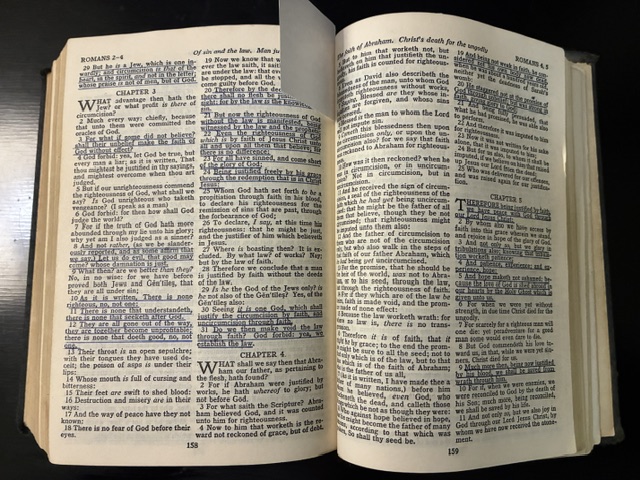
My first little Bible, the only one I had for years. Decades later it still has a marker at Romans 3:23.
Yet the Book of Romans has played a profound role in my life. In the sermon below, I share my conversion story, which begins when I was 17, and was, one Sunday, at Golden Gate Park in San Francisco. I think the day was a beautiful one, one which was seemingly spoiled when I got back to my car and found a religious tract under the passenger’s windshield wiper. Religious tracts and the people who passed them out irritated me no end in those days when I was an agnostic at best. The verse the tract first quoted was Romans 3:23—“All have sinned, and come short of the glory of God.” Oh, sure, I thought, angrily. Then I thought, even more angrily, I bet this isn’t even in the Bible!
The only Bible I had was one I had gotten as a fourth grade child when we lived on the Fort Ord Army base, just north of Monterey. It was black and small, measuring only 4 and 1/4 inch wide, and 6 and 1/8 inch high. I remember being on the steps of the base church, being able from its hillside perch to see the ocean in the distance. Pastor Paul was talking briefly to my parents, and I noticed the deep cleft in his chin. I’ve kept that Bible to this day, and when I picked it up to bring to church and tell this story of my first encounter with the Book of Romans, it still had four small bookmarks in it. One of them was Romans 3:23. It was to this Bible I went when I was 17 to confirm that “All have sinned and come short of the glory of God” wasn’t even in the Bible. But it was. I broke out in a cold sweat, and a heavy burden started to press down on my head and shoulders. It got heavier and heavier, and a couple of weeks later I gave in to the call of Jesus.
It all still seems illogical to me. I was, as I said, agnostic and best, and I didn’t believe in the sanctity of the Bible at all. Yet as I was preparing the sermon you can watch below, I realized, decades and decades after this event, that I was skirting the peripheries of what Paul was trying, often clumsily, to get at when he was attempting to align faith with The Law. The good The Law did was to drive us to understand that it was something that could not save us, that it only made us feel worse so that we would turn elsewhere to have the burdens lifted from us.*
* In fact, my sermon conclusion below steers away from this deeper conclusion here and towards a more practical, every day one—one which ties The Law into the things we do at church to prepare us to serve in the world.
♦ Go HERE for a complete list of sermons, like “Pentecost Means No ‘Supremacies,'” “Sacred Doing,” and “Theology and Race.”