
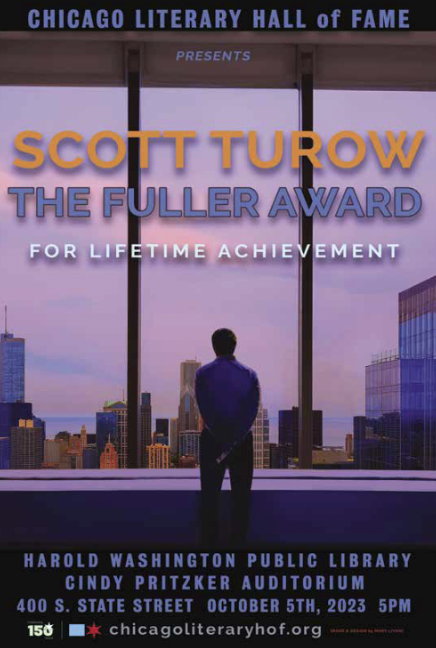
 This past October 5th the Chicago Literary Hall of Fame (CLHOF) held one of its biggest events when it presented novelist/lawyer Scott Turow with the Henry Black Fuller award for Lifetime Achievement. Held in the Cindy Pritzker Auditorium of the Harold Washington Library, it drew a large and star-studed audience, including Illinois Attorney General Kwame Raoul and seven luminaries who took the stage to make “the case for Scott Turow.” I was privileged to emcee the beginning and end of the show, and especially delighted to bring my eldest son, Rick, up on stage to present the actual award statue to Scott, whom we have both know for many years. Below is a 48-minute VIDEO I edited down from the full 96-minute video you can watch on the Hall of Fame’s website or HERE on YouTube.
You would be pressed to find a more articulate set of presenters anywhere, and Scott Turow’s acceptance speech was the most articulate of all—which was no surprise to anyone. I had to exercise some editorial privilege to include all of my opening remarks, which sought to lay out the whole vision of the CLHOF, all of Christie Heffner’s talk, all of Rick’s presentation comments, and, of course, all of Scott’s speech, which I have watched many times, and will continue to revisit.
The other presentations I edited, but only for the sake of time. I first introduced one of Chicago’s legendary power couples, Donna LaPietra and husband Bill Kurtis. She produced Siskel & Ebert at the Movies, as well as what many believe is one of the greatest newscasts in American History, CBS2 News with Bill Kurtis and Walter Jacobson. She is also an extraordinary civic leader. I have to return to the word “legendary” to describe Bill Kurtis’ career as a newsman. He continues a vast media presence with the important documentarues turned out by Kurtis Productions, as well as being the voice of NPR’s popular Wait, Wait, Don’t Tell Me. Jane Hamilton has won many literary awards and  twice been an Oprah’s Book Club choice. Aaron Freeman is a comedian, raconteur, interviewer and an enormous presence on the Chicago cultural scene, perhaps best remembered as the creator of the Star Wars parody “Council Wars,” recounting the Council turmoil following the election of Harold Washington, who appears as Luke Sky Talker. Christie Heffner—named three times as Fortune‘s Top 100 Most Powerful Women—besides being a CEO contines to crusade for free speech, better government and civil liberties. Cornelia Grumman won the Pulitzer Prize for her editorials about Illinois’ death penalty. They led to sweeping reform of the state’s prison system. Elizabeth Taylor has chaired five Pulitzer Prize committees and is one of the smartest people I know in the field of literature, Chicago and otherwise.
Which brings us to Scott Turow, who, in many ways needs little introduction. Author of 13 novels, from which three major Hollywood films and one TV series have been made. Three non-fiction titles, including Ultimate Punishment, his reflections on dealing with the death penalty and being on the commission that led to a moratorium and, finally, abolishment of the practice. Editor of a couple more volumes, including Guilty As Charged, short stories offering various perspectives on America’s criminal justice system. Oh, yes, he’s also a famous lawyer. Lots of pro bono work, including winning the release of a man who spent 11 years in prison for a crime he didn’t commit. And there’s that Operation Greylord thing, a wide-ranging investigation and prosecution of judges who did commit crimes. Turow was lead council on that one.
In Ultimate Punishment, Scott surprised Rick Guzman with an acknowledgement, even though Rick, then a recent college grad, was “just” a staffer on the commission which led to the moratorium. Scott also wrote a letter of recommendation for Rick’s application to law school, a letter which, Scott said, would make Rick blush. “The blood did rush to my head,” said Rick, when I opened a letter of acceptance that also contained a full tuition scholarship.” As he handed Scott the Fuller Award statue, he said perhaps the most important thing to know about Scott Turow. “Scott, I am deeply honored and privileged,” he said, “to offer this award to you not only for your extraordinary literary contributions, but also for your extraordinary contribution to humanity, to justice, and for just being one of the great human beings our community has to offer.”
♦ Go to my article about the founding of the Chicago Literary Hall of Fame, which will soon be updated with links to articles I’ve written about the CLHOF inductees and Fuller Award winners.