

Jazz. The Future?

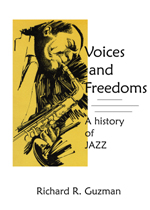
The Video/Audio below is an excerpt from the 16th, and final, show of my radio series Voices and Freedoms: A History of Jazz, based on my 1976 book of the same name.  The 16-part series played across the nation for five years in the late 70’s/early 80’ and holds its relevance—or is even more so—today than it was back then. The excerpts present about 6 to 10 minutes of the original 30-minute broadcasts, though this show— being the final, sum-it-up show—I let go a bit longer. The link above takes you to information about the book and our plans to re-release it and provide access to the full-length original shows. Go HERE for a complete list of shows and links to all excerpts.


Last shows in a series are always difficult. How do you sum it up?  How do you get a crystal ball with enough power to say anything really meaningful about the future? Most of the people I asked about the future of jazz said they didn’t know, so I followed their lead.

I thanked a lot of people, especially those jazz greats I was lucky enough to have on my show in the first place. Four of them join me here: three of the great players in jazz history, each of whom was also an important composer—reed man Wayne Shorter, trumpeter Freddy Hubbard, and keyboardist Joe Zawinul. Also joining me was one of the great jazz historians and critics, Martin Williams, at that time head of the Smithsonian’s jazz program.

Williams expresses some concern about jazz rock, and, being the late 70’s, I express some concern about the influence disco was having on jazz at the time.  Freddie Hubbard expresses concern about jazz getting so far out that it was losing its audience.  There were other worries, too, but still hope in the music’s future, with me expressing my expectation that jazz would continue to be a major force in keeping human voices and human freedoms alive.  We mention people we like, especially pianist Keith Jarrett, but I end by playing a number I didn’t know the name of, played by players I didn’t know either. It was the Fresno State Jazz Ensemble playing at the 1975 UC Berkeley Jazz Festival.  This was the future of jazz, and the number showed the players knew both how to play and the history of what they were playing, too.

Some twenty years after both the Voices and Freedoms book and radio series came out, I was teaching a course on jazz in a study abroad program in London.  At that time I was enthused—and continue to be enthused—about the combination of world music and jazz, and also of hip hop and jazz. I also loved jazz players soloing over all kinds of turntables and electronica.  I took my students to performances of this kind, but the class was unusually devoted to classic jazz and jazz standards.  One evening, I met them at Club 707, one of London’s famous jazz clubs. Reportedly, Paul McCartney and Elvis Costello frequented the place, so there was some excitement about possibly getting to rub shoulders with these rock greats. When I got there, however, the excitement was more about something else. “Thanks, Dr. G,” they seemed to say in rousing unison as I entered the room. I had written the club saying my jazz students were coming, and the club had assumed they were jazz musicians and were giving them all drinks on the house.

The band that evening combined Algerian Rai music with jazz.  They were good, but then unexpected launched into a Miles Davis standard—I think it was “So What?” from his classic Kind of Blue album—and suddenly got very, very good.  Everything seemed to click.  They got in the pocket, as we say, and the students seemed to turn to me as one, saying clearly though wordlessly, “See, the old ways, the classic stuff, is always the best.”

Wayne Shorter

I suppose the traditions in all kinds of so-called classic jazz are deep enough and challenging enough to keep jazz going forever.  There will always be players who will take your breath away because of their virtuosity and their inventiveness that brings constant newness to the standards.  Still, one wonders if there will ever be the searching experimentation of Bop or New Thing jazz again.  Perhaps the cutting edge of music has passed beyond jazz for good.  In the emphasis on spontaneous creativity, however, on virtuosity, and on finding newness in even the most standard of standards, I don’t think jazz will ever be eclipsed as an art.  Beyond this it still stands as uniquely dedicated to keeping the human voice and human freedoms alive.

♦ Go to the Diversity Training and Teaching main page, and to a complete list of these show excerpts.

Posted in Diversity & Multiculturalism, Music & Meaning, Music & Media Podcasts | Tagged , , , , | Leave a comment

The Beauty of the Lord

Ed Fontaine, daughter Christina, and me.

In late April this year, Jubilate—a choral group co-sponsored by University Baptist Church and the University of Virginia, Charlottesville—celebrated its 50th Anniversary.  Started in 1973 by Carl Beard, then music minister at UniBap, it first drew 12 auditioned University students, then 28 the next year, until reaching 44 in its third year, a number it has maintained for most of its 50 years.  During the 50th Anniversary 149 people made up the alumni choir!

In 1974 I showed up at the University to begin a PhD program, started attending University Baptist and began writing for and singing in their marvelous Sanctuary Choir.  I wrote for Jubilate, too.

I left the University in 1977, PhD in hand, taking a position at North Central College in Naperville, IL. But I was devastated to have to leave the area. I hoped for a position, any position, at Uva. Before leaving I took my first born, Rick, just weeks old, up on Sky Line Drive, overlooking the Shenandoah Valley and the eastern ridges of the Blue Ridge Mountains. He could just barely hold his head up, but I kept saying to him, Remember—You come from here—You come from here.  We traveled back to Charlottesville every chance we got, even spending an entire summer there around 1980, I think, when I accepted an NEH Fellowship there.

The times get fuzzy, but around 1979, when we were there for another visit, Carl Beard called me in to meet a new member of Jubilate, Ed Fontaine.  “Why don’t you two jam a little,” he said.  I sat at a piano in the church’s basement.  “It was right about there,” said Ed when we met again this year at the 50th Anniversary. “You were playing something that reminded me of some Stevie Wonder song, so I fell right in singing some Wonder-like words and melody.”  Ed was 19.  He had (and still has) a magnificent tenor voice, full of range and texture.  He can sing with grit and also float effortlessly, light and high. Afterwards, Carl said, “You think you could write a piece featuring Ed?”  I said, Why not try.

The following Sunday I was in church and one of the hymns was “For the Beauty of the Earth.”  It struck a chord in me.  The “Beauty of the Earth” soon became “The Beauty of the Lord” in my mind, and before long “The Beauty of the Lord” was born.  That’s what the Audio/Video below is: Ed Fountain, backed by Jubilate, singing a song I wrote for him. “What a gift you gave me,” he says every time we meet, and now his daughter Christina, also a Jubilate alum, says something similar.  The first time we met, she just gave me the biggest hug after her Dad said, “This is the man who wrote ‘The Beauty of the Lord.’”

It’s not a simple piece. “It’s a good thing your music is so good,” said Gary Walton, part of the Jubilate group that first did the piece, “because it’s hard.”  It also uses a verse from Julia Ward Howe’s “Battle Hymn of the Republic.” “That took guts,” said church friend Howard Newland.  There’s talk of Ed and his daughter doing the piece together for the 55th Anniversary concert.

Sometimes I wonder why I stay in the church, though the first answer is always obvious: it’s the people. They become friends. We deepen our friendship as we work together.  I have directed our church’s homeless shelter program for around 20 years now, and the others who volunteer with me have become close friends.  Yet as I work as a consultant on anti-racism issues for the Northern Illinois Conference of the United Methodist Church, I learn more and more about the church’s complicity in condoning and building racist structures and policies.  It’s taken the Pope till this year to renounce the Doctrine of Discovery, for example, the result of Papal Bulls in the late 1400’s that gave license for the Christian west to kill, enslave, and take land from indigenous peoples all over the world.

Still, I think of the friends I have and how the church provides means to work together to serve the poor and to lift up the message of anti-racism.   Most of all, however, I think it finally comes down to the beauty of Jesus, the Beauty of this Lord.  We fail this Lord mightily, we distort his meaning so much, but his beauty continues to call us and embrace us.

Go to the GuzMusic section of this site for more music by me and the family.

Posted in Faith, Music & Meaning, Music & Media Podcasts | Tagged , , , , | Leave a comment

The Green Book vs. The Green Book

In late March 2023 a group from churches in the Northern Illinois Conference of the United Methodist Church visited the Illinois Holocaust Museum to see an exhibit called The Negro Motorist Green Book and afterwards to have a discussion on Blacks in film, and, in particular, whether The Green Book movie—which won 2019’s Best Picture Oscar—did justice to the exhibit they had just seen.  Not really.  In fact, there was almost no relationship at all.

The 15-minute VIDEO below is a slightly expanded version of a talk I gave after the exhibit.  It set a framework for the audience and several panelists who shared their perspectives. I briefly discussed The Green Book movie in “Our ‘Green Book’ Fantasy, Plus Other Oscar Winners That Don’t Hold Up.” There I grouped it with Driving Miss Daisy and Crash, two other Oscar-winning films where race featured prominently.  At the Museum I got to put it in a larger context of films which present distorted images of Blacks, Black life and American history.

I begin by talking about the film which founded modern American cinema: Birth of a Nation.  In a country where racism is often spoken about as its “original sin,” it’s profoundly significant that this film is often considered the most racist ever made.  But in a different way so is Gone with the Wind, which I speak about next, and also many of the films starring one of America’s sweetest sweethearts, Shirley Temple. I speak especially of one of her frequent co-stars, Steppin Fetchit, whose exaggerated portrayal of a Black servant was probably an underhanded way—a “signifying” way—of parodying what Americans thought blackness was in the first place.

The exhibit the Holocaust Museum of Illinois hosted was a traveling Smithsonian exhibit on The Negro Motorist Green Book.  The book was the brainchild of New York mailman Victor Hugo Green.  It was an indispensable guide helping Black Americans navigate the often unfriendly, even violent and deadly, roads of our country.  It told Blacks where they could stop for gas, for food, for rest, which were often few and far between. But it’s been pointed out that in the movie The Green Book no black hands ever even touch The Negro Motorist Green Book.  It’s a mere prop, resulting in yet another film where Black life is seen through white eyes, here the eyes of chauffeur Tony Lip, who has signed on to drive black musician Dr. Don Shirley around on his concert tours.  It’s Viggo Mortensen’s film, and Mahershala Ali, who plays Don Shirley, wins the Oscar for best supporting actor.

The Green Book isn’t as thoroughly a “white savior” film as The Blind Side, or The Help, or Dances with Wolves.  There’s more of an exchange between the Tony Lip and Don Shirley characters. But it is on the white savior film spectrum, and Tony Lip (Viggo Mortensen’s character) does plenty of saving, including saving Don Shirley from being so separate from his own people. It’s almost as if Tony is blacker than Don Shirley is!  And in the end Tony even saves Don Shirley from spending Thanksgiving alone. Talk about a film feeding us comfort food.

I’m not very interested in saying a movie should have done this or that.  It is what it is.  I’m more interested in the effects it has on its audiences.  White savior films are among the most popular films of their day.  They feed us the comforting thought that whiteness is still central.  More than that, they comfort us by reducing racism to the level of the merely personal.  If only we could become friends like Tony and Don.  That solves it.  But it doesn’t.  It doesn’t touch the large historical, systemic aspects that keep racism alive and well in virtually ever aspect of our lives, including just trying to take your family on a simple, safe road trip.

Go to the Diversity Training and Teaching page, and to the Lead Post on the anti-racism workshop “Becoming the Beloved Community,” for which I have been the main presenter. This article is also cross listed there.

Posted in Diversity & Multiculturalism, Music & Media Podcasts, Social Change | Tagged , , , , | Leave a comment