




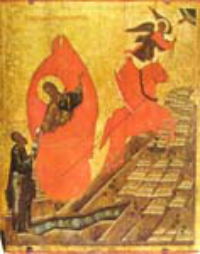
Elijah ascends to heaven in a chariot of fire.
Below is a short sermon—eight minutes long—I preached on June 25, 2023. It was so short for a couple of reasons, first because I was asked to do it around 9:30 p.m. just the night before! My pastor had taken ill and gave me only the scripture reading, Matthew 10: 24-39, and her title, which was “Do Not Be Afraid.” Also, she had planned to devote much of the sermon time to meditating on the scripture in Matthew 10 using the practice called Lectio Divina, where the same scripture passage is read over and over with time to reflect and answer one question in between.
At first I thought she wanted me to lead the exercise, but she had already found leaders for that. No, she wanted me to share a short sermon taking her title as a jumping off point. Because I’m generally not afraid of public speaking, I said ok, but it immediately struck me that, despite the title I had been given to preach on, I should talk about why it is so difficult not to be afraid, even when God has proven faithful over and over and been with you in times of great fear.
 When I speak I often mention the death of my son Bryan Emmanuel Guzman, whom we lost in 2006, just days after he had turned 21. In a Baccalaureate address I gave just six months after his passing, I spoke of how, despite the tremendous sorrow and fear I felt as I stayed beside his body, I felt held in the palm of God’s hand. Our souls still spoke clearly and strongly to each other, Bryan’s saying to me many times, “Dad, this is ok. It’s ok.” We felt loved. And his spirit hovered over me for a couple months afterwards just to make sure I was ok. I remember the exact spot it left me in late January 2007. I felt him lift upwards through the bare January branches of a tree on Gartner Road just yards from our house in Naperville. He’s always with me, but not hovering like he did those two months. Yet despite that it’s still hard for me not to be afraid, as I explain below.
I turned to the story in Genesis 21:8-21 that, in the Lectionary table of readings, Cycle A, is paired with the passages from Matthew 10 for this Sunday. It tells of when Abraham, at Sarah’s command, sends Hagar and his son Ishmael away, essentially to die in the desert. At one point Hagar leaves Ishmael under a tree and moves far enough away so that she will not hear his death cries. At that point an angel of the Lord comes to her, opens her eyes, and she sees a well of water. They live.
But the most spectacular story of someone being afraid after God shows him miracles that should make him fear-proof is the story of the great prophet Elijah and his battle with the false prophets of Baal on Mt. Carmel. (I have written a literary analysis sermon of the incident which you can read Here.) The story, in I Kings: 17-19, shows Elijah in his glory on Mt. Carmel, and, at just a word from Queen Jezebel, huddled in great fear on Mt. Horeb. This prophet, so great that he bypassed normal death by ascending to heaven in a chariot of gold, was afraid. It was hard for him not to be, as it is so often hard for all of us.
♦ Go HERE for a complete list of sermons, like “Pentecost Means No ‘Supremacies,'” “Sacred Doing,” and “Theology and Race.”

A Response to One of Those Lists
We love lists, and they’re thick on my newsfeed every day. Here’s a tiny sampling of lists I saw in just a couple of hours today: “8 ’90s Hit Songs That Are Offensive by Today’s Standards,” “3 ‘overlooked’ red flags that your job is setting you up for burnout,” “10 Things to Never Do After Having a Meal,” “21 Things That Were Cool in the 90s But No One Cares About Anymore,” “16 Laughable Scams That Thrive on the Stupidity of Their Victims.” Lots of these lists have to do with music, like the first one listed above, and they rank things, like all 229 Taylor Swift songs, worst to best, or the 10 best drum solos, or the top 5 reasons the Beatles broke up. And on May 31, 2023, one appeared titled “12 Cover Songs That Render the Original Renditions Entirely Obsolete,” and for some reason I felt I needed to reply to one item. Does Whitney Houston’s 1992 version of Dolly Parton’s “I Will Always Love You”—written by Parton and first released in 1974—render Dolly’s version “obsolete.” I don’t think so.
So many of us love Whitney, and rightfully so, though a Rolling Stone list ranking her the second greatest singer of all time is surely a giant over-reach. Jaimee Marshall, writing for the finance and pop culture website Wealth of Geeks, says that Whitney’s “rendition of ‘I Will Always Love You’ has become an iconic masterpiece. Houston’s powerful vocals, emotional depth, and stunning range elevated the song to new heights, capturing the hearts of millions worldwide. Her rendition effortlessly surpasses the original, infusing it with an unmatched intensity and raw emotion.” But I’ve always preferred Dolly Parton’s version.
Instead of making a list, I’ll probably just harken back to the pinnacle of list-making, David Letterman’s “Top 10 List.” I have three volumes of Top Ten Lists in my library. On the back of the first volume there’s the “Top 10 Reasons to Buy This Book” list. #5: You’re mentioned on page 43. #4: Paper made from criminal trees that deserved to die,” etc. Or go to Chris Rock’s parody, which I write about on this site: “Nat X: Top Five Reasons Brothers Don’t Play Hockey.”
♦ Go to the Reviews and Commentaries page.