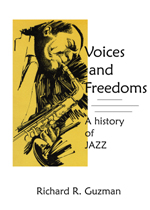

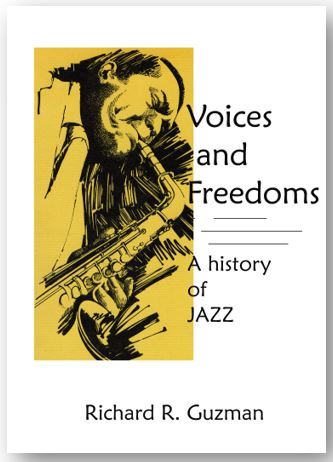
The Video/Audio below is an excerpt from the 16th, and final, show of my radio series Voices and Freedoms: A History of Jazz, based on my 1976 book of the same name. The 16-part series played across the nation for five years in the late 70’s/early 80’ and holds its relevance—or is even more so—today than it was back then. The excerpts present about 6 to 10 minutes of the original 30-minute broadcasts, though this show— being the final, sum-it-up show—I let go a bit longer. The link above takes you to information about the book and our plans to re-release it and provide access to the full-length original shows. Go HERE for a complete list of shows and links to all excerpts.
Last shows in a series are always difficult. How do you sum it up? How do you get a crystal ball with enough power to say anything really meaningful about the future? Most of the people I asked about the future of jazz said they didn’t know, so I followed their lead.
 I thanked a lot of people, especially those jazz greats I was lucky enough to have on my show in the first place. Four of them join me here: three of the great players in jazz history, each of whom was also an important composer—reed man Wayne Shorter, trumpeter Freddy Hubbard, and keyboardist Joe Zawinul. Also joining me was one of the great jazz historians and critics, Martin Williams, at that time head of the Smithsonian’s jazz program.
Williams expresses some concern about jazz rock, and, being the late 70’s, I express some concern about the influence disco was having on jazz at the time. Freddie Hubbard expresses concern about jazz getting so far out that it was losing its audience. There were other worries, too, but still hope in the music’s future, with me expressing my expectation that jazz would continue to be a major force in keeping human voices and human freedoms alive. We mention people we like, especially pianist Keith Jarrett, but I end by playing a number I didn’t know the name of, played by players I didn’t know either. It was the Fresno State Jazz Ensemble playing at the 1975 UC Berkeley Jazz Festival. This was the future of jazz, and the number showed the players knew both how to play and the history of what they were playing, too.
 Some twenty years after both the Voices and Freedoms book and radio series came out, I was teaching a course on jazz in a study abroad program in London. At that time I was enthused—and continue to be enthused—about the combination of world music and jazz, and also of hip hop and jazz. I also loved jazz players soloing over all kinds of turntables and electronica. I took my students to performances of this kind, but the class was unusually devoted to classic jazz and jazz standards. One evening, I met them at Club 707, one of London’s famous jazz clubs. Reportedly, Paul McCartney and Elvis Costello frequented the place, so there was some excitement about possibly getting to rub shoulders with these rock greats. When I got there, however, the excitement was more about something else. “Thanks, Dr. G,” they seemed to say in rousing unison as I entered the room. I had written the club saying my jazz students were coming, and the club had assumed they were jazz musicians and were giving them all drinks on the house.
The band that evening combined Algerian Rai music with jazz. They were good, but then unexpected launched into a Miles Davis standard—I think it was “So What?” from his classic Kind of Blue album—and suddenly got very, very good. Everything seemed to click. They got in the pocket, as we say, and the students seemed to turn to me as one, saying clearly though wordlessly, “See, the old ways, the classic stuff, is always the best.”
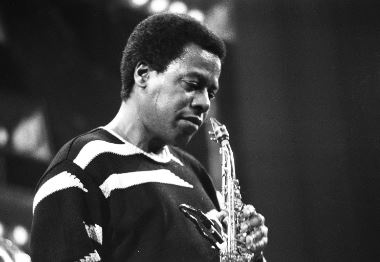
Wayne Shorter
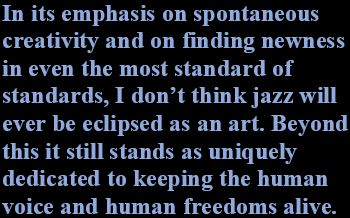
I suppose the traditions in all kinds of so-called classic jazz are deep enough and challenging enough to keep jazz going forever. There will always be players who will take your breath away because of their virtuosity and their inventiveness that brings constant newness to the standards. Still, one wonders if there will ever be the searching experimentation of Bop or New Thing jazz again. Perhaps the cutting edge of music has passed beyond jazz for good. In the emphasis on spontaneous creativity, however, on virtuosity, and on finding newness in even the most standard of standards, I don’t think jazz will ever be eclipsed as an art. Beyond this it still stands as uniquely dedicated to keeping the human voice and human freedoms alive.
♦ Go to the Diversity Training and Teaching main page, and to a complete list of these show excerpts.