


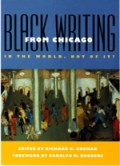
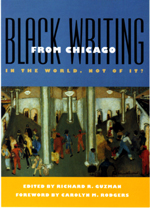
 In 2005 Carolyn Rodgers agreed to write a Foreword to my book Black Writing from Chicago: In the World, Not of It? which came out the following year. Gracious to me in print as she was in person, her words not only gave me assurance that I had succeeded in some measure, they also painted a vivid portrait of what Chicago meant to Black Writing in the 1960’s and 70’s—as much, in my view, as Harlem meant to Black Writing in the 20’s. On November 30, 2012, to add to Carolyn Rodgers’ list of accolades and awards, she was inducted into the Chicago Literary Hall of Fame along with Ernest Hemingway, James T. Farrell, Langston Hughes, Jane Addams, and Sherwood Anderson. Her Foreword follows. Go HERE for a lead post on all the writing I’ve done about her on this site.
________________________
This is an extraordinary book, and it goes without saying that it is long overdue. As editor Richard Guzman pointed out in his Afterward, only Jump Bad (published more than thirty years ago!), and NOMMO, published in 1987, preceded this unique kind of collection. Neither previous anthology has the scope or the versatility of this one. This anthologist takes on the mammoth task of assembling a completely diverse group of Black writers, welded together by the most probably, improbable, fragile and tenable bond, a Chicago experience gained by them either passing through or staying. He succeeds at doing this, and what we have here is a scholarly book which is of great importance, and a sheer delight to read.
 It does not seem as if it has been thirty years and more, since Jump Bad came out. I can still remember, as if it were yesterday, sitting in Gwendolyn Brook’s living room on 74th & Evans. We were discussing the birth of the anthology and she had told us that Dudley, (that’s what she called him, so that what we called Dudley Randall, founder of Broadside Press) was going to publish the book. I remember Gwendolyn saying, “What shall we call it?” and I promptly replied, jump bad, because a couple of days before, I had seen in my neighborhood, a little boy, throw his coat and books on the ground, make fists and challenge another young boy: “You wanna jump bad with me?,” he’d said. “Come on!” And they had started circling each other.
For obvious reasons, it had impressed me. The children, so pure and direct in their acts and feelings, I had thought, knew how to defend what they felt needed defending. They knew how to fight, and not only with words! When they became angry enough, they showed little fear. I told Mrs. Brooks about it.
Gwendolyn Brooks had laughed and said, “All right, we’ll call it that, but you have to write the book jacket notes for that! I had agreed to, happily.
I remember how Chicago was a focal place for Black authors, during the 1960’s and 70’s. I truly believe that there was something very special, perhaps even magical, about being a Black Writer in Chicago, and most likely even before then. We all felt that. Maybe, it was something like being in Harlem during the 1920’s Harlem Renaissance, only it was like the 1920’s Harlem in Chicago all the time.
During the 1970’s, I met James Baldwin at Mrs. Brooks’ home when he swept into the windy city, stopped off at her house, the first Black Pulitzer Prize winner in poetry, and she and her husband threw a party for him. And not once, during the entire evening, did I see him without a drink in one hand and a cigarette in the other. Later on, I met Alex Haley when he came to an OBAC meeting at Margaret Burrough’s home which at that time was also the first home of the DuSable Museum of African-American history. We used to hold our weekly meetings there, and Hoyt W. Fuller was our writing workshop sponsor and leader. He was also the editor of Negro Digest/Black World, published by John H. Johnson.
Hoyt had invited Alex Haley, who had published The Autobiography of Malcolm X to come and read portions of an unpublished Roots to us. I met Conrad K. Rivers, Theodore (Ted) Ward, Margaret Danner, Margaret Walker, Lerone Bennett, Jr. and of course, Margaret Burroughs, and so many others it is impossible to name them all here. Giants. Many of them, had already become living legends. Some of them passed through Chicago and some stayed. We claimed them all.
This book includes over fifty Black authors who came to Chicago, who either stayed, or passed through Chicago’s ivory and Benin doors. It must have taken hours and hours of research and reading to compile this magnificent African-American piece quilt of writings; this mosaic of fear, hope, desperation, triumph, love, laughter and joy; essays, poems, short stories, bits and pieces of novels and plays. It’s all here.
When you read this book, you will be inspired; you will be moved to tears and laughter and anger; and you will come away with this sure knowledge.
Every Black writer in this book has in no uncertain terms let the world know that they are definitely in the world, even if they are not, of it.

Takers, Makers, and the Fiscal Cliff
“Top Republicans rushed to do damage control last week,” read a news item a couple of weeks ago, “after Mitt Romney blamed his election loss on what he called an Obama strategy of giving ‘gifts’ to blacks, Latinos and young voters—groups instrumental to the President’s re-election victory.” Several of his post-election pronouncements reinforce his belief—it wasn’t just a mis- or “inelegant” statement—that 47% of Americans are takers, a sentiment echoed by Paul Ryan’s division of Americans into Takers and Makers—the former being “Republican people,” evidently, the latter being those other guys.
But viewed state by state, this is simply not so.
The picture I used for this post is of a chart published by U.S. News and World Report showing that the top ten states producing more tax revenue than consuming it all voted Democratic, while, paradoxically, all but two of the top ten states that consume—that is take—more tax revenue than they produce voted Republican. This in an article whose title sums up the paradox pretty well: “Obama Supporters Subsidize Romney Supporters.” (I had to shrink this chart, so in case it’s impossible to read, the top ten tax-producing states are: New Jersey, Nevada, Connecticut, New Hampshire, Minnesota, Illinois, Delaware, California, New York, and Colorado. The ten most tax-dependent: New Mexico, Mississippi, Alaska, Louisiana, West Virginia, North Dakota, Alabama, South Dakota, Kentucky, Virginia. Of these only New Mexico and Virginia voted Democrat. Texas is the only net payer of federal taxes among “Red States.”)
The Republican Party is just beginning to show signs of comprehending the fact that the country is growing more diverse, though its first really serious efforts at reaching out to diverse populations (including all women) is being met with understandable suspicion. Louisiana Gov. Bobby Jindal, chairman of the Republican Governors Association, recently warned that the party could not broaden its appeal unless it stopped insulting the very voters its was trying to reach. But it’s even more intriguing than that. It’s insulting its very base. One could say that Romney and Ryan had it exactly backwards: Takers supported them more than Makers did. This is part of a phenomenon that’s old hat to political scientists who, many years ago, named it the Red State-Blue State paradox. It’s complex. Columbia University’s Andrew Gelman and his colleagues even called this paradox into question in their 2008 Red State, Blue State, Rich State, Poor State. (I’d recommend the article of much the same name, and focused on Connecticut, out of which the book grew.)
Still, imminent danger—going over a cliff, for example—has a way of wonderfully clarifying issues. Most people, it seems, would lose if the current Washington stalemate continues. To the degree that the Red State-Blue State paradox holds, the Blue States would certainly have to give much more, but the Red ones would certainly lose much more as well. Perhaps the ultimate paradox is that Republican law makers aren’t just insulting the very voters they’re trying to reach, they’re taking away from most of the very voters who already support them. If these supporters ever got wise—questionable if they keep listening to Fox News and Rush Limbaugh—it would be an even bigger lose-lose proposition for the GOP politically. Economically, it would be lose-lose for everyone.