


 THE AUCTION: The 2012 Emmanuel House/Bryan House silent auction is history—and for the fourth year in a row it raised well over $20,000 to help break the cycle of working class poverty.
Thanks to the hundreds who came, and to our many volunteers, especially Sandy Wunderlich, who coordinated it all. The video below names those on the auction team, but special thanks here goes to those many who came many days and evenings to help assemble items and baskets, load and unload trucks, and set up tables. Then there were those who worked as monitors and cashiers during the auction itself, and those who pitched in to clean up after it was all over. You were so good—especially you East Aurora High students!—that we were all done by 10:30 p.m. “Hey, we’re not staying until 1:00 a.m.?” I said to my daughter-in-law Desiree, co-founder of Bryan House and Emmanuel House. “The youth of America,” she simply said, “has stepped up!”
THE YEAR IN REVIEW: 2012 was a tremendous year of growth for Emmanuel House.
We doubled in size and impact, purchasing three duplexes to double the number of “savings apartments” available to the community. Four families purchased homes and we’ve welcomed six more who will be starting to save to become homeowners and send their children to college. We also doubled our staff—Jesus Diaz, and new executive director Hayley Meksi joining Casey Barrette and Rey Garrido. And we’ve purchased our first official office: 5,000 square feet we plan to share with World Relief, plus put two new apartments upstairs to help two more families start saving.
“As I get to know Emmanuel House participants,” says Hayley Meksi, “I’m constantly struck by their passion and desire to put down firm roots—something that many have been chasing for a very long time. These roots bring much needed stability, not only to their own families, creating a springboard for their children’s future, but also stability to the community as a whole by creating safer and stronger neighborhoods.”
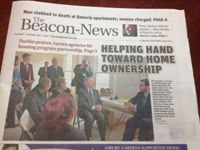
The visit of U.S. Senator Dick Durbin to our Claim St. Emmanuel House site this May 2012 was one index of our success over the past year and a half. Watch a video of his visit HERE, and to read more about Bryan House and Emmanuel House and explore some of the many resources we’re collecting on this site go HERE.
NEXT YEAR’S AUCTION: Join us for our 2013 Silent Auction. The date, the Friday before Thanksgiving, is November 22nd. In the meantime consider donating monthly by visiting www.EmmanuelHouse.org. $13 helps support a family for one day. $52 supports operations for a whole day. When you support our efforts to help the working poor, you help create better communities for EVERYONE.
♦ Go to Emmanuel House/Bryan House main page for more information.
♦ Music by Dan Guzman. Go here for more of Dan’s music.


Red State, Blue State, Civil War
Commentary by
Richard R. Guzman
I lived in the South for several years in the late 70’s and at least once a day had this thought: The Civil War isn’t over, is it? It felt vitally alive there, still breathing fire in town squares, flags, social institutions, personal interactions. And I lived in a relatively progressive area, Charlottesville, Virginia, where I pursued my PhD at the University of Virginia, Mr. Jefferson’s University, founded by one who articulated some of our basic concepts of freedom while owning slaves. During 1976 Bicentennial celebrations, I was honored to have one of my choral compositions, “The Love of Thy Children,” performed by a combined choir from several of Charlottesville’s Black and White churches. That Bicentennial service, I heard, was one of the first times Black-White churches had ever cooperated. 113 years after the Emancipation Proclamation, but better late than never, I suppose.
Though I know it’s a very complex relationship, the Civil War breathes on strongly in our Blue State/Red State dilemma, as suggested by this map I saw posted the day after Barack Obama won a second term as President of the United States.
For me the greatest danger to our democracy is its growing inequality—one measure being, of course, that the greatest amount of wealth is now concentrated in the smallest percent of our people in our entire history. In fact, the top tenth of the top 1%, make the lower nine-tenths of that top 1% look somewhat middle class by comparison.*
But rich-poor doesn’t play in the South. State’s Rights plays. We’ll-have-slaves-(or whatever)-if-we want-to plays. This is one reason why the South—which contains some of the poorest, most unequal areas in the country—simply cannot see the irony of voting for a rich man whose policies would likely have made inequality worse.
Of course, not all Red states are southern states. The non-geographical divide is between those who hate government more than they love equality. We—all of us, both Democratic and Republican, progressive or conservative—need to focus on coming to some truce over the government side of this love-hate stalemate. Though mostly liberal, I, too, am suspicious of government, especially as it has contributed to the concentration of wealth I mentioned above. We need to hate government less and also champion it less. But there’s no give on equality—which we all have to treasure more. As the great American historian John Hope Franklin wrote, “Equality is indivisible.” ** It’s ultimately illogical to think of some as equal and others not. Societies become uncivil—sometimes they crumble all together—if they don’t realize this.
_______________
* See Jacob Hacker and Paul Pierson’s recent book Winner-Take-All Politics: How Washington Made the Rich Richer — And Turned Its Back on the Middle Class, and read my article “Graphic Inequality.”
** Read more about John Hope Franklin here. His quote comes from his essay “Racial Equality in America,” which I excerpted in my book Black Writing from Chicago.