



NOTE: In 2018, after a great seven-year run, CFD ceased formal operations. It’s impact was such, though, that it may yet serve as a model for future efforts at tutoring and mentoring youth.
Chicago Family Directions started as a class project for Dr. Guzman’s MLD 683 – Leadership for Social Change. “After the class I thought, ‘Well, that’s probably the last I’ll hear of it,'” said Melanie Murphy or her husband Dennis Nyhan’s project. But soon afterward Dennis was taking steps to create a 501 (c)(3) non-profit organization, and Melanie began working overtime on the project herself, completing its formal marketing plan as her master thesis (see the plan Here), and becoming vice-president of an organization that, in October 2011, began delivering tutoring to homeless and disadvantaged children at the John Schoop Academy in Chicago.
In the first eight months of its existence, Chicago Family Directions has delivered the equivalent of $48,000 of tutoring to Schoop. More important, it has significantly increased scores—sometimes more than doubling them—for their second grade students in critical areas such Oral reading fluency, Re-tell fluency, and Word usage fluency. Next year their second graders move on to third, and the program expands, keeping up with old students and taking in new second graders.
Chicago Family Directions’ program is now in demand at other schools, and the plan had originally been to add a second grade class at a second school next year, then more and more schools in subsequent years. However, research shows that starting in second grade isn’t soon enough. At its recent meeting, CFD’s Board of Directors therefore decided that adding a first grade class at Schoop was another next step before expanding its program to other schools in the coming years. Unless more money can be raised. (See below.)
The former CFD website has these stats on its home page:
- 63.5% of the homeless population in Chicago are mothers and their children
- The average age of a homeless person is nine years old
- Homeless students are twice as likely to score lower on standardized tests
- 36% of homeless students repeat a grade and are three times more likely to be placed in Special Education programs
- Homeless students are four times more likely to drop out of school
- During the 2009-2010 school year, roughly 15,000 students in the Chicago Public School (CPS) system were homeless.
Such statistics are at least the same across much of the U.S., and in some places far worse—this in the richest nation in the world.
♦ See advisory board member Diane Nilan’s Hear Us website (www.hearus.us) for more on homelessness and how you can be involved. Read more about Hear Us and homelessness on this site.
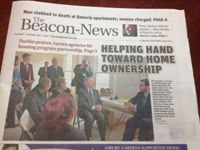
♦ Read “Seeds of Change” an article about the early days of Bryan House, which became Emmanuel House, and is now THE NEIGHBOR PROJECT (TNP). Rick Guzman’s vision of the importance of home ownership began with his awareness, as a child, of homelessness.


Rubber, The Movie
The dialogue in Quentin Dupieux’s really odd film Rubber begins when a police man, crawling nonsensically out of a car’s trunk, addresses us about all the things that don’t make sense in movies. This prepares us for seeing a tire slowly twist itself out of the ground, and, after crushing a plastic bottle and a couple of insects, realize it has telepathic powers that can kill things—first a rabbit, then a bird, then people. All of this a group of people watch through binoculars. It’s their watching that keeps this movie and its murderous tire star keep going. When the police man who had first addressed us—he’s the master puppeteer—decides he’s had enough of the movie, he has the watchers killed. Having watched in the desert for hours, they’re starving by the next morning and ravenously descend upon a poisoned turkey. All except one. He lives and continues watching, and so no one—not even “the master”—can stop. The movie must continue. Tired of the tire and wanting to speed up the film’s ending, the master finally just blows the murderous tire away, handing the remains to the lone watcher.
Suddenly, however, the lone watcher realizes the tire’s been reincarnated—as what I’ll let you discover: it’s so fitting and even crazier than the tire bit—and the reincarnation blows him away. But the film still doesn’t end. The reincarnation rolls down the street, a pied piper now, tires coming to life everywhere it passes and joining a growing procession of tires which finally comes to rest in front of famous letters on a Los Angeles hill. H-O-L-L-Y-W-O-O-D. It’s going to take the concentrated telepathy of the reincarnation and all those tires to blow that up.
If you don’t like something, then don’t watch it. This movie has a more cynical take on that simplistic cliche. Rubber finally says it’s not enough to blow up everyone in an audience, or even the actors in a film. You have to blow up HOLLYWOOD itself, and this weird indie film makes the prospect feel like an actual solution. But, of course, it isn’t. Hollywood may have turned reality into film, but the Internet, and YouTube, and Facebook have turned reality into a screen—something everything seems to have these days. We watch them—screens—incessantly, 24/7. In colleges and universities some are beginning to use the term “screen studies” instead of “film studies.” And if someone—like you—isn’t on a screen, how real can you be, after all? Blowing up Hollywood would be just a beginning.
(2010, Dir. Quentin Dupieux, 82m, R. I say 3 stars.)
*** See a list of other reviews.