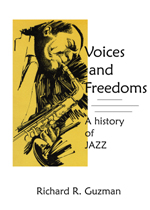


Voices and Freedoms: A History of Jazz

Voices and Freedoms: A History of JazzA sweeping history of jazz from its roots in African and Blues music to the present day, Voices and Freedoms presents ways to understand and appreciate jazz’s major stars and its musical evolution more deeply.  The book was also made into a nationally syndicated 16-part radio series of the same name.

 Hear a sample from the radio series based on the book.  It’s from Show #14, on Ornette Coleman.  And go to the RADIO SHOWS main page to see the complete list of Voices and Freedoms episodes, a list which mirrors the Table of Contents of the book.  Links to other excerpts will also be available on this Radio Shows main page.

 BUY the book below. (A Buy Button will go live when the book becomes available.)

This was Dr. Richard Guzman’s first book.  The 16-part radio series of the same name ran for many years across the nation, and is still considered one of the deepest explorations of jazz ever to play on radio.  Soon an updated pdf and e-book version will be available.  Those who buy the book in either form can register to hear the 16-part radio series. The book and radio series follow jazz history by focusing on voices—a bedrock quality of jazz that doesn’t change—and freedoms, issues in musical form, which do.  It sees jazz history as part of a larger panorama of American history where voices and freedoms continually play out not just in music, but in the areas of race, Civil Rights, and equality.

Book Excerpt:

“The sound of the human voice is more precious than we know.  It breaks out in laughter, in words bitter and sweet, shy or commanding; it sighs, cries and groans; it lapses into silence, which can be one of its most expressive moments. And jazz has always been obsessed with it.  Though basically an improvisational instrumental music, jazz tone, concept, and feeling derive mainly from the vocal milieu of black folksong.  When jazz musicians play, they speak, growl, moan, mutter, croon, confess the blues, shout, whisper: they treat their instruments as extensions of the human voice.”

  Return to the BOOKS page of this site, and go to the Teaching Diversity main page.


Posted in Jazz History, Music & Meaning | Tagged , , , , , , , , , | Leave a comment

Black Writing From Chicago

Review:  Black Writing from Chicago:
In the World, Not of It? 
( 5-Stars )

Native Sons and Daughters

Chicago’s black lit history gets its due in a new anthology.
By — Jonathan Messinger

Cover for Black Writing from ChicagoRichard Guzman’s new collection of African-American writing from Chicago is a heady mix of old-school agitprop and literary wonderment, a testimony not only to the multitude of great black writers who were born or passed through here, but to the myriad forms literature may take.

In his introduction, Guzman addresses the dearth of anthologies collecting African-American literature.  The late Gwendolyn Brooks published Jump Bad in 1971, and the Organization of Black American Culture published Nommo: A Literary Legacy of Black Chicago (1967-1987) in 1987.  Guzman’s Black Writing from Chicago: In the World, Not of It? (Southern Illinois University Press, $19.95) is the first academic attempt to gather the disparate, and, arguably diasporic, literature of Black Chicago from the 19th century to the 21st.

Guzman uses author’s birth dates to organize the collection chronologically.  At first glance, this approach seems to eschew intellectual heft in favor of an easy way out, allowing Guzman to avoid making thematic connections.  But Black Writing has an elliptical resonance: There are echoes of Ida B. Wells and W.E.B. DuBois, both included at the beginning of the anthology, in the excerpt from Barack Obama’s Dreams from My Father, included toward the end.

Guzman has approached his task like a curator. He’s chosen work from such luminaries as Brooks and Richard Wright, that identifies their idiosyncratic styles, even if they’re not quintessential selections.  Similarly, he’s included pieces that would otherwise now be inaccessible to contemporary readers.

Take, for example, two selections published in the Chicago Defender during the newspaper’s early years.  In an editorial from 1917 headlined “Keep Your Mouth Shut, Please!” the editors exhort new residents to keep their voices down on city buses and trains.  The editorial reads: “Cut this out, dear reader, and whenever you see one talking loudly hand it to them.”  It’s a tasty bit of old-school newspaper belly-aching, but it’s also an extension of the Defender’s leading role as a voice of the “Great Black Migration,” when the paper circulated nationwide and printed train schedules to facilitate the movement of blacks from the South to the North.  A few pages later, though separated by nearly 30 years in the paper’s history, Langston Hughes satirizes a similar social problem in one of his popular “Simple Stories” columns, featuring the comic character Jesse B. Semple.  Jesse is perturbed at the amount of grease people put in their hair: “…there ought to be a law against people with greasy heads going around leaning them up against people’s walls and spotting them all up.”

It’s to Guzman’s credit that he included both of these.  Though they seem to address frivolous topics, they also encapsulate the different ways literature can speak to social concerns in the space of the same newspaper.

. . . . . . . . . . . . . . . . . . . . . . . . . . . . . . . . . . . . . . . . . . . . . . . .
Black Writing has an elliptical resonance…by the end, you can almost hear the contemporary writers talking to their forebears.
. . . . . . . . . . . . . . . . . . . . . . . . . . . . . . . . . . . . . . . . . . . . . . . .

The anthology includes important contemporary figures as well.  The latter years are necessarily focused on poetry, given spoken word and slam’s dominance in the last 15 years.  Guzman reprints poet and performer Marvin Tate’s gorgeous “The Ebony Mannequin in the Marshall Fields State Street Store Window” and Tyehimba Jess’s fiery poem “We Live.”

Though diverse in style and voice, subject matter and perspective, enough charged current runs through the anthology that, by the end, you can almost hear the contemporary writers talking to their forebears.

Time Out Chicago, June 8-15, 2006: 73

…. from other reviews___________________________

“A work of great importance, and a sheer delight to read.”
—Carolyn Rodgers, poet, National Book Award nominee

“…an important contribution that will be greatly appreciated by scholars and by much of the general public.”
—Lonnie G. Bunch, Founding Director, National Museum of African American History

“A tremendous resource for anyone interested in the literature of Chicago…At the same time each selection has a national significance.”
—Lisa Woolley, Author, American Voices of the Chicago Renaissance

“…impressive…fascinating…” —Chicago Tribune

…. for more___________________________________

  Go HERE to see an image of the review much as it appeared in Time Out Chicago, and for more reviews Go Here.

  Listen to WBEZ radio interview.

 Go to the Emmanuel House main page on this site.  This organization was founded by Rick and Desiree Guzman as a living memorial to my youngest son Bryan Emmanuel Guzman (1985-2006), who worked with me on Black Writing from Chicago.  In 2016, Emmanuel House was named one of the “Top 100” social change organizations in the world.

  BUY  Black Writing from Chicago.

Posted in Black Writers, Chicago Writing, Diversity & Multiculturalism | Tagged , , , , , , , , | Leave a comment

Bryan E. Guzman

He Would Have Been One of the Greats

Bryan E. Guzman

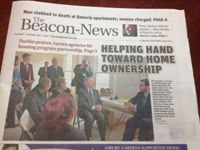
Bryan Emmanuel Guzman died on December 9th, 2006, shortly after his 21st birthday. His passing was widely covered, taking up nearly the entire front page of one paper with the headline “He would have been one of the greats.” This referred to his enormous musical talent, but he was already a great spirit who drew so many to him with his humor, grace and gift for friendship. HeBryan E. Guzman on Naperville Sun front page played in bands with his brother Daniel and also with his father and Daniel doing shows on Chicago and the poetry of war.***

He helped his father with the book  Black Writing from Chicago,  called “A work of great importance” by poet Carolyn Rodgers, and “impressive” and “fascinating” by the Chicago Tribune.  He majored in sociology at North Central College, where one of his professors said Bryan “always asked the right questions.” He said he saw himself and his music contributing to changing the world. He was an artist with a strong sense of justice who wanted to make a difference—and did.

Among the many memorials to him is the song “Hallelujah” recorded by a group of Chicago musicians, but perhaps the most visible is Bryan House, founded by his older brother Rick and Rick’s wife Desiree to serve refugees.  As the Bryan House concept grew the house itself became part of a larger organization, Emmanuel House, which serves all of the working poor, helping lift them out of poverty through home ownership, education, and community development, things very important to Bryan.  Learn more about Emmanuel House HereEmmanuel—“God with us”—was Bryan’s middle name.  A plaque of the newspaper front page shown above now graces the conference room of the Emmanuel House headquarters.

In 2016, Emmanuel House was named one of the “Top 100 Most Innovative” social change organizations in the world.  In 2018 it merged with long-time partner The Joseph Corporation to become The Neighbor Project.

_______________________

>>> View or download Remembering Bryan—a booklet of pictures, tributes, and memories—HERE.

>>> Listen to Dan Guzman’s music.  On some songs —like “Moby Stank,”  “Roundabout,” and “But It Was” —you can hear Bryan’s playing and singing.  Plug into speakers or use headphones to catch his bass more clearly on these songs and on music accompanying videos like the Grand Opening of the Emmanuel House Headquarters.

*** Listen to “Why I Oppose the War” a combination of MLK, Jr’s voice and words and the Guzman’s music.  It was a staple in shows Bryan did with Daniel and his father.


Posted in Family, Social Change | Tagged , , , , , , , , , | 1 Comment