Yesterday an acquaintance forwarded this to me in an email. It’s a typical piece of web debris, asking you to please not delete it before you pass it on to as many of your friends as possible.
So I am passing it on, but not without some comment.
 It’s about why Muslims can’t be good Americans. It hardly deserves a response because it’s so riddled with irrationality and historical and social distortion. It also misquotes the Qur’an so blatantly it amounts to outright lying. Still, we can’t totally give in to this era where anyone can apparently say anything they want, while the internet provides a vehicle to infect thousands and thousands so easily. So we fight back as we can, though waves of stupidity roll endlessly and seem to be gaining overwhelming strength. More important, the email expresses what tens of thousands of Americans believe openly, and millions secretly. It’s such ignorance that truly endangers democracy.
I should say, for what it’s worth, that I’m not Muslim and am not making an argument for Islam. In fact, I’m Christian and, in many respects, fairly conservative theologically. But I also believe lying about other religions is one of the most un-Christian things you can do.
Here’s the email I got. I’ve numbered the points so I can respond briefly to just a few of them.
“CAN MUSLIMS BE GOOD AMERICANS?????”
“This is very interesting and we all need to read it from start to finish. And send it on to everyone. Maybe this is why our American Muslims are so quiet and not speaking out about any atrocities.
“Can a good Muslim be a good American?
“This question was forwarded to a friend who worked in Saudi Arabia for 20 years. The following is his reply:
“1) Theologically-no…Because his allegiance is to Allah, The moon god of Arabia .
“2) Religiously-no…Because no other religion is accepted by His Allah except Islam. (Quran, 2:256)(Koran)
“3) Scripturally-no…Because his allegiance is to the five Pillars of Islam and the Quran.
“4) Geographically-no…Because his allegiance is to Mecca, to which he turns in prayer five times a day.
“5) Socially-no…Because his allegiance to Islam forbids him to make friends with Christians or Jews.
“6) Politically-no…Because he must submit to the mullahs (spiritual leaders), who teach annihilation of Israel and destruction of America, the great Satan.
“7) Domestically-no…Because he is instructed to marry four Women and beat and scourge his wife when she disobeys him. (Quran 4:34 )
“8) Intellectually-no…Because he cannot accept the American Constitution since it is based on Biblical principles and he believes the Bible to be corrupt.
“9) Philosophically-no…Because Islam, Muhammad, and the Quran does not allow freedom of religion and expression. Democracy and Islam cannot co-exist. Every Muslim government is either dictatorial or autocratic.
“10) Spiritually-no…Because when we declare ‘one nation under God,’ The Christian’s God is loving and kind, while Allah is NEVER referred to as Heavenly father, nor is he ever called love in the Quran’s 99 excellent names.
“Therefore, after much study and deliberation…Perhaps we should be very suspicious of ALL MUSLIMS in this country. They obviously cannot be both ‘good’ Muslims and ‘good’ Americans. Call it what you wish it’s still the truth. You had better believe it. The more who understand this, the better it will be for our country and our future. The religious war is bigger than we know or understand!
“Footnote: The Muslims have said they will destroy us from within.
“SO FREEDOM IS NOT FREE. THE MARINES WANT THIS TO ROLL ALL OVER THE U.S.
“Please don’t delete this until you send it on.”
First, I hope the Marines track down whoever made up these untruths. Perhaps a few Marines—very few—might agree with some of this, but it’s hardly part of any Marine marching orders. I’m sure there are also a few—very, very few—Muslims who actually do want to destroy us and who think America is the Great Satan. But these very, very few are fundamentalist radicals, some with terrorist leanings. Muslim terrorists attacked us on September 11th, not Muslims, just as Christian terrorists blew up the Murrah Building in 1995, not Christians.
Second, in points (2) and (7) whoever wrote this quotes the Qur’an. But the “interpretations” put forth are pretty much the opposite of what the Qur’an actually says. Chapter (or Sura) 2: verse 256, one of the Qur’an’s most famous verses, says, “There is no compulsion in matters of faith,” meaning that when it comes to religion you shouldn’t “compell” anyone to be one way or another. It’s their choice—and though there are certainly consequences to choices, this is more a statement of religious tolerance than one of non-acceptance. Likewise, 4:34, quoted in point (7), says nothing whatsoever about multiple wives or beating women. In fact, it says, if you’re having problems with women you are to “talk to them suasively, then leave them alone in bed without molesting them.” True, most religious texts, including the Bible, heavily favor males, male interests, and male points of view, but in giving women the right to divorce abusive husbands, for example, or to actually inherit property, the Qur’an actually represents a step forward in the treatment of women. When Muslim societies oppress women, it’s because they are NOT following their founding religious text; and the same goes for Christians in the U.S. who likewise want to keep women “in their place.” It’s also untrue that the Qur’an, or Islam generally, forbids friendships with other faiths, as stated in point (5). Nor is it true that Muslims—except, again, the very, very small percentage who are radical fundamentalist, perhaps with terrorists leanings—believe the Bible to be totally corrupt. Muslims may disagree on some fundamental issues and believe some of it is corrupt, but certainly not all. When my students actually look at the book, they’re always surprised, often stunned, that Islam holds enormous reverence for the same people Judaeo-Christians do: Abraham, Moses, Isaac, Jonah…and Jesus.
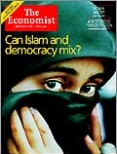
Other points, like number (4) and parts of (9) and (10) are just silly. But there are actually serious core issues running through many points, especially the last three: (8), (9), and (10). Even very thoughtful, and somewhat informed people, question whether Islam and democracy can co-exist. See, for example, the cover of The Economist, which I’ve used above as the picture for this post. It’s a 2000 cover. About a decade later the Arab Spring erupts. But still The Economist and others doubt, and not without reason. Perhaps their democracy will really not be exactly as ours. Anyway, we’ve hardly perfected democracy ourselves and we’ve been at it two and a half centuries. We should wait at least two and a half decades before we think we know if Islam and democracy will or won’t work. The inspirational courage of those tens of thousands of Islamic protesters, their willingness to lay down their lives for freedom, deserves at least that much leeway.
Also, most people who think like the ones responsible for this ten-point email simply do not understand the importance of one of our founding concepts: the separation of church and state, the idea forming the bedrock of our highly touted religious freedom. If the U.S. were as exclusively Christian as they think it is, we would be far less free. Most of the “Biblical principles” our nation is founded on aren’t really that exclusively Christian. Liberty, equality, respect of individuals—these and others are more universal principles, ones you can find in other religions, philosophies, and even some political systems. I mentioned earlier that as a Christian I’m theologically fairly conservative. I believe by faith, for example, in the Resurrection and abiding presence of Jesus Christ. But not one core concept in the Constitution or the Declaration of Independence depends on this very traditional Christian belief. I even know many very faithful Christians and very good Americans who believe in the Christian God without believing that Jesus literally rose from the dead, as I do. Thomas Jefferson, the Founding-Father source of the separation of church and state idea, either didn’t believe in the Ressurection, or didn’t think it was very important, because he literally cut out all references to it, as well as to miracles, and to Jesus’ divinity in his personal Bible, what we now call the “Jefferson Bible.” As a Ph.D. graduate of the University of Virginia, Mr. Jefferson’s university, I, along with most alums, are rather expert on facts like these. I believe the central genius of our Constitution and most of our other founding documents—including Jefferson’s “Statute of Virginia for religious freedom”—is that we can be good Americans without being Christians, Muslims, Jews, or whatever—however good it might be to be one of these. Even atheists—though they would certainly chaffe at the “under God” parts—can be good Americans if they love liberty, strive for equality, respect the freedom and aspirations of others, and stand against things that oppress and deny others their fair share, their fair opportunities. That’s freedom, and it’s profound.
So let’s say a person follows a religion whose main book isn’t necessarily the Bible but the Book of Mormon (a book which seems to sanction multiple wives, by the way). Say his religion’s major prophet isn’t necessarily Jesus but Joseph Smith. If that person loves America, and liberty, and some notion of equality, he not only ought to be accorded full good-American status, he ought to be able to run for President of the United States.




 The video below focuses on the Guzman’s place in the Oak Creek Estados complex and on areas just a few minutes from it. Click on the video icon below to see it. The picture to the left is the view from just across the street. Also below, note how you can win a week in Sedona.

10 Reasons Why Muslims Can’t Be Good Americans
Yesterday an acquaintance forwarded this to me in an email. It’s a typical piece of web debris, asking you to please not delete it before you pass it on to as many of your friends as possible.
So I am passing it on, but not without some comment.
I should say, for what it’s worth, that I’m not Muslim and am not making an argument for Islam. In fact, I’m Christian and, in many respects, fairly conservative theologically. But I also believe lying about other religions is one of the most un-Christian things you can do.
Here’s the email I got. I’ve numbered the points so I can respond briefly to just a few of them.
“CAN MUSLIMS BE GOOD AMERICANS?????”
“This is very interesting and we all need to read it from start to finish. And send it on to everyone. Maybe this is why our American Muslims are so quiet and not speaking out about any atrocities.
“Can a good Muslim be a good American?
“This question was forwarded to a friend who worked in Saudi Arabia for 20 years. The following is his reply:
“1) Theologically-no…Because his allegiance is to Allah, The moon god of Arabia .
“2) Religiously-no…Because no other religion is accepted by His Allah except Islam. (Quran, 2:256)(Koran)
“3) Scripturally-no…Because his allegiance is to the five Pillars of Islam and the Quran.
“4) Geographically-no…Because his allegiance is to Mecca, to which he turns in prayer five times a day.
“5) Socially-no…Because his allegiance to Islam forbids him to make friends with Christians or Jews.
“6) Politically-no…Because he must submit to the mullahs (spiritual leaders), who teach annihilation of Israel and destruction of America, the great Satan.
“7) Domestically-no…Because he is instructed to marry four Women and beat and scourge his wife when she disobeys him. (Quran 4:34 )
“8) Intellectually-no…Because he cannot accept the American Constitution since it is based on Biblical principles and he believes the Bible to be corrupt.
“9) Philosophically-no…Because Islam, Muhammad, and the Quran does not allow freedom of religion and expression. Democracy and Islam cannot co-exist. Every Muslim government is either dictatorial or autocratic.
“10) Spiritually-no…Because when we declare ‘one nation under God,’ The Christian’s God is loving and kind, while Allah is NEVER referred to as Heavenly father, nor is he ever called love in the Quran’s 99 excellent names.
“Therefore, after much study and deliberation…Perhaps we should be very suspicious of ALL MUSLIMS in this country. They obviously cannot be both ‘good’ Muslims and ‘good’ Americans. Call it what you wish it’s still the truth. You had better believe it. The more who understand this, the better it will be for our country and our future. The religious war is bigger than we know or understand!
“Footnote: The Muslims have said they will destroy us from within.
“SO FREEDOM IS NOT FREE. THE MARINES WANT THIS TO ROLL ALL OVER THE U.S.
“Please don’t delete this until you send it on.”
First, I hope the Marines track down whoever made up these untruths. Perhaps a few Marines—very few—might agree with some of this, but it’s hardly part of any Marine marching orders. I’m sure there are also a few—very, very few—Muslims who actually do want to destroy us and who think America is the Great Satan. But these very, very few are fundamentalist radicals, some with terrorist leanings. Muslim terrorists attacked us on September 11th, not Muslims, just as Christian terrorists blew up the Murrah Building in 1995, not Christians.
Second, in points (2) and (7) whoever wrote this quotes the Qur’an. But the “interpretations” put forth are pretty much the opposite of what the Qur’an actually says. Chapter (or Sura) 2: verse 256, one of the Qur’an’s most famous verses, says, “There is no compulsion in matters of faith,” meaning that when it comes to religion you shouldn’t “compell” anyone to be one way or another. It’s their choice—and though there are certainly consequences to choices, this is more a statement of religious tolerance than one of non-acceptance. Likewise, 4:34, quoted in point (7), says nothing whatsoever about multiple wives or beating women. In fact, it says, if you’re having problems with women you are to “talk to them suasively, then leave them alone in bed without molesting them.” True, most religious texts, including the Bible, heavily favor males, male interests, and male points of view, but in giving women the right to divorce abusive husbands, for example, or to actually inherit property, the Qur’an actually represents a step forward in the treatment of women. When Muslim societies oppress women, it’s because they are NOT following their founding religious text; and the same goes for Christians in the U.S. who likewise want to keep women “in their place.” It’s also untrue that the Qur’an, or Islam generally, forbids friendships with other faiths, as stated in point (5). Nor is it true that Muslims—except, again, the very, very small percentage who are radical fundamentalist, perhaps with terrorists leanings—believe the Bible to be totally corrupt. Muslims may disagree on some fundamental issues and believe some of it is corrupt, but certainly not all. When my students actually look at the book, they’re always surprised, often stunned, that Islam holds enormous reverence for the same people Judaeo-Christians do: Abraham, Moses, Isaac, Jonah…and Jesus.
Other points, like number (4) and parts of (9) and (10) are just silly. But there are actually serious core issues running through many points, especially the last three: (8), (9), and (10). Even very thoughtful, and somewhat informed people, question whether Islam and democracy can co-exist. See, for example, the cover of The Economist, which I’ve used above as the picture for this post. It’s a 2000 cover. About a decade later the Arab Spring erupts. But still The Economist and others doubt, and not without reason. Perhaps their democracy will really not be exactly as ours. Anyway, we’ve hardly perfected democracy ourselves and we’ve been at it two and a half centuries. We should wait at least two and a half decades before we think we know if Islam and democracy will or won’t work. The inspirational courage of those tens of thousands of Islamic protesters, their willingness to lay down their lives for freedom, deserves at least that much leeway.
Also, most people who think like the ones responsible for this ten-point email simply do not understand the importance of one of our founding concepts: the separation of church and state, the idea forming the bedrock of our highly touted religious freedom. If the U.S. were as exclusively Christian as they think it is, we would be far less free. Most of the “Biblical principles” our nation is founded on aren’t really that exclusively Christian. Liberty, equality, respect of individuals—these and others are more universal principles, ones you can find in other religions, philosophies, and even some political systems. I mentioned earlier that as a Christian I’m theologically fairly conservative. I believe by faith, for example, in the Resurrection and abiding presence of Jesus Christ. But not one core concept in the Constitution or the Declaration of Independence depends on this very traditional Christian belief. I even know many very faithful Christians and very good Americans who believe in the Christian God without believing that Jesus literally rose from the dead, as I do. Thomas Jefferson, the Founding-Father source of the separation of church and state idea, either didn’t believe in the Ressurection, or didn’t think it was very important, because he literally cut out all references to it, as well as to miracles, and to Jesus’ divinity in his personal Bible, what we now call the “Jefferson Bible.” As a Ph.D. graduate of the University of Virginia, Mr. Jefferson’s university, I, along with most alums, are rather expert on facts like these. I believe the central genius of our Constitution and most of our other founding documents—including Jefferson’s “Statute of Virginia for religious freedom”—is that we can be good Americans without being Christians, Muslims, Jews, or whatever—however good it might be to be one of these. Even atheists—though they would certainly chaffe at the “under God” parts—can be good Americans if they love liberty, strive for equality, respect the freedom and aspirations of others, and stand against things that oppress and deny others their fair share, their fair opportunities. That’s freedom, and it’s profound.
So let’s say a person follows a religion whose main book isn’t necessarily the Bible but the Book of Mormon (a book which seems to sanction multiple wives, by the way). Say his religion’s major prophet isn’t necessarily Jesus but Joseph Smith. If that person loves America, and liberty, and some notion of equality, he not only ought to be accorded full good-American status, he ought to be able to run for President of the United States.