 In my sermon “Who Do You Stand With?” I spoke of the shameful record the Christian church had when standing up for the lives and rights of the oppressed. In fact, it has played a major role in the rise and continuation of racism, the suppression of women and LGBTQ persons, and, during the Holocaust, the support of Nazis. There were exceptions, of course. The Civil Rights Movement was to a large degree church-based, though the churches on the front line were mostly Black. There was opposition to Nazi rule, too, from the so-called Confessing Church. One of its leaders was Dietrich Boenhoeffer, who wrote the great book The Cost of Discipleship, which begins with that startling sentence, “The great enemy of the church today is cheap grace.” We want all the advantages of grace but don’t want to do anything for it. We don’t want to stand with people, speak up for them. Bonhoeffer was executed. Another leader of the Confessing Church was Martin Niemoeller, who uttered the famous words: “When they came for the Communists, I didn’t say anything because I’m not a Communist. When they came for the Jews, I didn’t say anything because I’m a Christian. When they came for the Trade Unionists, I didn’t say anything because I don’t belong to a Trade Union. And then they came for me, and it was too late. There was no one to speak up for me.” Niemoeller spent seven years in a concentration camp. But on the whole, the traditional German church whispered its objections. Its virtual silence enabled the horrors of the war and the concentration camps, and much of the church openly stood with that evil regime.
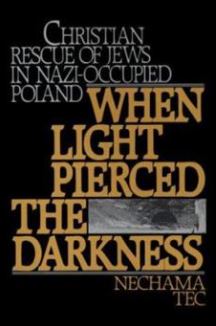
The very first conference we ever put on at North Central College was “Christianity and the Holocaust,” November 8-10, 1989, directed by Dr. David Frolick, from political science,* and me as director of the two co-sponsoring entities, The Visiting Lecturer Committee and The Master of Arts in Liberal Studies. Frolick had approached me about bringing Nachama Tec, who had written When Light Pierced the Darkness: Christian Rescue of Jews in Nazi-Occupied Poland,” and when I said, Why not more speakers? I remember him saying, “You mean an actual conference!? We’ve got to get a good brochure!” I remember, too, rushing by a group preparing lunch, saying, “No ham,” and hearing gasps as I sped away to take care of other business.
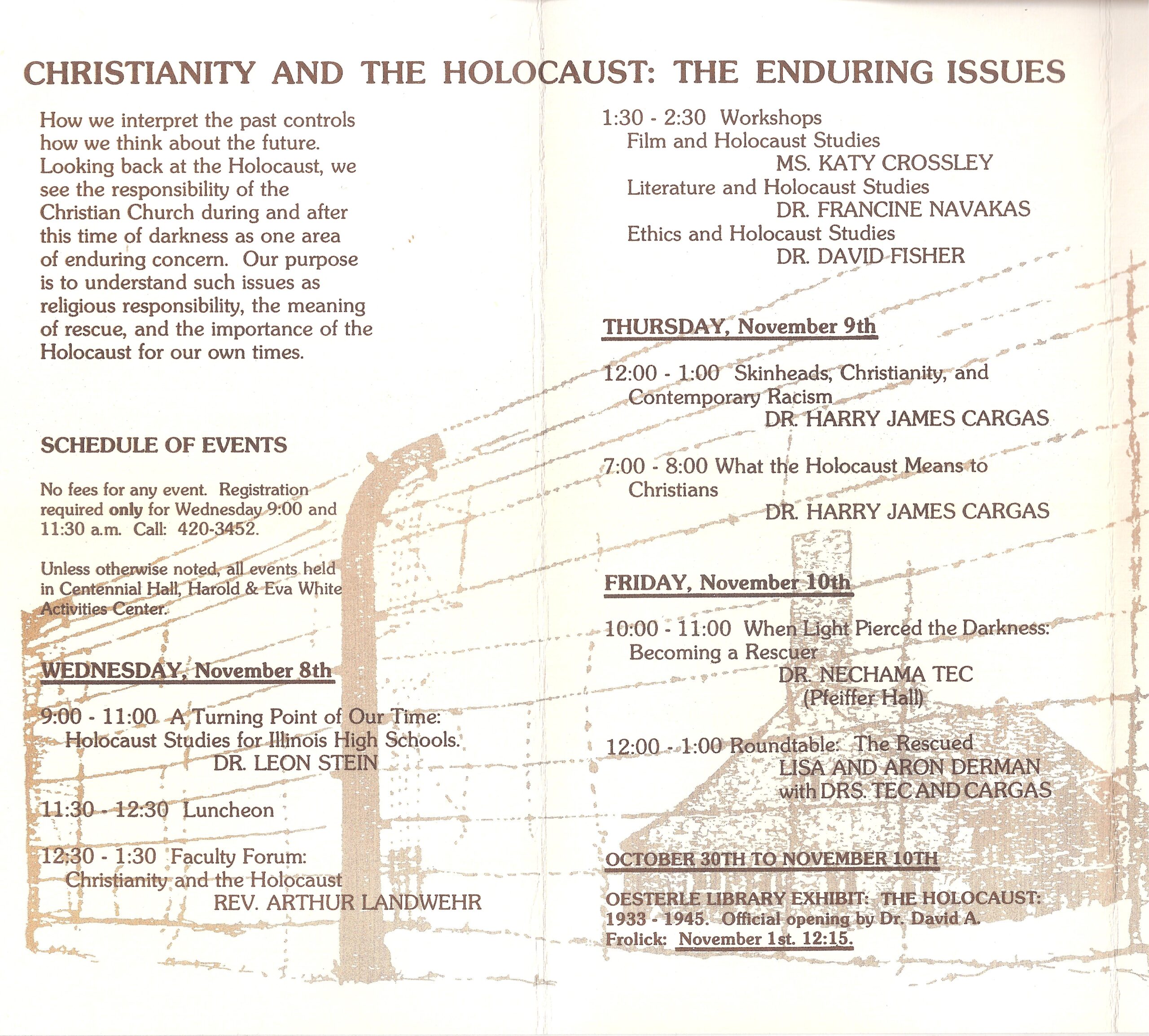
 As part of that brochure shows below, we covered a wide spectrum of issues: the Holocaust and the Christian church, of course, but also Holocaust studies for high schools, the Holocaust in film, literature, and ethics, the Holocaust’s relation to contemporary racism—all culminating with Nechama Tec’s talk “When Light Pierced the Darkness: Becoming a Rescuer.”
It was a reprise of the central aspects of her book, which begins with noting that while the whole world knows so much about Anne Frank, it knows very little about the two people who hid the family. The Encyclopedia Judaica, for example, refers to them only as “friendly Gentiles.” Their names, Tec tells us, were Mr. Koophius and Mr. Kraler. They were both arrested and sent to camps. Koophius was released a few weeks later due to poor health, but Kraler spent eight months at forced labor. In 1972 Yad Vashem bestowed upon them the title of Righteous Christians.
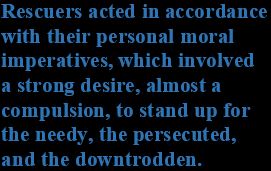
Tec—herself a Holocaust survivor helped by Polish rescuers—identifies six highly inter-related traits of those who became rescuers, including some who were actually anti-semites! 1) An almost marginal status vis a vis their communities, resulting in increased individuality and separateness. 2) Independence and self-reliance allowing them to act on their convictions. 3) Broad and lasting commitment to stand up for the helpless. 4) Consistently denying their actions were heroic, and seeing aiding Jews as a matter of fact thing. 5) Unpremeditated, unplanned beginnings of rescue efforts. 6) Universal perceptions of Jews as helpless and dependent on others, and the ability to disregard all other attributes except those that expressed extreme suffering and need. In other important summary passages, Tec says: “…it was this moral force that motivated the rescuers independent of likes or dislikes…Liking and helping, they knew, did not necessarily go hand in hand…The relative independence, strength, and freedom of these rescuers suggest that they were able to act in accordance with their personal moral imperatives, which involved a strong desire, almost a compulsion, to stand up for the needy, the persecuted, and the downtrodden.”
These sound to me like core values in Jesus’ ministry, values that are often forgotten, buried by our easy, comfort-seeking religiosity. In the dismal history of the pain, the torture, the death we inflict on each other, and our usually feeble attempts to speak out against these, it was good to be reminded that light does occasionally pierce the darkness.
* The other conference committee members were Dr. George Karnezis, Mr. David McGuire, Dr. William Nauman, and Dr. Roger Smitter. Alice Stonebreaker (Arts & Letters), and Lina Ariffin and Jerrie Lea Hopf (Graduate Programs) were also of great assistance to me.
♦ Go to my personal history of significant persons and conferences I helped bring to North Central College.



 Hoagland sees in red wolves and black bears counterparts to the communal and solitary aspects of human nature. But these animals are not part of human nature. They are part of the dwindling natural world, and one of the major catastrophe’s of our time is that nature is being relentlessly wiped out by human nature. Sesame Street‘s Big Bird, says Hoagland, is less bird-like than Bugs Bunny is rabbit-like, and even Bugs is less rabbit-like than either Br’er or Peter. Thoreau found refreshing intensity, vibrant emotion, and comforting stability in the interplay of nature and human nature. How do we find these things now? In these nineteen fine essays—which range in subject from a naturalist’s wanderings and research, to writing, cartoon characters, sports, slavery, pets, divorce, and more—this is the major question. Sometimes he finds answers, sometimes not.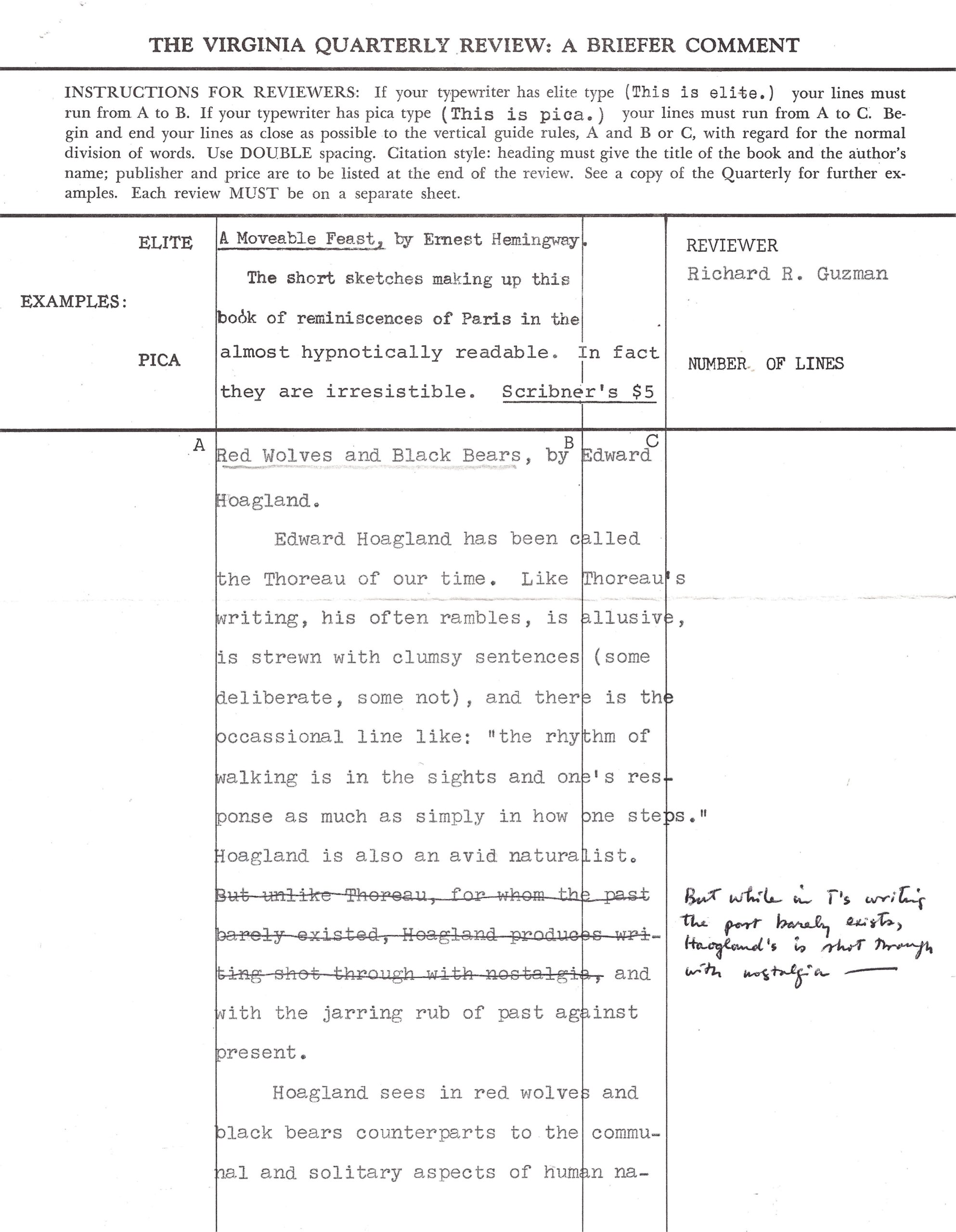

Thinking Globally, Acting Locally?
It’s just five days after Earth Day 2021, the 51st celebration of the event first held on April 22, 1970. Founded by environmentalist Wisconsin Senator Gaylord Nelson—whose many other works included protecting the Appalachian Trail and banning DDT—this year’s Day was, like almost everything else since March 2020, overshadowed by our Pandemic. One of the words of the day is the awkward “politicizing.” Wearing masks, for example, is just beginning to show some signs of not splitting along Republican/Democrat lines, a split which prompted one person to say, “This is as silly as politicizing toilet paper.” But the silliness continues, and reaches into way too many areas of our life.
Earth Day, too, has suffered increasing politicizing, and we’re caught more than ever between so-called Climate Alarmists and Climate Deniers. I used to think that 97% of scientists believed in climate change, but I’m assured by friends I trust that that’s not so, a view espoused by many articles such as Forbes’ “’97% Of Climate Scientists Agree’ Is 100% Wrong,” a 2015 opinion article by Alex Epstein. “If you look at the literature,” writes Epstein,
“the specific meaning of the 97% claim is: 97 percent of climate scientists agree that there is a global warming trend and that human beings are the main cause–that is, that we are over 50% responsible. The warming is a whopping 0.8 degrees over the past 150 years, a warming that has tapered off to essentially nothing in the last decade and a half.”
The opening lines of the brochure read: “The Earth faces ominous environmental threats—global warming, deforestation, toxic wastes, the recent ravages of the Gulf War. What the cumulative effects of such threats?…What do Earth’s people need to do to sustain human society in the future? What cab this college and the community around it do to fulfill Rene Dubois’ admonition for the first Earth Day in 1970 to ‘Think globally, Act locally.’”
These days it seems we’re all out of whack. We’re thinking just locally—meaning our “local” party affiliation vs. yours, our local problems vs. yours, our local set of facts vs. yours, our corner of the globe vs. the globe as a whole. As many have said, The earth is going to survive all we throw at it. It’s going to last far, far longer than humans will.
♦ Go to the lead post in my personal history of significant persons and conferences I helped bring to North Central College.