
Sam Greenlee: Spooks Sitting by Doors

Sam GreenleeBorn in Chicago on July 13, 1930, Sam Greenlee has written poetry, fiction, plays and screenplays, and been a teacher, producer, director and actor.  He traveled the world as a first lieutenant in the U.S. Army in the early fifties, then through a long career as an officer in the U.S. Information Agency where he has served in Iraq, Pakistan, Indonesia and Greece.  These experiences have led to a unique literary vision which deals with race issues in a military and “spy” context, especially in his two novels The Spook Who Sat By the Door (1969), and Baghdad Blues (1976).  Accepting a literary award for the former in 1999, he said, “I had no idea when I wrote the book on the island of Mykonos during the summer of 1966 that one day Black people would call it a classic.”

The Spook Who Sat by the DoorSpook tells the story of Dan Freeman, who tries to climb the CIA ladder after being recruited to work in an elite espionage program.  Blocked and plagued by race, however, he drops out to train young Chicago blacks as Freedom Fighters to spread revolution throughout the U.S.  “Oakland blew first, then Los Angeles, then, leapfrogging the continent, Harlem and South Philadelphia. After years of crying conspiracy, the witch hunters found, to their horror, there was a conspiracy afoot among the black masses.”  In Chicago, the Freedom Fighters “moved easily and silently through the ghetto which offered them affection and support, their coloration finally protective.” Few books have dealt with race, civil rights, and black militancy in so focused and unusual a way, which Time magazine described as blending “James Bond parody with wit and rage.”

It is also a story of a Freeman’s relationship with a woman named Joy, who regarded his “militant idealism and total identification to his race first with amusement, then irritation and finally, growing concern.”  With “no intention of becoming her black brother’s keeper,” she convinces Freeman he can best help Negroes as a Civil Rights lawyer, “join the legal staff of one of the established civil-rights bureaucracies,” “argue precedent-making cases before the Supreme Court.”  But Freeman, after trying that route, says, “Baby, there ain’t no way I can work for those motherfuckers.  They don’t give a damn about any niggers except themselves and they don’t really think of themselves as niggers.

“You ought to hear the way they talk about people like us.  Like, white folks don’t really have much to do with the scene.  It’s that lower-class niggers are too stupid, lazy, dirty and immoral.  If they weren’t around…why, everything would be swinging for the swinging black bourgeois bureaucrats, their high-yellow wives, their spoiled brat kids, and their white liberal mistresses.  Integration, shit!  Their definition of integration is to have their kids the only niggers in a white private school….”

Again, an excoriation the black middle class.  I included passages from Spook in my book Black Writing from Chicago, whose subtitle is “In the World, Not of It?”  You can read my Introduction Here, paying particular attention to the idea that the controversy over how much Blacks should want to be part of “the World”—that is, a society which they have so largely made, but which so virulently shuts them out—boils down to attitudes about middle-classness.  It’s a certain way up and out, but at what price?  This argument, this complex dilemma, runs through the book like, as one critic put it, a “charged current.”

For a February 2005 forum at the Carter Woodson Library in celebration of OBAC (the influential Organization of Black American Culture), Greenlee read a prose poem written for the occasion.  Called “Weary Warrior Blues,” it bemoans the disappearance of “warriors, revolutionaries devoted to a solution of the global pollution of Western Imperialism….”  Almost four decades after Spook, Greenlee’s wit and rage seem undimmed as he casts a suspicious eye towards those who are “doing all right and without a fuss dropped back into the system they used to cuss.”

As a side note, I had done a lot of research for Black Writing from Chicago at the Woodson and went to its OBAC celebration, partly hoping I’d run into Sam Greenlee.  A year before, I had sent him the excerpt from The Spook Who Sat By the Door that I wanted to put in Black Writing from Chicago.  I heard nothing back.  I had created the excerpt by rearranging passages and providing context and transitions using Sam’s words and my own.  “Did you like what I did with Spook?” I asked him after his reading.  “Oh, I loved it!” he said.  I had brought along a copy of the permissions contract I had sent him.  “Well, can I get you to sign this contract so I can put the excerpt in my book?”  “No you can’t,” he said.  “I won’t sign anything.  That’s the white man’s way.  You can put it in the book, but you and I will just have to shake on it right here.”  And so we did.  And so my publisher had to accept a most unusual permission process.

Movie: The Spook Who Sat by the DoorThe Spook Who Sat by the Door was made into a film in 1973.  Distributed by United Artists, with screenplay by Greenlee and Melvin Clay, it starred Laurence Cook and Paula Kelly, and featured music by Herbie Hancock.  In addition to “Spook” being a racial slur against Blacks, the entire title refers to a practice in the early days of Affirmative Action.   When a company hired a Black person, that person would be seated close to the office entrance, so that all could see that the company was “integrated.”  See protagonist Dan Freeman’s expletive above.


  Read Leanita McClain and Barack Obama on Black middle-classness

  Go to a list of Black Writers written about on this site, and to the Teaching Diversity main page.

Posted in Black Writers, Chicago Writing, Diversity & Multiculturalism | Tagged , , , , , | Leave a comment

Ronald L. Fair: “We Can’t Breathe”

May 2020 Update:  Ronald L. Fair: We Can't BreatheAnother “I-Can’t-Breathe” incident. I could not watch the video of the police killing of George Floyd in Minneapolis on May 26, 2020.  But I heard it while my wife described to me what she was seeing: a police man with his knee on the neck of an already-subdued black man.  It was on YouTube.  A few will see these cops as heroes, but just as disturbing will be all those familiar gasps of disbelief: “How can this be happening in 2020?!” —while virtually nothing else will be done.  The article below was originally published on February 11, 2015, and revisited on July 13, 2016.  I could have revisited it many more times in between, and there will doubtless be more “opportunities” to do so for the conceivable future…

____________________

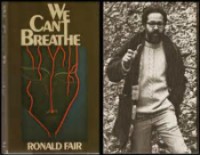
Many Thousands Gone, published in 1965, brought Ronald L. Fair (b. 1932) considerable critical acclaim, and that novel was quickly followed the next year by Hog Butcher.  In 1970 Fair published two novellas as World of Nothing, which received the National Institute of Arts and Letters second-highest prize, and 1972 saw the publication of the autobiographical novel We Can’t Breathe.  For several years, aided by several writing grants, Fair traveled abroad, pursuing a writing life of great ambition.  In the early 70’s critic Shane Stevens called him “one of the two best black writers in the country.”  Yet this promise somehow never came to full fruition.  In 1977 he relocated to Finland, dedicating himself more to sculpture than writing.  In December 1980 he became “born again,” thereafter identifying himself as a “Christian writer” and founding the International Orphans’ Assistance Association.

R.L. Fair, Movie: Cornbread, Earl, and Me Perhaps his most successful book, the novel Hog Butcher revolves around the shooting by Chicago police of an innocent black basketball star, Corn Bread.  This was the basis of the 1975 film Cornbread, Earl and Me, with a cast including Rosalind Cash and a very young Laurence Fishburne.  Though some have commented on the novel’s humor and, in particular, on the energy and courage of the two adolescent protagonists through whom some of the action is seen, the novel is a sobering exploration of social class…and, of course, police violence.  It’s a topic much in the news—again—with the 2014 deaths of Michael Brown in Ferguson, Dontre Hamilton in Milwaukee, Eric Garner in Staten Island, who kept gasping, “I CAN’T BREATHE”….  Besides the many “non-suspicious” shootings by police and others of young black men, there have been at least 29 decidedly suspicious shootings  since 2012—16 of them occurring after Trayvon Martin.   As I revisit this article now, on July 13, 2016—just 17 months after its original posting—the tragedies in Baton Rogue, St. Paul, and Dallas continue to reverberate across the nation, though these usually just result in people being so surprised that racism is still with us.

Rodney-King-like beatings continue as well, and, given Eric Garner’s fate, Fair’s title—We Can’t Breathe—echoes eerily across the nearly five decades since the novel’s publication.  It’s almost too much to keep up with, and we are disheartened to see the pace of these incidents has not slowed.

R.L. Fair, Hog ButcherI included two excerpts from Hog Butcher in my book Black Writing from Chicago, the first excerpt a surprising essay interlude appearing half-way through the book.  It sets the novel’s particular action against a history of social class and the Great Migration of Blacks from the South in the early 20th Century.  It excoriates the pretensions and weakness that, according to Fair, beset many of those early migrants and their children.  “They came to Chicago forty, fifty years ago like a school of black minnows frantically dashing away from danger,” the excerpt begins.  They then

“…shouldered their way in and mingled with the foreigners and fought the aliens for jobs, and won the jobs as they won the negative respect of the established citizens.  They squeezed their way as close to the existing social structure as they were allowed to go, and then they settled back and prospered and raised children and taught their children not to fight, not to resist, but to accept their limited progress as the end of the evolutionary pattern.  They grew weak and mellowed from their success, and their children never developed hearts or shoulders or minds, and were gutless.

“Their children refused to involve themselves with trivial things like politics or social improvements and pulled in the fences that surrounded their tiny ranch houses.  Their children tightened the requirements for entrance into their sick social clubs.  At first they only wanted light skin and straight hair.  Then they added a college degree to the light skin and straight hair.  Then they added a minimum salary.  Then they added the possession of a Buick.  Then they added the Cadillac.  They had arrived; they had reached the top of their limited world and they were scared shitless.”

The second excerpt illustrates that “gutless” history by focusing on Larry Atkins, a Black Chicago police officer close enough to the killing to be a decisive factor in uncovering the truth that is being lost in a clumsy cover-up.  Will Atkins rise to the challenge?  That is the question that occupies much of the book’s second half.  At first, Larry dreams of becoming a teacher, helping kids, uplifting the neighborhood, but he’s worn down by neighborhood crime, he’s shot, he’s knifed.  He gives up.  I end my excerpt with these words:

shitless2“He found himself wanting to be something other than a black man and finally succeeded in convincing himself that he had nothing in common with these people except color, which was purely an accident of birth…He would finish school and he would become a teacher, but not because he was dedicated, not any longer…He would take up teaching because he wanted to break all ties with that animalistic world, and becoming a professional man would make the break final.  This would put him at the very pinnacle of his middle-class society, and he would never look back again.”

The subtitle of Black Writing from Chicago is “In the World, Not of It?  You can read the book’s Introduction, paying particular attention to my idea that the controversy over how much Blacks should want to be part of “the World”—that is, a society which so violently and systematically shuts them out—boils down to attitudes about middle-classness (see below).  It’s a way up and out, but at what price?  (James Baldwin was obsessed with this price.)  This argument, this complex dilemma, runs through my book like, as one critic put it, a “charged current.”  The tragic run of shootings and beatings referred to above have had tens of thousands of precedents which were not caught on film or even live-streamed, as Philando Castile’s shooting was.  The middle-classness that Ronald L. Fair indicts—a condition that besets both whites, obviously, and  blacks—might be moved by our age’s overwhelming video evidence, plus the use of social media by #blacklivesmatter and others.   There’s a slim chance it could move more and more of us to be less gutless in challenging “the World,” instead of just being surprised that it’s still so racist.

Read Leanita McClain and Barack Obama on “Middle-Classness.”

Read Haki Madhubuti on whether Black Men are “obsolete.”

 Go to a list of Black Writers written about on this site, and to the Teaching Diversity main page.  And go to my newer series on Unpacking Racism.


Posted in Black Writers, Chicago Writing, Diversity & Multiculturalism, Featured Posts | Tagged , , , , , , , , , , , , , , | 1 Comment

The Daybreak Team

Daybreak Shelter volunteersSunday, February 1st, saw the biggest snow fall so far in the Chicago area.  The foot of snow—at least!—left us hoping it will be the biggest of 2015.  This winter does not seem—seem—that it will be as brutal as 2014’s, but no one’s saying that out loud yet.

It was my turn to preach at Friendship United Methodist Church in Bolingbrook, IL, our pastor Rev. Kyunhae Anna Shin having asked me to preach on “What is in your hand?”—the question God asks Moses as he prepares to say to Pharoah, “Let My People Go.”  The snow and impending blizzard kept many away, but I’ve spoken and played to smaller crowds!  I may post some text of the sermon later, if I can remember it, but thought I would just comment on one experience I had while preparing to speak:  I realized most of my notes were simply lists of people, especially those who have helped me as I lead Core Group One or coordinate our church’s mission to the Daybreak Homeless Shelter in Joliet.  I thought at first I would just read them from the pulpit, but—not wanting to sound like some awardee thanking an endless list of people—I decided I’d put them in more permanent form here, focusing just on our Daybreak Shelter mission for now.

First of all, thanks to Deji Sanyaolu, our main breakfast cook.  He and Ann Marie Villacorta are my mainstays for that early, early, 5:00 a.m. shift on Saturday mornings.  On Friday evenings I’m almost always joined by Efren Ramos and Bill Tarbell, who know the drill so well they could easily run everything, and often do.  Stacey Caudill often shows up with her girls: Haley, Elise, and Aubrey.   And Jeff Thoreson with daughter Brittany, whose opinions often spark great conversation.  Dawn Callahan brings son Joe, whose sense of humor I always enjoy.  Amy and Greg Hanna are recent regulars. Amy usually winds up holding one of the shelter’s kids.  “A kid magnet,” Greg says, smiling.  Other young people have come, like Efren’s son Anthony, and Kumi Olatunde, who came with Joe Callahan this past January.  Youth in various confirmation classes come, which also means a big thank you to those who bring them, like Pastor Anna, Tom Marsh, Melissa Schoonover.   I also look forward to the Boy Scouts and John McWilliams, whose better half, Donna McWilliams, will be bringing some of her Girl Scouts soon.  My Filipino compatriots like Joy Bernardo, the Corpuz family, the Valdez Family.  I know I must be leaving people out, but go easy on me!  Please let me know if I’ve inadvertently left you out, and I’ll make up for it somehow.  I could name lots of youth, but you can at least see many of them on this video Here.  (The picture above also shows some of those youth.)  The video also shows members from an entire Core Group who came down once.   Our whole choir has come for two Christmases in a row now (thanks, Pam Stephan—who has also come down to help without the choir).

Then there are all who contribute food regularly.  Margaret Hicks is always there with one of our breakfast mainstays.  Once we talked about her retiring, and I said, “But who’s going to step up and bring the hash browns every month!?”  When we first came to Friendship Church, Daybreak was probably the first thing I got involved in, and I got to know so many people calling them about their Daybreak contributions.  I remember especially having long talks with Dave Hargett, and Jody Hargett continues to give month after month.  As do so many:  Paquettes, DeWitts, Shirley Eatwell, Sharon Hall, Kathy Campbell, Kathy Bulman, Julie Verson, Dena Byrd, Audrey Arowolo, Susan Higginbotham—who bought us four large boxes of pizzas recently.  Leonard and Carolyn Jones, Audrey and Paul Miculsik, Chris Mader and Tim Leith.  Carolyn Weber, Jim Steadman, Jane Pierce, Sam Mends, Fern Deatrick, the Lichtys, Lorna Tumamayo.  And welcome to the team, Deborah Marion, our newest contributor.

What do you have in your hand?  I have a lot of helping hands.  Part of my sermon urged us to think about Moses having less in his hand than we do now.  “What is in your hand?” God asks him when Moses says, “Why would Pharoah listen to me?”  His staff was in his hand.  He threw it down as God commanded, and it became a serpent, which turned into a staff again when he picked it up (Exodus 4: 1-5).  We tend to think of this staff and this moment as super powerful things—which of course they are in certain ways.  But not every way.  And not really, in the long run, as powerful as many hands serving together.

 See the Daybreak Service Schedule and feel free to join us.

♦ Learn more about Emmanuel House, Chicago Family Directions, and Feed My Starving Children, three organizations working on issues of hunger, education, and housing.  And read about the crisis of Growing Inequality in America.

♦ Learn about famed homeless advocate Diane Nilan.  Thirty years ago she started what would become the Daybreak shelter.

Posted in Faith, Social Change | Tagged , , , , , , , | Leave a comment