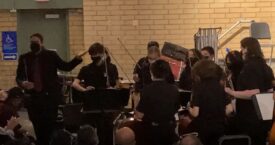





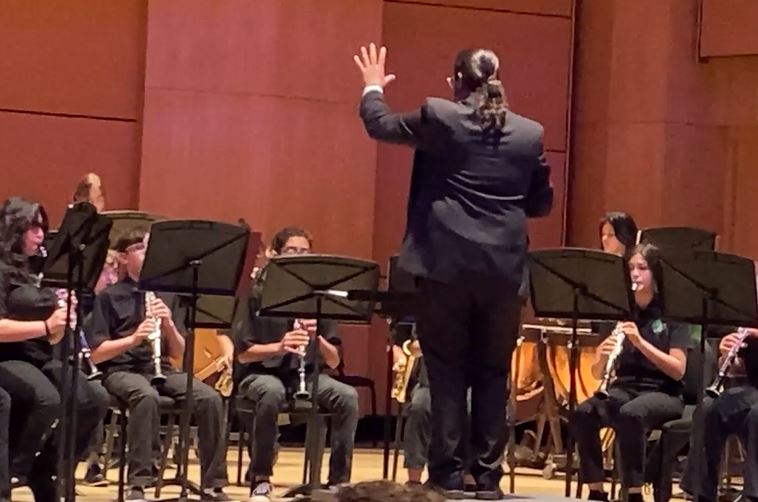
 What a joy it was to be able to attend several performances during one day of the Orchestra and Band Festival of the Riverside Unified School District in California this late March 2024. The 8-minute Video below shows two performances. First, the Gage Middleschool band, conducted by my son Aaron, playing Randall Standridge’s “Fields of Clover.” Aaron has taught in the RUSD for over 20 years, creating a deep, lasting legacy—which brings us to the second performance in the video below: the Poly High School band, directed by Arwen Hernandez, playing Ralph Vaughn Williams’ “Rhosymedre.” “We have to see this,” Aaron said, “because these are my Covid Kids.” It’s a magnificent performance (as is “Fields of Clover”) showing how much you can grow through difficult times. Ralph Ellison, author of the great novel Invisible Man, called the Blues a “technique of survival,” an idea that can be extended to most, if not all, of the arts.
It goes well beyond survival mode, however. It elevates our humanity in profound ways. Elsewhere on this site, in “Beauty in the Time of Pandemic,” I write again about Aaron and another one of his groups that helped build community in the midst of our Covid crisis. In “Art, Rhythm, Intuition, and Social Change” I write about how art helps produce some of the most fundamental characteristics of great leaders. Here I just wanted to say how beautiful it all was, and how profoundly it must have affected all those students playing in the Gage and Poly bands to have created such beauty together. I just wanted to say how meaningful if was for everyone there, both the teachers and the audience, to experience that beauty together with those students.
 We’ve had a small place in Sedona, Arizona, for well over 20 years. There are crystals everywhere, and salt baths, and studios for taking pictures of your aura. Most of all there are vortexes, special places on the earth where the universe’s cosmic energies align in special ways. The Great Pyramids is a vortex spot. Machu Pichu is too. And Sedona supposedly has more of these than any place on earth. I was once up on Bell Rock—a mountain our family calls Bryan’s Mountain—when an Italian man asked me, “Is this the vortex?” Yes, I replied, and he burst into tears, sobbing, “I knew it. I knew it.” I’ve gotten somewhat adjusted to Sedona’s New Age loopiness, and don’t necessarily disbelieve, but when people ask me about cosmic alignments, I usually say, Well all of this could also be explained by beauty. Sedona is just beautiful. The beauty both stuns you and gives you a sense of peace and oneness. On his first visit, my brother Joe, who had suffered insomnia for years, woke up his first morning there at 9:00 a.m. profoundly rested. “What the hell just happened?” he said. Could have been vortexes, but for sure it was beauty. In my over-40-year career in college teaching I often asked my students why they were there in the first place. A great education gives you many things, I would say, but to access its real depth ask yourself two questions: Do I have a greater hunger for beauty? Do I have a greater passion to serve. Beauty in the widest sense, and serving, too, because these are deeply interrelated. So justice is beautiful, and serving to help turn injustice to justice is beautiful.
Beauty is in the eye of the beholder, the old saying goes, which doesn’t mean that the beautiful is totally relative just because it’s deeply personal. For me the two pieces below were beautiful not just as music, but also because I got to see one of my sons conduct and got to see his legacy in the high school band later that afternoon. He’s a beautiful conductor as well, fluid and graceful, and I especially liked when his left hand flashed fully open to coax a swelling, blossoming sound from his band. More than that, his daughter Grace, our granddaughter, helped highlight their band’s performance when she played the opening clarinet duet in “Fields of Clover” with first clarinetist Desiree Vargas. She’s just in 7th grade but is in advanced band already and loves it so much she wants, she says, to be a music teacher like her Dad. What a beautiful moment when, at the end of “Fields of Clover,” he has both Desiree and Grace stand. He tries to get his French Horn player to stand, too, but that student, says Aaron, is usually off in his own world, and Aaron just smiles and takes a bow for everyone.