Father Mike Pfleger and Other Gospel Extravaganza Memories

Father Mike Pfleger

Father Mike Pfleger in a typical pose: protesting!

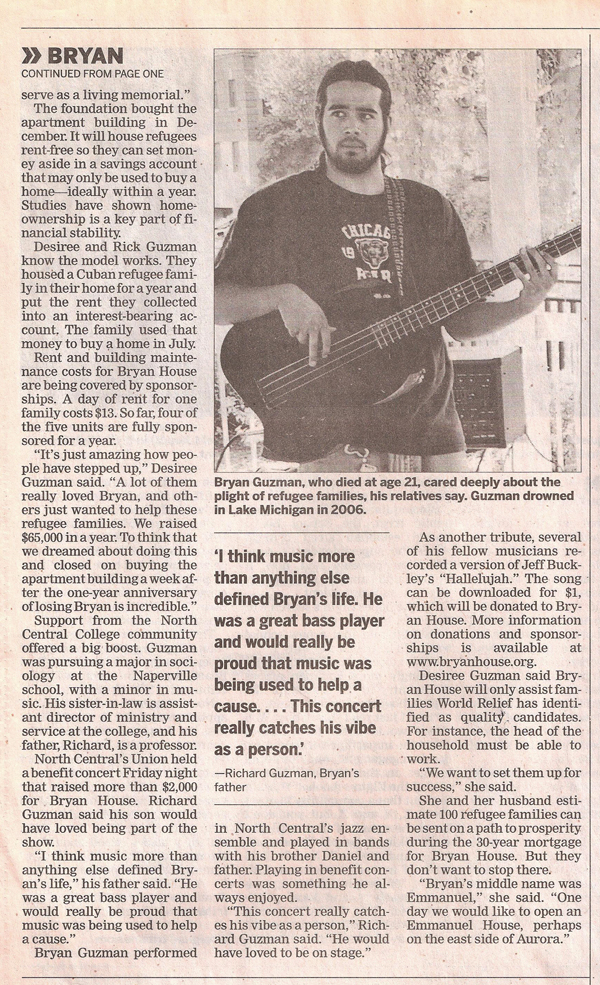
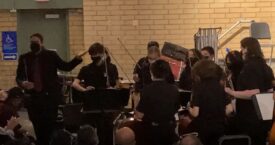
Saturday, January 26, 2013, North Central College:  the 25th Anniversary concert of the Gospel Extravaganza, an event I helped start that many years ago.  My cell phone went in and out of my pocket all evening, partly because my wife Linda kept nudging me all-concert long: “Hey, why aren’t you filming this?” “Hey, you’re not getting this?  What’s wrong with you!?”  But I was too caught up in the moment.  Anyway, in the end the phone managed to capture only about 25% of how the music sounded (if you plug in to speakers or use headphones), but only  5% of the electric spirit in the room no matter what you plug into.  Like trying to capture the Grand Canyon in a single, point-and-shot photo—but, still, it’s something.  Go HERE to see my 4.5-minute version of the 2.5-hour concert.

“You were the only faculty who gave us support, who believed in us,” said Harold McCadd to me this year.  He was one of the leaders of a group of students who, a little more than 25 years ago, had actually put a gospel concert together at the Community United Methodist Church down the street.  I was in the middle of building the college’s Cultural Events program at the time, and when I went to see it at the church and felt the energy of their praise, I told the students it would be a college event and in Pfeiffer Hall from now on.

It’s always drawn hundreds of people, and I think in its earliest days we must have topped a thousand  a few times—which makes it one of the largest events that still remains essentially on the margins of the college’s consciousness.  (How serious are we about “diversity,” really?)  At least Pfeiffer Hall always seemed jammed, seemed standing-room-only.  At the second or third Extravaganza everyone was clapping, dancing, shouting, jumping so hard, I swear  I saw the Pfeiffer balcony move.  “Oh, no, oh, no,” I thought, but everything held together—kind of.

“Oh, no,” you’d hear regularly at every concert. “Oh, no.  Somebody’s getting blessed.”  And someone in the choir or in the audience—sometimes many ones—overcome by emotion, caught up in the atomic energy of praise, would start trembling, would even pass out: “slain in the spirit,” some call it.  At the third Extravaganza one of my abiding memories is when two white men, both with short-cropped hair and skinny ties, came with erratic, trembling steps down the right center aisle and fainted at the foot of the stage, where Tracy Smith—now Dr. Tracy Smith-Malone, a district superintendent in the United Methodist Church—looking slightly annoyed, fanned them with a program until they came to.

Father Mike Pfleger, famous for his activism and pastoring at St. Sabina’s in Chicago, was one of our earlier supporters.  At the second or third Extravaganza he was supposed to do the opening prayer, but had been arrested earlier that afternoon for defacing billboards in his neighborhood, billboards that targeted the black population with higher-tar cigarettes, higher-alcohol-content beers.  It was a half hour past starting time, and I was going to go out and do the opening prayer myself when the alley doors to Pfeiffer flew open and in he walked.  “How’d you get out?” I asked.  Everyone knew he was guilty.  He just smiled and, looking around back stage,  said, “Where’s the organ player? Can’t pray without an organ player.”  I rushed upstairs shouting, “Someone get down here to play for Father Mike, or I’ll do it!”  After some loud rustling, Eldred—so large, and such a great musician—was in place.  As I went out to introduce Father Mike, he grabbed me by the shoulder.  “Remember,” he whispered, “put the mic down on the floor in the center of the stage.”

I gave short welcomes, gave Father Mike a short intro, then, “Here to lead us in prayer!  Father Mike Pfleger!”  Mike Pfleger is an Irish Catholic, blonde hair, bright green eyes.  But it could have been James Brown who rushed past me, slid on one knee, and swooping up the mic and jumping two feet off the ground in one motion, landed, shouting, “The Apostle Paul taught us how to understand our salvation!  But!  David!  David!  David taught us how to P-r-a-a-a-a-i-s-e!”  “To Praise! To Praise!” he shouted over and over, the crowd instantly at a fever pitch, on its feet, shouting, “To Praise, To Praise!” back at him, antiphonally, everything on the brink of bedlam.  This before the first musical act had even made it to the back wings.

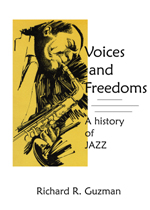
Gerald McCadd, Harold McCadd, Richard Guzman

The McCadd’s and me: three of those who started the Extravaganza 25 years ago.

“When we pray we ask God this, tell God that, but it’s praise that moves the world.”  That’s what I said at the beginning of the 25th Anniversary concert.  I was slightly less animated than Father Mike—LOL—but could have meant it almost as much.  “Tonight,” said Rev.  Chris Druce Jones, our host for the evening, “this is a Tabernacle of Praise,” a sentiment echoed over and over for, now, 25 years.  There’s no denying it’s quite a show.  But everyone has been super anxious over the years to say that it’s much more than a show.  It’s church—church in the broadest sense—whether you’re a believer or not.

For the first Extravaganza the students brought me a proposed poster that had “JESUS IS THE ONE!” arching across the top half, and “Gospel Extravaganza” in smaller, straight print below.  I suggested we reverse it.  “Dr. Guzman,” someone said, “are you putting our Lord in second place?”  No. No.  I explained that Gospel Extravaganza was a broader term, suggesting that everyone, believer or not, Christian or not, was welcomed in.  “Jesus is the Lord of all, even if people don’t know that,” I said.  It seemed to satisfy them, though I got plenty of second, sideways looks for weeks.   I still get them.

Thanks to the many, many people—especially the students—who have kept the Gospel Extravaganza going and vital for 25 years, for I myself have not been actively involved for a while.  Lynn Pries, college chaplain, has been the event’s chief advisor the last few years. It usually happens the last Saturday of January, and we’re already looking forward to next year, the 26th iteration.

The music is wonderful, something everyone should experience at least once.  It’s not only skillful and infused with incredible energy, but shot through with hope and belief—or at least the burning, tempest-laden desire to believe, to hope.  Out of many highlights this year was the song featuring the lead male singer of the DuPage African Methodist Episcopal (AME) choir.  “Speak.  Speak,” he intoned, the choir echoing the word behind him.  I felt immediately the power of the image of God speaking, and the world being created thereby.  “Whatever it is.  Speak.  Speak.  Speak it to the atmosphere.  Speak it to the atmosphere.”  A burning desire to believe that someone will hear, that some saving, creative thing will come into being.

Posted in Diversity & Multiculturalism, Faith, Music & Meaning | Tagged , , , , , , | Leave a comment

Remembering London – Part 4: Nationalism and Cheese

Monty Python: The Cheese Shop

Monty Python’s famous Cheese Shop. Watch it HERE.

At the northeast end of Hyde Park is Speakers’ Corner where on Sunday afternoons an assortment of crazies and true believers hold forth in exercises of free speech.  The British cherish these as symbols of their democracy, even as they see most of it as silly.  On a recent Sunday afternoon the silliest person I saw wore a white Panama hat and the British flag as a cape.  In one hand he held a wine bottle and a corkscrew with the cork still on it, in the other a smoldering cigar.  Rambling on and on about Bob Marley and buffalo soldiers, he drew a crowd that heckled him with laughter and obscenities.  Ten yards down the walk Tony Allen, apparently a favorite at Speakers’ Corner, stood on the bottom step of a small aluminum ladder, a chalkboard fastened to the front proclaiming him “Advocate Heckler—Anarchist Parasite—Mixed-Ability Shaman—www.newagenda.co.uk.”   Just across from him a fiery socialist standing on the middle step of a wooden ladder had drawn by far the biggest crowd, though during the first moments I saw him he had gotten himself tangled in an unfortunate twist of logic, both semantic and political, trying to defend his assertion that while England was an imperialist nation, China was not.

Muslims at Speakers Corner, LondonI went to school at the University of California, Berkeley, arriving in the late 60’s at the tail end of the Free Speech movement and leaving with the Cambodia crisis and the killings at Kent State.  When it wasn’t thick with tear gas, its central plaza, Sproul Plaza, was always thick with speakers and pamphleteers, so Speakers’ Corner was almost too familiar, especially the earnest bombast of the socialist.  Yet for all the politicos at Berkeley, I most remember two religious speakers.  Parking himself at the south end of Sather Gate, the university’s main entrance, and, standing still, Holy Hubert thundered hell fire, while Isaac the Satanist, dressed in black, strode a five yard stretch back and forth at the north end discoursing more softly about his Father.  Together they achieved a curious and ultimately cherished religious ying/yang, one preaching salvation from damnation, the other salvation through damnation.  The religious speakers at Speakers’ Corner were not nearly so balanced.  One bellowed about his personal relationship with Jesus, another proclaimed the true meaning of the Koran, both, like all the religious I saw that day, exuding a presumptuous, irritating purity that made holiness something bitter and prideful.

A speaker at Speakers Corner, LondonMy favorite speaker drew virtually no one at all.  He had a shy, beseeching look, partly because he had the most precarious perch of all.  About nine inches off the ground, made of a small 1×8 board balanced on two stacks of small 2×2 wood pieces, it reminded me of every wobbly thing you ever made with Lincoln Logs.  To steady himself he had to lean against a fence, which only seemed to add to his unease.  Two feet to his left someone had tied a white plastic trash bag to the fence to which people came to deposit miscellaneous garbage, thereby creating the illusion that some had straggled near him to actually listen.   Gripped in his right hand was a cardboard box he had cut so that it unfolded into a poster about 3 feet long, and on which he had written:

Say no to European Union
The New World Order And the United Nations
Are evil
Capitalism and Socialism
Are Bad
Religion & Secret Societies Want Power
The Labour Party Is Anti-English because it
Wants International Law Above British Law
All British Television Radio and Newspapers Lie
FRIEDRICH NIETZSCHE Said become the Ancestors
Of the SUPERMAN
And a Free Spirit Thinks Differently
From What On The Basis of His Origin
Environment Class etc. Would Be Expected
Support Animal Rights
Organic Farms & Nationalism


During the Vietnam War I knew several literary types who refused to chant “Hell No, We Won’t Go” because they thought it was just bad poetry.  I admired this speaker for his diffident refusal to stick to just one line, and of all the speakers he was actually the most current, especially with his “Say no to European Union.”

In late September the Danes gave the European Union a thoughtful blow as it voted down adopting the EU’s proposed currency, the euro.  Some think the Swedes will follow suit.  I judge that at least 70% of Londoners loathe the idea of giving up the pound, and even in Germany—the euro’s greatest backer—a recent poll showed 66% saying they’d just as soon keep the deutschmark.  Few people express enthusiasm for the currency, but there’s a lot of campaigning for it coming from somewhere.  In France there are posters showing the proposed euro currency and the caption, “Your Future. Our Future.”  Many receipts now give the price in francs and what it would be in euros.  An October 28th receipt of mine carries the information that “1 EUR = 6,55957 FRF,” so that my bill of 179,00 francs would be just 27,29 euros.  Still, the feeling is that most everyone would be in favor of keeping to their own, and not just regarding currency.

On an early October Sunday I and some of my students joined a group called Philosophy For All for a hike around the Boxhill region in the village of Westhumble,  just outside the southwest border of London—London’s “Lover’s Lane,” I was told.  A largely liberal group, many of its members expressed initial enthusiasm for the European Union, an enthusiasm which waned considerably when it got down to specifics.  Cheese, for example.

The European Union will call for more uniform standards imposed across a wide variety of areas—law, currency, pension funding, etc.  “The French probably think their cheese is the best in the universe, so don’t tell me they won’t try to impose their standards on our cheeses,” said a fellow hiker as we stepped through the classically lovely English countryside.  I had just mentioned that Monty Python’s “The Cheese Shop” was one of my favorite pieces of comedy, the joke being that a man goes into a cheese shop desperate for cheese only to discover slowly, torturously, that the shop has no cheese whatever (see link above).  It is a minor goal in my life to taste each one of the 43 or so cheeses he reels off in an attempt to purchase any morsel he can, and I had just had my 19th of the 43, a piece of Red Leicester I got at Vincent House.  “But we want to keep our cheese just as it is now,” our fellow hiker said.  “It’s pretty good if you ask me, and we want to sell it to our own people in our own way and for the price we want to sell it for.”  So add cheese to the many, many things the European Union may be stumbling—or choking—on.


Posted in Diversity & Multiculturalism | Tagged , , , , , , , , , , , | Leave a comment

MLK Jr: Conquering Racism, Militarism, and Economic Exploitation

Martin Luther King, Jr. portraitOn April 4, 1967, Martin Luther King, Jr. delivered a speech at New York’s famous Riverside Church.  Giving it the title “Beyond Vietnam—Breaking Silence,” King called for “radical departures from the destruction of Vietnam.”  He had been moving towards this speech for two years, “[M]oved,” he said, “to break the betrayal of my own silences and to speak from the burnings of my own heart.”  But over those two years he faced resistance, perhaps most strongly from many of his own supporters, who urged him not to join those protesting the Vietnam War.  It would, they felt, endanger his drive for Civil Rights—and, in the short term, they were right.  The day after the speech the Washington Post declared that King had “diminished his usefulness to his cause, his country, his people,” and Time magazine denounced him as a puppet of Hanoi.

From this distance we now marvel that his supporters did not see a connection between peace and Civil Rights.  King, however, saw not only the connection between these two clearly, but to one more thing as well. He called for a “Revolution of Values,”  saying, “When machines and computers, profit motives and property rights are more important than people, the giant triplets of Racism, Militarism, and Economic Exploitation are incapable of being conquered.” Perhaps—perhaps—we have gained some insight into the connection between Racisim and Militarism, but it seems we are only dimly beginning to grasp an important economic connection.  “A true Revolution of Values,” said King, “will soon look uneasily at the glaring contrast between poverty and wealth…and say ‘This is not just.'”  If we are beginning to feel uneasy about the corrosive effects of the enormous, growing wealth disparity in the United States—greater today than at virtually any other time in our history—then we can say we’re only about 46 years behind King’s vision.

Eerily, on April 4, 1968, just hours before the exact moment he began his Riverside speech a year earlier, King would die on the balcony of the Lorraine Motel in Memphis.  The year left to him after Riverside was discouraging.  His power to move large segments of the people of his day would never be quite the same.

On April 16, 1967, King delivered a sermon at the Ebenezer Baptist Church in Atlanta, a pulpit he shared with his father.  Based on the Riverside speech he had given 12 days earlier, and now called “Why I Oppose the War in Vietnam,” the sermon is, in my view, one of the greatest, stinging, prophetic sermons of all time.  Miles away from the warm fuzzies we now feel when we hear “I have a dream,” this sermon—in retrospect perhaps his most courageous statement—deserves to be heard as the truest counterpart to his iconic speech.

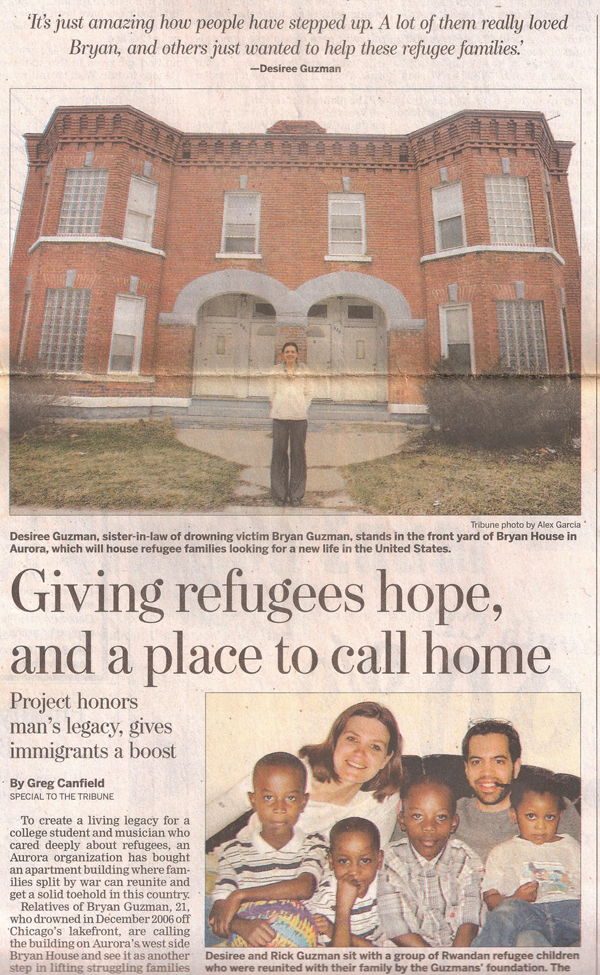
Martin Luther King, Jr. - Why I Oppose the War in VietnameIn 1970 Motown Records, under its Black Forum label, had released the record Dr. Martin Luther King, Jr.—Why I Oppose the War in Vietnam, produced by Junius Griffin, and with a wonderful black, blue, and white cover by Curtis McNair.  I found the record about fifteen years later in a cut-out album bin in Chicago, and had been listening to it a lot as our nation made its frenzied run-up to invading Iraq, a move so many of us felt was wrong for so many reasons.  The WMD argument seemed weak at best, and we realized that invasion would further destabilize the uneasy balance of Sunni and Shi’a, a present-day imbalance that has caused endless misery and threat.  An Afghani professor, visiting one of his relatives our family foundation, Bryan House, had helped, begged me at dinner one night to tell the President—as if I really had that kind of voice—not to go adventuring into Iraq but to stay and help Afghanistan truly rebuild.  “You will,” he said, “be compromising the futures of two countries.”

But any counter voices seemed so feeble, and the few actual street protests so thin compared to Vietnam protests.  Of course, there was no time to get anywhere near as big.  We blinked and were suddenly at war again.  Feeling the inevitability of war, the ineffectualness of protest, I somehow found the record of King’s sermon again and listened to it over and over.   Daniel was home a lot at that time, too, and began listening as well.  One day I heard him playing his unique brand of blues and folk as he listened to King’s sermonizing.  Just days before, I had taken samples from the sermon and been layering them, and when I heard Daniel’s music, I knew immediately how well it would fit underneath it all.  The resulting four-minute song managed to capture, I feel, the essence of the 45-minute sermon.  With war coming, I knew it wasn’t much, but was still something at least.  Today it can continue to remind us of how much a prophet King truly was, and how his day should be viewed less as a holiday and more as a reminder of how far behind him we still are.

  • To hear our song—layered samples riding over layered blues, drone, and folk—go HERE.
  • Read more about the Growing Wealth-Gap in the United States, one of the most disheartening and dangerous trends in America today, and about Emmanuel House, named one of “The Top 100 Most Innovative” social change organizations in the world for it’s efforts to deal with the growing wealth gap.

We first played the song on February 12, 2003, at a reading organized at North Central College by my colleague Dr. Jennifer Jackson.  The event—part protest against our looming intentions in Iraq and part in reaction to the White House’s cancellation of a celebration of American poets—was called “Poets Against the War.”

Below is what part of Melissa Franic’s report looked like in the Naperville Sun on February 14, 2003.

Poetry and Protest by Melissa Franic


Posted in Faith, Music & Media Podcasts, Social Change | Tagged , , , , , , , , , , , , , , | Leave a comment