

The Neighbor Project Challenge: BE the Neighbor

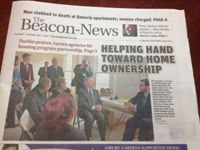
TNP-Logo1May 11, 2019.  Just a year after Emmanuel House and The Joseph Corporation merged to become The Neighbor Project, the new organization held its very first Gala fund raiser in one of Aurora’s newest premium venues: Bureau Gravity, just across the street from Emmanuel House’s first headquarters.  The VIDEO below shows a few minutes from this wonderful evening, complete with—in addition to a great dinner—live art, live music, a live auction…and a unique challenge.

On the Emmanuel House page on this site, I spoke of helping 20-30 families a year, but of being poised to triple that number.  The merger made that tripling a reality, creating an organization that went far beyond what the two could do separately.  In its first year The Neighbor Project saw nearly 100 families start on the path to home ownership, plus dozens more saved from being foreclosed on in the house they already lived in.  It was truly something to celebrate.

TNPgala1Catherine Tilley Design did live art.  Coming into the venue’s main third-floor space, you saw her and an assistant busy painting a mural containing some answers gala attendees gave to the question, Who is my neighbor?  Then near the end of the evening, the two painters began peeling away what they had just created!  What was going on?  As Rick Guzman, The Neighbor Project’s executive director, spoke of The Neighbor Project’s birth, its goal of giving hope to families, and how unleashing their potential made not just them but all of us better people, the two painters peeled away what we thought was a finished work to reveal a mural reflecting the evening’s major challenge.  “Be the change you want to see in the world,” Gandhi famously said.  So we must go beyond even “Love thy neighbor” to actually “Be the neighbor,” a much more complex, transformative challenge.

You can see them painting, then revealing “Be the Neighbor” in the VIDEO below and catch a glimpse of Rick’s message, too, a message where he echoed some words he spoke when he first introduced The Neighbor Project a year ago—especially: “We ignore our neighbor’s promise and potential at our own peril.”

OurPerilThe live music from Violetta and Lucas featured a range of songs, and I was heartened that the young duo did many songs from the Great American Songbook: “How High the Moon,” “The Nearness of You,” etc.  The music’s safe in these young hands, I thought.  It was a thought doubly reinforced when we heard from Joseph and Angeline, two young people whose growth and future took off when their parents were able to buy a home with Emmanuel House and The Joseph Corporation, who were long-time partners before they merged.  Joseph is now a college grad with a finance degree and property of his own, while Angeline got her CNA even before graduating from high school and is now off to college for her full nursing degree.

Then the live auction, always entertaining, especially because of our auctioneer, the fabulous Peter Burchard!  There’s a few seconds of him extracting the highest bid of the evening, but what’s not shown in the VIDEO below is perhaps the most moving moment of fund raising that evening.  Just as he did in early April last year when Emmanuel House held its own gala, the final event it held as Emmanuel House, Peter simply asked people to give more. “Rick, how much does it cost to put a family through The Neighbor Project program?” “$5000,” Rick answers.  “How many people would pledge $5000 to put a family through the program?” Peter says.  Three people raise their hands.  More raise their hands at $2500, more at $1500, even more at $1000.  They’re not bidding on anything, not going to get anything but the joy of giving.  Peter Burchard is touched, on the verge of tears.  Perhaps it’s a sign that these, and many others there that night are actually on their way to Being The Neighbor.

Go to The Neighbor Project website, and to the Emmanuel House website for more information, and (on TNP’s site) to watch an intro video.

Posted in Music & Media Podcasts, Social Change | Tagged , , , , | Leave a comment

Robert S. Abbott: Champion of “The Race”

Robert S. Abbott

Robert S. Abbott

In 1905 Robert Abbott began one of the biggest return-on-investment acts of his day: he invested 25 cents to issue 300 copies of his newspaper The Chicago Defender.  Eventually this two-cent weekly paper—which he heralded as “The World’s Greatest Weekly”—made Abbott one of the first self-made Black millionaires.  It became the most widely circulated Black newspaper in American history.  At its height in the 1930’s the paper—bought, passed hand-to-hand, smuggled into the South—is estimated to have had a weekly readership of over 500,000. It was as major a vehicle as our country has ever had for a radical, heads-on attack against the evils of racism.

Robert Sengstacke Abbott (1868-1940) was born on St. Simon’s Island, Georgia, attended Hampton Institute in Virginia, and Chicago’s Kent College of Law, from which he graduated in 1899.  Unable to practice law because of race prejudice, he turned to the newspaper trade which he had learned at Hampton and from his step-father.  In 1940 Abbott’s nephew John H. Sengstacke took over the paper and continued its championing of full equality. It became the Chicago Defender Daily in 1956, and though its circulation has dwindled and the company has experienced some hard times, its history and influence Abbott-Defenderremains vital.  In fact, it is perhaps impossible to exaggerate the Defender’s influence. Running editorials, cartoons, and train schedules, for example, the Defender helped fuel the Great Northern Migration, which brought over a million Blacks north, over 100,000 of them to Chicago.  And though it practiced its own kind of yellow journalism it was a major outlet for some of the most influential Black writers and thinkers in America, including Langston Hughes, Gwendolyn Brooks, W.E.B. DuBois, Arna Bontemps, Walter White, and many others.  Reading a collection of letters between Hughes and Bontemps, it was easy to notice the Defender being mentioned more often than any other site of publishing   Its success eclipsed The Broad Ax, The Conservator, and The Illinois Idea, though these other important black Chicago papers deserve mention as well.

In a major review of my book Black Writing from Chicago for Time Out Chicago, Jonathan Messinger spent considerable time on my Chicago Defender selections. He wrote that I had “…included pieces that would otherwise now be inaccessible to contemporary readers.”

“Take, for example,” he continued, “two selections published in the Chicago Defender during the newspaper’s early years.  In an editorial from 1917 headlined ‘Keep Your Mouth Shut, Please!’ the editors exhort new residents to keep their voices down on city buses and trains.  The editorial reads: ‘Cut this out, dear reader, and whenever you see one talking loudly hand it to them.’  It’s a tasty bit of old-school newspaper belly-aching, but it’s also an extension of the Defender’s leading role as a voice of the ‘Great Black Migration,’ when the paper circulated nationwide and printed train schedules to facilitate the movement of blacks from the South to the North.  A few pages later, though separated by nearly 30 years in the paper’s history, Langston Hughes satirizes a similar social problem in one of his popular ‘Simple Stories’ columns, featuring the comic character Jesse B. Semple.  Jesse is perturbed at the amount of grease people put in their hair: ‘…there ought to be a law against people with greasy heads going around leaning them up against people’s walls and spotting them all up.’  It’s to Guzman’s credit that he included both of these.  Though they seem to address frivolous topics, they also encapsulate the different ways literature can speak to social concerns in the space of the same newspaper.”

The major theme running through Black Writing from Chicago is expressed in the book’s subtitle.  It’s a question, “In the World, Not of It?”—pointing to a historic, long-running debate among black writers and intellectuals: given our nation’s deep, persistent racism, how much could blacks really hope to be a fully integral part of the wider American world?  And how much should they want this in the first place?  Complex stances and opinions about these questions flowed across a wide, contested spectrum during the Defender’s heyday, and they continue to flow perhaps even more intensely today. The Chicago Defender manifested this complexity and intensity as much as any publication ever has.  On the one hand it expressed a radicalism that demanded full equality and, perhaps, integration.  Yet its habit of referring to African Americans not as “Blacks” or “Negroes” but as “The Race” maintained a strong separatism.

In 2017, Robert Sengstacke Abbott was elected to the Chicago Literary Hall of Fame.

Defender-Hansberry case  Go to the article “Lorraine Hansberry: The Battle for Fair Housing,” and to a list of Black Writers on this site.


Posted in Black Writers, Social Change, Writing | Tagged , , | Leave a comment

Willard Motley: His “Race”

In the Afterword of my book Black Writing from Chicago, after I apologize first for not including the great novelist Leon Forrest, I apologize second for not including Willard Motley.  I wrote: “Among other worthy novelists that could not be included is Willard Motley.  The opening pages of We Fished All Night is one of the finest evocations of Chicago’s Loop, and his most successful novel, Knock on Any Door, likewise contains brilliant passages rendering Chicago atmospherics as well as any writer ever has, including Nelson Algren, with whom Motley is often compared.”

MotleyThe Chicago Defender published Motley’s fiction when he was only 13 years old, and Robert S. Abbott himself hired him to write a weekly kids’ column called “Bud Says” under the pseudonym “Bud Billikin,” after the famous parade and picnic still going strong today.  Besides Knock on Any Door (1947), and We Fished All Night (1951), Motley wrote two other novels: Let No Man Publish My Epitaph (1958), and Let Noon Be Fair (published posthumously in 1966).  Born in Chicago in 1912, he died in Mexico City in 1965, aged just 52, of intestinal gangrene.

Despite an early family life of mixed up identities—as a youngster he believed his grandparents were his parents and his mother his sister—that life was steady and full of important role models, including his grandfather, who was a Pullman Porter.  Living in the then mostly white neighborhood of Englewood, he also had few hostile interactions with whites, a situation, we suppose, that made it more normal for him to write mostly white characters.  In fact, Nelson Algren—a good friend, mentor, and early editor—once said Motley “wrote about white people for white people.”  To the accusation that he avoided race, Motley famously replied, “My race is the human race.”  But although race was a relatively minor concern in his novels, these did touch on many social issues, some—like white poverty in Knock on any Door, PTSD in We Fished All Night, and the exploitation of Mexicans in Let Noon Be Fair—which occupy headlines to this day.

Motley-Race2In our 1999 book Smokestacks and Skyscrapers: An Anthology of Chicago Writing, David Starkey picked an excerpt from Knock on Any Door, which basically follows the descent into crime of Nick Romano, an Italian American and former altar boy.  Convicted of killing a cop, “Pretty Boy” Romano—whose motto was “Live fast, die young, and make a good-looking corpse”—becomes something of a media star before he is finally electrocuted.  The novel was an instant success, selling over 47,000 copies in its first three weeks on the shelves, and eventually spawning a movie starring Humphrey Bogart and John Derek.

In an unpublished introduction to Knock on Any Door, Motley outlined his aesthetic: “the writer approaches his subject matter—his fellow man—in humility and understanding, in sympathy and identification.  And he tries—only the serious writer knows how hard—to tell the truth, frankly and unshrinkingly.”  This truth-telling, from Motley’s point of view, garnered less and less praise in succeeding novels, which readers and critics often characterized as grim and hopeless.  Motley, a conscientious objector during the war, was particularly sensitive to the effects of war on both returning vets and the civilian population, a theme grounding We Fished All Night, where he follows the descent of three protagonists from before their induction into the army and through the years immediately following WWII.  It is a vision of individuals, and the entire population, becoming hardened and less tolerant of diversity and dissent.

Motley-FishedIn 2014, Willard Motley was inducted into the Chicago Literary Hall of Fame, the citation reading, in part: “Motley was criticized in his life for being a black man writing about white characters, a middle-class man writing about the lower class, and a closeted homosexual writing about heterosexual urges. But those more kindly disposed to his work, and there were plenty, admired his grit and heart…Chicago was more complicated than just its racial or sexual tensions, and as a writer his exploration was expansive….”  And beautifully written.  Here’s a small passage from the larger Knock on Any Door excerpt David Starkey selected for Smokestacks and Skyscrapers.  It’s about the famous Maxwell Street Market, near which Motley settled when, after traveling the U.S., he returned to Chicago in 1939.

“Before him [Nick Romano] stretched the Maxwell Street Market extending between low, weather-grimed buildings that knelt to the sidewalk on their sagging foundations…On the stands were dumped anything you wanted to buy: overalls, dresses, trinkets, old clocks, ties, gloves—anything…There were still other rough stands—just planks set up across loose-joined wooden horses: hats for a quarter apiece, vegetables, curtains, pyramid-piled stacks of shoes tied together by their laces—everything…The noises were radios tuned as high as they could go, record shop victrolas playing a few circles of a song…men and women shouting their wares in hoarse, rasping voices, Jewish words, Italian words, Polish and Russian words, Spanish, mixed-up English. And once in a while you heard a chicken cackling or a baby crying.”

Go to lists of Chicago Writers and Black Writers (mostly from Chicago) on this site.

Posted in Black Writers, Chicago Writing, Writing | Tagged , , , , , | Leave a comment