
Guzman for Aurora: Leverage and Opportunity

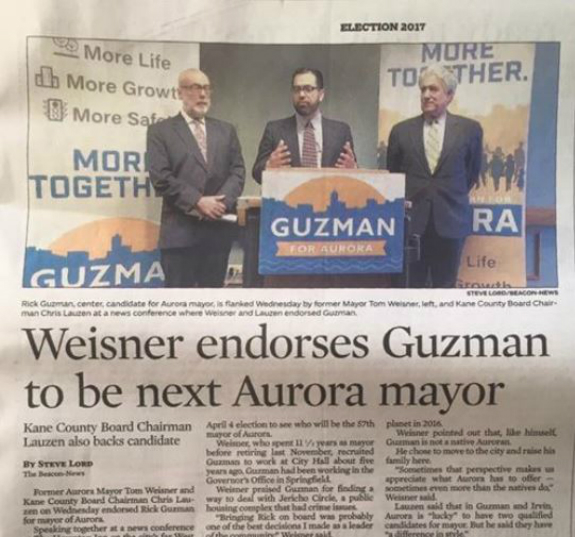
guzman-for-auroraBelow are links to articles and videos on this site about Rick Guzman and Guzman for Aurora, the organization promoting his run for mayor of Aurora, Illinois, the state’s second largest city.  A biographical sketch also appears below.

But before the links and bio, some words from his campaign website, words which capture my eldest son so well, I’ll just add the following for now.  In our family we’ve often laughed at Rick for being so cheap, and marveled at how he’s able to find the best deals for everything…always! From tooth paste to mortgages he’s always turning a dime into a dollar. In an executive position, that translates into being able to do more with less, one of the big themes on the campaign website.  Another of Rick’s favorite words is “leverage.”  He’s always leveraging this to get that, making the most of every opportunity, so that even if the opportunity is small, many small ones eventually start adding up to something big, even huge.  For example, go to the first link below to find out how he got a 70 to 1 return on investment for Aurora city funds.  But while he’s “cheap” with money, he’s expansive with people.  He values every person’s life and human potential.  This has made him a brilliant bridge-builder and collaborator who turns the cliche “Bringing Us Together” into powerful realities.  Professor Tom Cavenagh, one of his college mentors, has said, “He was a splendid student, and is now, as he was then, a man of principle and conviction. Any city would be blessed to have him as its leader.”

Guz4Aurora-MORE2The Guzman for Aurora website says, in part:  “Rick Guzman’s campaign for Mayor of Aurora is about what happens when the limited resource of local government meets the unlimited potential of community…It’s about recognizing that every resident is a resource and every voice is valuable.  We’re voting for more progress and more participation. We’re voting to make Aurora more itself.

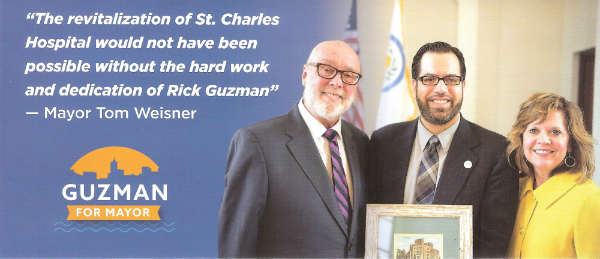
WHY RICK?   Doing more—with less. That’s been his focus for 15 years of executive leadership.  As Assistant Chief of Staff to Mayor Tom Weisner since 2011, Rick’s creative solutions have been behind many of the city’s most successful campaigns and development initiatives.  He’s a big-picture thinker who specializes in listening well, understanding deeply—and then finding creative ways to leverage little opportunities to create big results.  Rick’s not a legislator; he’s an executive.  And his specialty isn’t talk.  It’s action.”

  Go to Endorsements for Rick Guzman.

 Go to “How to Turn 500k into 35mil” to learn how Rick Guzman leveraged opportunities to turn $500,000 into a $35,000,000 development commitment.  And read more about Arts and Economic Development.

 Go to “If Mayors Ruled the World” for the importance of executive vs. legislative leadership, a major theme on the campaign website and campaign literature.

  PARADES!  Go to a highlight video from Aurora’s Memorial Day Parade, where Guzman for Aurora was the entire parade’s largest contingent, and to videos of the July 4th Parade (featuring the Rick Guzman cardboard cutout!), and Guzman for Aurora in the Fiestas Patrias Parade.

_____________________

About Rick Guzman: Upon graduating from North Central College in 1999, Rick Guzman became a Mikva Fellow, then special advisor to the Governor of Illinois on issues of housing and anti-hate.  He also helped run the committee which led to Illinois’ historic moratorium on the death penalty, and later helped create projects such as Sweet Beginnings, designed to help released prisoners re-enter society and avoid re-arrest.  In memory of his brother Bryan Emmanuel (1985-2006), he and his wife Desiree founded Emmanuel House, an organization helping refugees and the working poor lift themselves out of poverty.  He directed Community Christian Church’s Lighthouse Project, an effort to develop the East Aurora community, and then became assistant chief of staff to Aurora Mayor Tom Weisner, specializing in community development.  In this role he has had tremendous impact on the city—developing stronger relationships with community groups, pursuing policies to strengthen both neighborhoods and the downtown, and bringing in over $70,000,000 in development money in just five years.  He was given the Learners to Leaders award by his high school alma mater, and, upon graduation from Northern Illinois’ law school, the Thurgood Marshall Award, given to the student who “best epitomizes Justice Marshall’s deep understanding and commitment to equal justice under law, his dedication to the rule of law in a just society, and his use of the law as an instrument of social change.”  His law school monograph “An Argument for a Return to Plessy vs. Ferguson” was both a work of scholarship and a radical re-visioning of how to make Illinois schools more equal.  In 2016 Emmanuel House was named one of the “Top 100 Most Innovative” social change organizations in the world.  In the same year Guzman also announced his candidacy for mayor of Aurora.

♦♦♦  Return to the Lead Post on this site for the Guzman for Aurora campaign.

Posted in Social Change | Tagged , | Leave a comment

How To Turn 500k into 35mil

Aurora-ArtsCntrTax2bYou could be excused for not believing it at first.  A Rick Guzman led project turned a City of Aurora $500,000 investment into $35,000,000 of development commitments: a 70 to 1 return!  It’s just one reason Guzman for Aurora is pushing so hard to make Guzman the next mayor of Aurora:

He has brought in more development money to Aurora in the last five years than the other three candidates for mayor combined.

And his recent 70 to 1 return on investment gets even better.

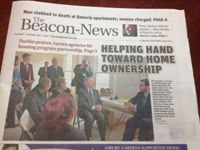
guzman-for-auroraBecause of this project—which turns an empty building next to the Paramount Arts Center into a school of the arts, a restaurant complex, and loft apartments—on September 16th, 2016, the Illinois Housing and Development Authority announced a tax credit award to the city that’s worth over $15,000,000.  (See headline pictures above and below.)

It’s not alchemy, but Rick Guzman did lead in putting together a complex economic formula that leverages smaller dollars to create huge returns. Only he among the other candidates for mayor has demonstrated a thorough understanding of such processes.

Though supported by Mayor Tom Weisner and the overwhelming majority of the city council, the plan initially drew sharp criticism from some because Guzman seemed to be proposing using $5,000,000 of city money.  In the end that would still have been a 7 to 1 return on investment, but even that wasn’t good enough for Rick.

Aurora-ArtsCntrTax-bHere’s the way he led in working it out.  1) Use only $500,000 of locally collected taxes, which are TIF dollars only paid by downtown property tax payers.  2) Use $1.3 mil in Federal “pass through” funds ($600,000 from one HUD source, $700,000 from another HUD source), which are specifically targeted for the type of housing and job creation the project will bring.  3) Create a $3 mil loan to the Paramount—which the city could even use a federal loan fund pool to bridge if it wanted to—and which will be completely recouped through the revenues and savings the project itself creates, including: a) $500,000 of new property tax increment; b) $1 mil of already identified savings the Paramount will realize over the term of the load; c) $1.5 mil in uncommitted lease revenue from the restaurant complex and the loft residences.  This doesn’t even count the $15,000,000 tax credit mentioned above.

Seeing this package and this commitment, developers came in to the tune of $35,000,000. Seeing the formula was not magic, but solid economics, the city council overwhelmingly approved it.

Amid all these numbers one could forget that this is about the ARTS.  But arts and economics are no strangers.  This plan to use the arts for economic revitalization follows a highly successful trend I report on HERE.  For more on the reaction of the press and civic leaders to this Rick Guzman led project, go HERE (this link will go live soon).

 Go to the Lead Post on this site about the Guzman for Aurora campaign, and to the Guzman for Aurora website.
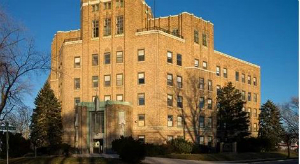
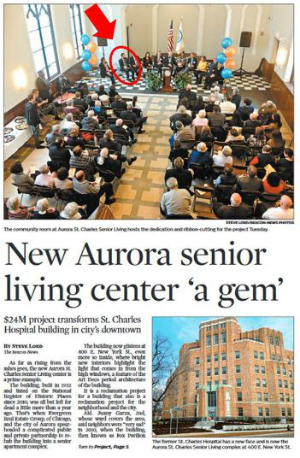
  Read about another Rick Guzman led initiative, the St. Charles Hospital renovation, that leveraged an even smaller city commitment into $24,000,000 of development dollars.


Posted in Arts | Tagged , , , , | Leave a comment

Art, Economics, and Identity

Aurora's future Arts Center

Aurora’s future Arts Center

Next to Aurora’s Paramount Theater sits a historic building, most recently the home of Waubonsee Community College’s Aurora campus.  It’s been vacant for five years.  However, a Rick Guzman led initiative, which leveraged $500,000 in city funds into $35,000,000 of development commitments—a 70 to 1 return on investment!—will soon change that.  Go HERE for details on how he did this.  For more on his mayoral campaign, go to the Guzman for Aurora website, and go Here for more on this site.  For now let’s just note that Rick Guzman is wise to follow a growing trend which uses the arts to help revitalize urban areas, especially downtowns.

guzman-for-aurora“When you bring artists into a town, it changes the character, attracts economic development, makes it more attractive to live in and renews the economics of that town,” says Rocco Landesman, head of the National Endowment for the Arts from 2009 to 2012. While chairperson he coined a new slogan for the NEA: “Art Works.”  He meant to “highlight both art’s role as an economic driver and the fact that people who work in the arts are themselves a critical part of the economy.”  “Someone who works in the arts,” said Landesman, “is every bit as gainfully employed as someone who works in an auto plant or a steel mill.”

In a July 2011 article for The Urbanist titled “What Makes an Arts District Successful?”  Deborah Frieden writes, “For civic leaders facing limited resources, arts and cultural initiatives have become an appealing community-development strategy. In recent years, the fine-grained arts district—one that does not reinvent a neighborhood wholesale but enhances the existing community with diverse new development—has burgeoned. In fact, some cities are developing more than one of these districts at the same time. This may be due in part to the dramatic downturn in national and local economies, which has made funds for larger capital projects scarce. But there’s another reason why these arts districts are so popular: They have the potential to deliver many types of benefits, for both the public and private sectors, at a time when other tools for community development are flagging.”

Creating arts centers to spur economic growth goes by several names.  The National Endowment for the Arts created a white paper titled “Creative Placemaking” for the Mayor’s Institute for City Design, a leadership initiative co-sponsored by the United States Conference of Mayors and the American Architectural Foundation.

Mural in a Miami Arts District

Mural in a Miami Arts District

Americans for the Arts refers to these centers as “Cultural Districts.” This link leads to its one-stop shop “Toolkit” for creating them.  It covers: Cultural Districts Basics, Developing a Cultural District, Advancing a Cultural District, Profiles of Cultural Districts, Cultural Districts Research, and Cultural District Issue Briefs, briefing papers on everything from district management to cultural tourism.

Successful examples abound.  The Frieden article looks briefly at three of them under the headings: “Seattle, Miami, Cleveland: Sharing resources fosters community,” “Cleveland and Queens: Meeting social needs creates new audiences,” and “Miami and Columbus: ‘Going big’ builds a brand.” We often see the arts as a means for expression—often just self-expression—but they can also powerfully express the soul of a community. “Every town has a public square or landmark buildings or places that have a special emotional significance,” says Landesman. “The extent that art can address that pride will be great.”  That pride spurs economic growth, certainly, because art, in expressing a community’s pride, also encourages the sharing of resources, the meeting of social needs, and a city’s “brand”—which isn’t just a business/marketing term.  “Brand” can be an expression of a city re-finding or re-creating a more vibrant identity.

If Guzman for Aurora is successful, it will enable Rick Guzman to lead more initiatives to use the arts not only for more business growth, but also for bringing more vibrance to Aurora’s identity.

 Go to the “Lead Post” about the Guzman for Aurora campaign on this site.

  Go to the ARTS main page.

Posted in Arts | Tagged , , , , , | Leave a comment