

If Mayors Ruled the World

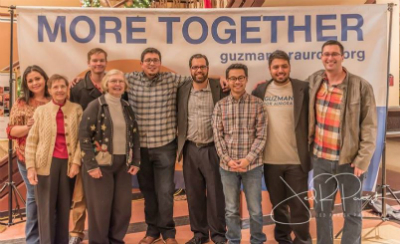
In April 2016 my son Rick announced he was running for mayor of Aurora, Illinois’ second largest city, and his supporters formed Guzman for Aurora.  Soon afterwards I thought of iconic New York mayor Fiorello LaGuardia, who famously said, “There is no Democratic or Republican way to fix a sewer,” thus cutting to the heart of the pragmatic, get-things-done mentality that usually motivates a mayor, the city’s chief executive—that word, “executive,” being crucial.  It’s no secret that paralysis is a major feature of government these days, especially in Washington, D.C.—though I’m writing from Illinois, widely acknowledged as one of the worst-governed states in the country, a state now entering its third year without passing a budget.  D.C. or Springfield, once you get that far past the city level, things seem to enter a shadow world of political horse trading, a world where symbols and accruing power and partisanship become more important than actually doing things or forming alliances that actually do things.

ifmayorsruledThat’s the main idea behind Benjamin Barber’s book If Mayors Ruled the World.  Cities and the mayors who run them, he asserts, offer the best new forces of good governance.  Already the home of half the world’s population (and rising), and the center of cultural and social innovation, cities and their mayors exhibit a non-partisan, pragmatic approach lacking in national, international, and—increasingly—state governments.  City executives are freer to work across party lines and to form all kinds of win-win alliances, alliances especially attractive to investors, because mayors are so focused on solving real, down-to-earth problems for real, living communities.

Barber is author of another acclaimed book, Jihad vs. McWorld, a 1995 publication also growing in relevance as it explains how a world of both growing convergence (McWorld) and one of growing disintegration (Jihad) are not only happening at the same moment, but also how the two opposing trends are actually part of a single process that has in common a taste for anarchy and a disdain for democracy.  If Mayors Ruled the World is another major analysis of world trends and deeply supportive of democracy.  You can easily find lots of discussion of it on the web, as well as a pdf of the book itself, plus a good TED talk by Barber himself.

guzman-for-auroraI have only glanced at a few points in If Mayors Ruled the World, and will only mention one of Barber’s major suggestions here—that a Parliament of Mayors needs to be formed—because my main objective in several posts over the next few weeks will be to focus on ideas that resonate deeply with Rick Guzman’s campaign.  He’s had tremendous executive experience and headed a long list of win-win initiatives that have solved problems in pragmatic, non-partisan ways.  As the Guzman for Aurora website says:  “Doing more—with less.  That’s been his focus for 15 years of executive leadership.  As Assistant Chief of Staff to Mayor Tom Weisner since 2011, Rick’s creative solutions have been behind many of the city’s most successful campaigns and development initiatives.  He’s a big-picture thinker who specializes in listening well, understanding deeply—and then finding creative ways to leverage little opportunities to create big results.  Rick’s not a legislator; he’s an executive.  And his specialty isn’t talk. It’s action.”

In contrast to Illinois being one of the worst-governed states in America, the City of Aurora has recently been named one of the best-governed big cities in America, and a top place for safety and for families.  Mayor Weisner’s leadership has been a major factor in this, and Rick aims to continue on this path and to create new, vibrant directions and initiatives to add to Aurora’s remarkable turnaround.  In following posts we’ll report on some of Rick’s win-win solutions, including a recent project which yielded a 70 to 1 return on city investment dollars.  Rick and his wife Desiree also founded Emmanuel House, which in 2016 was named one of the “Top 100 Most Innovative” social change organizations in the world.

 Go to the “Lead Post” in a series of articles about the Guzman for Aurora campaign.
Posted in Social Change | Tagged , , , , , | Leave a comment

Charity has beginning…(Part 2)

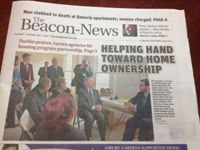
Part 1 of the article below ends with Bryan Emmanuel Guzman talking about the contributions he hoped to make to change the world.  Part 2 now begins with reference to that desire.  We post this article about Emmanuel House—written by Jenette Sturges for the Aurora Beacon—as part of commemorating the 10th anniversary of Bryan’s death.  Founded by Rick and Desiree Guzman as a living memorial to him, Emmanuel House was, in 2016, named one of the “Top 100 Most Innovative” social change organizations in the world.  Also in 2016, Rick announced Guzman for Aurora, the organization behind his run for mayor of Illinois’ second largest city.

_________________________

That contribution has touched more than just the few families who live at Bryan House at any one time.

Families like the Labradors are now following in the Bryan House tradition. They’ve since opened their home to another family of Cuban refugees, helping them get on their feet.

“They were located to Florida,” said Yanary. “They said it’s hard to find a job, so we said the only way to help was to come here and live with us.”

bryhs-charity2

Both families came for last Sunday’s early Thanksgiving celebration, joining in the prayer before dinner.

“We give thanks for the amazing number of ways you’ve blessed us,” prayed Guzman, “and we ask your blessing for these families on their journeys in this country and in this wonderful city.”

Among those blessings is the expansion of the mission of Bryan House to a larger umbrella organization. Dubbed Emmanuel House, the new nonprofit, with the support of the local church community, aims to bring the same model established at Bryan House to working poor families while also helping to stabilize Aurora’s near East Side.

Around the beginning of the new year, Emmanuel House will be up and running, welcoming East Aurora families — typically, those who earn about 50 to 80 percent of median income ­­— into a series of homes on the East Side that will use the same Bryan House model of temporary rent-free living to save for a down payment.

“The only other requirement besides income is you have to already be living on the East Side, and you have to buy your home on the East Side,” said Guzman.

Families go through an application process that emphasizes recommendations from other community members, and the waiting list for these East Side Emmanuel House apartments is growing.

Each home will be sponsored by an area church that provides financial support to the operation of the house, but also emotional support to the families who will live there.

bryhs-charity3Already, one home on Claim Street is undergoing renovations — the house had been gutted by former homeowners and needed everything from new wiring and plumbing to a new furnace — and should open within a few months. Another, on Spring Street, is a short sale that’s under contract and awaiting bank approval.

Uni Muniz and her son, Issac, will be the first family to move into Emmanuel House.

“Being widowed, and with this so close to home, I jumped at the opportunity,” said Muniz, a massage therapist and volunteer at the Jesse Torres Boxing Club, also on the East Side. “There’s something about owning that just makes you feel a little bit better about yourself.”

But the goal isn’t just helping individual families, said Guzman. Helping families become homeowners helps stabilize an entire community.

“All other things being equal, when you own a home versus rent, families have 12 times the wealth, and you move less often. The stability means kids are more likely to graduate high school and college,” said Guzman. “The community ends up significantly better off, too. More people becoming homeowners helps create jobs and greater neighborhood stability, and people who own homes become more engaged.”

Home values also increase in neighborhoods where more people own their homes rather than rent.

Just like at Bryan House, families will pay market-rate values for rent, but all those funds go into a savings account. They’ll also have an established record of savings and of regular payments on their lease, and they’ll get financial counseling from Joseph Corporation to prepare them for taking on a mortgage.

Muniz said she can’t wait to have her own home for the holidays.

“For me, it’s something you can leave to your kids,” said Muniz. “If the parents own a home, the kids are more grounded. Mine are all grown up, but it still applies — that’s mom’s house.”

End of article.  Read PART 1

  Go the Emmanuel House main page on this site, or to the Emmanuel House website.

  Go to a video chronicling Senator Dick Durbin’s visit to an Emmanuel House site in 2012.  One of its features: Uni and Isaac’s Emmanuel House story.  You can also catch a glimpse of Isaac marching up front with Guzman for Aurora in the July 4th Parade.

Posted in Family, Social Change | Tagged , , , , | Leave a comment

Charity has beginning…(Part 1)

As part of commemorating the 10th anniversary of Bryan Emmanuel Guzman‘s death, below we post Part 1 of a front page article about Emmanuel House written by Jenette Sturges for the Aurora Beacon.  Go here for PART 2.  Founded by Rick and Desiree Guzman as a living memorial to Bryan, Emmanuel House was, in 2016, named one of the “Top 100 Most Innovative” social change organizations in the world.  Also in 2016, Rick announced Guzman for Aurora, the organization behind his run for mayor of Illinois’ second largest city.

_________________________

Families routinely pull out old photo albums around the holidays, to remember loved ones who have always had a seat at the table but have since passed, or to recall the joys of past Thanksgiving and Christmas get-togethers.

But few of those old family photos probably include treks to African refugee camps.

John Mushunduzi, 19, smiled wide as he sprawled out on the living room floor, looking through a photo album of his family surrounded by the leafy green foliage of sub-Saharan Africa.

John looks much the same, tall and lean, with close-cut hair, but his sister is unrecognizable. In the photo, taken in a refugee camp after they fled their home in the Democratic Republic of Congo, she is small, skinny and bald. Now in the U.S. more than three years, her hair, shorn in the refugee camp, has grown long and she’s gained more than a foot in height.

bryhs-charity1

On Sunday, the siblings teased one another as they looked over the album together. John, now a senior at West Aurora High School, puts his family’s upheaval simply.

“It wasn’t easy,” he said.

Having a place to live, especially one that gives refugee families a place to establish themselves in America, has made the adjustment a little easier.

And on Sunday, the families of Bryan House gave thanks for that home as they gathered for an early Thanksgiving dinner. Thirty-nine people, only a portion of the families who have lived at the refugee home, crowded into the kitchen of Rick and Desiree Guzman over a turkey and large dishes filled with rice, meat, bean and vegetable dishes representing the cuisines of seven countries.

“We were living rent-free at IMSA and we took the money we would have been spending on rent and saved for a down payment,” said Rick Guzman, who founded Bryan House with his wife, Desiree, and now chairs the organization’s board. “We just thought if we could do it, a lot of refugees and working-class families could do it, too.”

So Bryan House got its start five years ago in the Guzmans’ own home when they welcomed in the Labradors, a family of three Cuban refugees the couple had met through Desiree’s work at World Relief. Rey Labrador, his wife Yanary and their daughter Amanda had sought asylum in the U.S. after Rey started running into trouble with the Cuban government.

“When they asked us to be the first family, I never in my mind thought it would be this big, this many families,” said Yanary. “It was just something new for us and something new for them.”

A few months after moving in with the Guzmans, the Labradors had saved enough for a down payment and bought a home in Aurora.

“The best part is that it’s mine,” said Yanary. “It’s not a big house or a castle, but it’s our house.”

Just as the organization was getting off the ground, Bryan Guzman, Rick’s brother and a student at North Central College in Naperville, died unexpectedly.

So the fledgling nonprofit took his name.

In 2007, when Bryan House grew into an actual house—the organization had raised enough through sponsorships to purchase an apartment building on Lake Street that is home to five families—a brick was laid at the foundation of the building in Bryan’s memory, inscribed with an excerpt from an e-mail he sent that was found after his death: “I’ve always envisioned myself as someone who would change the world—even though I haven’t done that much to contribute yet.”

The tribute seemed fitting, said Guzman, since Bryan had been involved with the refugee families from the start. Now he is contributing, said Guzman, “not to his own memory, but to real solutions to the urban poverty and housing issues that we all cared about.”

—Read PART 2 of this article—


  Go the Emmanuel House main page on this site, or to the Emmanuel House website.

  Go to a video chronicling Senator Dick Durbin’s visit to an Emmanuel House site in 2012.  One of its features: Rey and Yanary speaking with him about their Emmanuel House experience.

Posted in Family, Social Change | Tagged , , , , , , , | Leave a comment