

Aurora’s future Arts Center
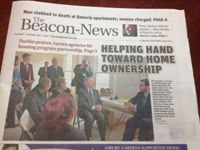
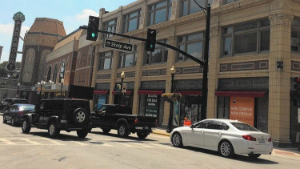
Next to Aurora’s Paramount Theater sits a historic building, most recently the home of Waubonsee Community College’s Aurora campus. It’s been vacant for five years. However, a Rick Guzman led initiative, which leveraged $500,000 in city funds into $35,000,000 of development commitments—a 70 to 1 return on investment!—will soon change that. Go HERE for details on how he did this. For more on his mayoral campaign, go to the Guzman for Aurora website, and go Here for more on this site. For now let’s just note that Rick Guzman is wise to follow a growing trend which uses the arts to help revitalize urban areas, especially downtowns.
 “When you bring artists into a town, it changes the character, attracts economic development, makes it more attractive to live in and renews the economics of that town,” says Rocco Landesman, head of the National Endowment for the Arts from 2009 to 2012. While chairperson he coined a new slogan for the NEA: “Art Works.” He meant to “highlight both art’s role as an economic driver and the fact that people who work in the arts are themselves a critical part of the economy.” “Someone who works in the arts,” said Landesman, “is every bit as gainfully employed as someone who works in an auto plant or a steel mill.”
In a July 2011 article for The Urbanist titled “What Makes an Arts District Successful?” Deborah Frieden writes, “For civic leaders facing limited resources, arts and cultural initiatives have become an appealing community-development strategy. In recent years, the fine-grained arts district—one that does not reinvent a neighborhood wholesale but enhances the existing community with diverse new development—has burgeoned. In fact, some cities are developing more than one of these districts at the same time. This may be due in part to the dramatic downturn in national and local economies, which has made funds for larger capital projects scarce. But there’s another reason why these arts districts are so popular: They have the potential to deliver many types of benefits, for both the public and private sectors, at a time when other tools for community development are flagging.”
Creating arts centers to spur economic growth goes by several names. The National Endowment for the Arts created a white paper titled “Creative Placemaking” for the Mayor’s Institute for City Design, a leadership initiative co-sponsored by the United States Conference of Mayors and the American Architectural Foundation.
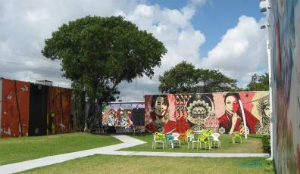
Mural in a Miami Arts District
Americans for the Arts refers to these centers as “Cultural Districts.” This link leads to its one-stop shop “Toolkit” for creating them. It covers: Cultural Districts Basics, Developing a Cultural District, Advancing a Cultural District, Profiles of Cultural Districts, Cultural Districts Research, and Cultural District Issue Briefs, briefing papers on everything from district management to cultural tourism.
Successful examples abound. The Frieden article looks briefly at three of them under the headings: “Seattle, Miami, Cleveland: Sharing resources fosters community,” “Cleveland and Queens: Meeting social needs creates new audiences,” and “Miami and Columbus: ‘Going big’ builds a brand.” We often see the arts as a means for expression—often just self-expression—but they can also powerfully express the soul of a community. “Every town has a public square or landmark buildings or places that have a special emotional significance,” says Landesman. “The extent that art can address that pride will be great.” That pride spurs economic growth, certainly, because art, in expressing a community’s pride, also encourages the sharing of resources, the meeting of social needs, and a city’s “brand”—which isn’t just a business/marketing term. “Brand” can be an expression of a city re-finding or re-creating a more vibrant identity.
If Guzman for Aurora is successful, it will enable Rick Guzman to lead more initiatives to use the arts not only for more business growth, but also for bringing more vibrance to Aurora’s identity.
♦ Go to the “Lead Post” about the Guzman for Aurora campaign on this site.
♦ Go to the ARTS main page.

MLK Jr. Hails a Cab?
This morning after returning from my college’s 7:00 a.m. annual Martin Luther King, Jr. Prayer Breakfast I was struck by two stories that came across my Twitter feed. The first was a short compilation from the New Yorker of some of its covers featuring MLK, Jr., including this one of him trying to hail a cab:
The second, from the Evanston Review (a Chicago Tribune subsidiary), carries the headline “Man at center of video, excessive force lawsuit ‘should have been allowed to go his way:’ attorney.” A lawsuit filed October 11, 2016, in Cook County circuit court, asks $50,000 for “compensatory and punitive damages, fees, costs, and such other relief” on behalf of Lawrence Crosby, a Northwestern University doctoral student, a black man, who was pulled over by Evanston police responding to a call “from a woman who said she believed the car he was driving was stolen.” It wasn’t. It was his own, police confirmed. Yet he was “subdued” and arrested anyway. You can read the full story Here, which, at this posting, also includes the police dash cam video. Here’s a still from that video:
This isn’t a full analysis of a situation—a situation which does, however, seem to have many parallels, especially pronounced in Chicagoland these days because of the recent release of a scathing Department of Justice report on racism in the Chicago Police Department. On this national holiday it’s common to acknowledge—the phrase is a cliche—that “we have a long way to go to realize Dr. King’s dream of equality.” These two images just struck me this morning as so, so similar, and made the phrase, once again, not so cliche after all.
♦ Hear a Richard and Daniel Guzman music (and video) treatment of MLK, Jr.’s “Riverside Sermon,” perhaps the greatest, most courageous of all his speeches. Against even his closest advisers, he began joining the struggle for Civil Rights to the struggle against the Vietnam war, and identified “racism, militarism, and economic exploitation” as standing in the way of equality.
♦ Read more about MLK, Jr.’s “Riverside Sermon” and his thoughts on racism, militarism, and economic exploitation.