





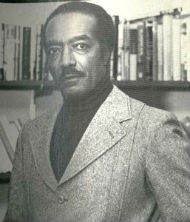
 Hoyt W. Fuller (1923 – 1981) was one of the most revered figures in Chicago literary history, publishing articles and criticism for Negro Digest and Black World, the Chicago Defender, Tribune and Sun-Times, The Nation, the New Republic, and many other periodicals. He also published poetry and fiction, and the non-fiction book Journey to Africa (1971), which I excerpted in my book Black Writing from Chicago. But he made perhaps his greatest contributions as an editor for Ebony, and especially his founding of Negro Digest (which later became Black World), plus his tireless championing of Black writers and writing. Many see him as a father figure, the main man not only of Chicago writing, but for much of American Black writing and cultural production from 1960 on, including rap and hip-hop.
Addison Gayle called Fuller’s “Towards a Black Aesthetic” (1967) “one of the seminal documents in Black American criticism.” “The great bard of Avon,” wrote Fuller in that enormously influential essay, “has only limited relevance to the revolutionary spirit raging in the ghetto.” His goal was to “set in motion the long overdue assault against the restrictive assumptions of the white critics.” “In Chicago,” he wrote, “the Organization of Black American Culture has moved boldly towards a definition of a black aesthetic. In the writers’ workshop sponsored by the group, the writers are deliberately striving to invest their work with the distinctive styles and rhythms and colors of the ghetto, with those peculiar qualities which, for example, characterize the music of a John Coltrane or a Charlie Parker or a Ray Charles.” Fuller defined a Black cultural mission that gave direction and assurance to an extraordinary number of artists and writers. Robert L. Harris wrote that, “Hoyt W. Fuller lived as a beacon in the murky waters of race that challenge the identity, if not the sanity, of every Afro-American.”
Fuller could issue such clarion calls because he himself was perhaps the most restless seeker of them all. Fuller begins Journey to Africa with a profile of Sekou Toure, president of the Republic of Guinea, as well as the French West African-wide Union of Black African Workers, then 700,000 strong. He makes much of his subsequent meetings with Toure, probing through him and other leaders both the immensity of many African dilemmas, as well as the real power that black men have to solve them socially, technologically, politically. The prospects are a real mixed bag. “I could rhapsodize…and marvel at the incredible energy of the people,” he writes, “but the overwhelming fact about Africa is its helplessness, the staggering task to be performed in transforming potential into power….” On a return trip in 1969 he notices progress and the book ends with some optimism in an African “coming of age,” which is nonetheless tempered by his clear-eyed assessment of “the staggering task.” In the end, however, Africa does fulfill his “desire for rootedness” and gives him international insight into the position of American Blacks.
His journey was a “voluntary exile,” his escape from an America he found increasingly intolerable. “Every single day,” he writes, “had brought moments when there was need to find some refuge from the nerve-wrenching reality of the omnipresent war of race. A report of some incident in the papers, the rudeness of some waiter in a restaurant, a walk through the Black slums or a drive (it had to be a drive) through a white suburb, an encounter with some unwittingly patronizing ‘liberal’—any of these things, and countless others. But even more than these things, the terrible apathy of ‘educated’ and ‘affluent’ Black people plunged me into impotent rage.”
 Frantz Fanon, whose picture appears on the cover of an edition of Negro Digest reprinted here, wrote of the “bourgeois stage” as both a useless and dangerous phase in the decolonization process, a thought Fuller embraced to begin understanding his rage. “The American black bourgeoisie,” he wrote, “was not merely content to serve out its useless existence emulating white people in America but now its members had embarked on far more dangerous and demeaning adventures. They were scattered all over Africa—in the Peace Corps, in the various embassies, as agents of international aid organizations, as teachers, consultants, specialists and representatives of American industries—using their black skins as a shield behind which they carried out schemes calculated to keep Africa weak, exploited and dependent.” No wonder Fuller split with his early mentor John Johnson, who seemed to be taking his great publishing empire—especially Ebony and Jet—towards a black middleclassness Fuller saw as the seedbed of black apathy and bourgeois presumption.
Africa proved to him how enslaved American blacks had become to whiteness. In contrast to the “vivid, almost screeching colors” African women wore, for example, “Dark-skinned Black American women,” he writes, “are intimidated by brilliant colors. They turn their backs on them. For the aquamarines and tangerines and fuchsias would call attention to their skin, and that would never do! In America, one does not accentuate one’s blackness; one tries to hide it beneath creams and paints and powders. And failing that, one plays it down with quiet, dark and neutral colors, appropriately matched with a bland, apologetic manner.
“But one understands their shyness,” he continues. “For the Black American, all his years on the American continent, has been fleeing the color he associates with his shame. He has been running from the color which forever marks him, in his imposed language and religion, as not quite a man. One understands this. One understands when a friend’s mother, learning her son wants to marry a dark-skinned girl, threatens to take poison if he does. ‘Think of the children,’ she moaned. ‘They will be black.’ And one understands when a co-worker, regarding a fair-skinned, straight-haired little girl, says, ‘Now that’s a fine example of selective breeding.’ And what he meant, what Blacks in America go on proving, is that the fairer the skin and the straighter the hair the closer they come to feeling whole….”
√ Go to a list of Black Writers written about on this site, and the Teaching Diversity main page.



Graphic Inequality
Note: For an October 2021 update, go to “The Wealth Gap Widens.”
Year-old statistics about America’s wildly growing wealth gap have been animated in a recent You Tube video that’s gone viral: over 5,650,000 views the last few days. Take a look Here.
Based mainly on work attributed to a “Harvard business professor and economist,” and reported by Mother Jones in 2012, the video walks us through (1) what Americans believe our current wealth distribution is, (2) what they believe an ideal distribution should be, and (3) what that distribution actually is today. The differences between (1) and (2) are significant, but the difference between these two and number (3) are stunning. Few have very little idea of how out of whack—how terribly unequal—wealth distribution and income inequality have become.
But for me the most stunning graphic remains the chart below, a chart constructed by David Cay Johnson, winner of a Pulitzer Prize for his coverage of tax policy when he was with the New York Times. Now a professor at the Syracuse University College of Law and author of three books about taxes—Free Lunch, Perfectly Legal, and The Fine Print—Johnson based his chart on statistics compiled by Saez and Piketty from IRS data.
It works this way. From 1966 to 2011 real income for 90% of Americans grew by just $59, while income grew $116,071 for the top 10% of Americans, $628,817 for the top 1% of Americans, and $18,362,740 for the top 1% of that top 1%. You can get figures roughly the same from many sources, and analyses of the causes for such gigantic inequalities also from many sources, the most astute one, I believe, being Jacob Hacker and Paul Pierson’s book Winner-Take-All Politics: How Washington Made the Rich Richer—And Turned Its Back on the Middle Class.
Now, let that $59 growth for 90% of Americans equal one inch on a chart that, in order to fit on half of a normal 8.5″ x 11″ piece of paper, we’ve made 5.5″ tall.
The $59 line—the first vertical line on the chart below, the one on the left—fits “comfortably” in its place, of course.
However, the next line, representing the top 10%, would have to go 163 feet off the chart to represent the $116,071 income growth for that segment of Americans. The next line, representing the income growth of the top 1%, would go 884 feet off the chart.
But the last line, representing the income growth of the top 1% of the top 1% would go 4.9 MILES off the chart. One inch vs. more than 4.9 miles.
Pile in all the synonyms for “stunning” and “gigantic” you want, and maybe add ones for “obscene,” depending upon your political persuasion, and language would still seem inadequate to express what should be astonishment no matter who you are—even if you’re part of that 1% of the top 1%. What to do? Anything? It’s got to be “discouraging” (plus synonyms) for us 90-percenters. But possible solutions begin with awareness. Over 5,650,000 views of the video above could begin to look like a glimmer of hope, faint as it still is.
♦ Read about Emmanuel House, the Guzman’s “family” foundation—it’s grown far beyond the family by now—honored as one of the “Top 100 Most Innovative” social change organizations in the world for its efforts to fight against this growing wealth gap.