The following is Part 2 of an article that originally appeared in The Virginia Quarterly, Vol. 60:1 (Winter 1984): 102-118. (Read Part 1.) Widely considered one of the best single articles on Gonzalez and Philippine culture, it has been widely reprinted, including in a University of the Philippines commemorative box-set of Gonzalez’s work, and in Asian American Writers, a collection by Yale University’s Harold Bloom of what he considered the best 15 contemporary articles on Asian American writing. For more on Philippine culture from a widely different angle, one that contradicts some of Gonzalez’s efforts, go to an article featuring the pop duo of Pops Fernandez and Martin Nievera.
II
A Season of Grace revolves around the contrasting of two couples who live on the island of Mindoro. One couple is Epe and Tiaga Ruda, the establishment, the supervisors, the people of means to whom others become beholden. The other couple is Doro and Sabel Agnas, poor folk who leave the Rudas’ employ to seek a life for themselves on a frontier farm, or kaingin. Their life is hard. Crops often fail: “There was a week when they lived on nothing but mushrooms; and there was the week of the bamboo shoots, which tasted quite all right, pickled in vinegar that Blas Marte’s wife sent over. Still, can one go on that way? The thought was like a temptation. It said further: Leave the clearing for once! And, mouse-like, it gnawed at Sabel’s mind.”
Gonzalez does not at all romanticize their hard lives, yet it is impossible not to sense that, because of the sharing among the poor folk and because of their closeness to the earth, people like Doro and Sabel maintain vital connections to those elemental rhythms
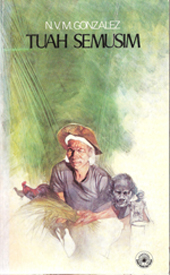
Malay cover of Season of Grace
of life that sustain communion and make them more whole. For the Rudas, especially Tiaga, the story is different. They are not portrayed as villains. Rather, because they are unconnected with the earthy rhythms of planting and harvest, they also partake only superficially in real sharing with people. They are lonely, and one notices in Tiaga a growing paranoia which is accompanied by an increasingly frantic rhythm in her movements and speech. In the end, in contrast to Sabel, we also confirm the fact of Tiaga’s physiological infertility as we learn, sadly, of her third miscarriage. A Season of Grace—which consists of a prologue, epilogue, and three long, unnumbered chapters—follows the Rudas, Agnas, and others through just over one cycle of planting and harvest. Yet the feeling of time is expansive, so much so that the Philippine Free Press reviewer described the book as, “…a poem about an island—and so full of myth-making images that it recovers for Mindoro, poor island with a wondrous name—something of the mystery…with which the conquistadores and the early navigators saw it.” This feeling of expansive mythmaking comes largely from those things previously mentioned: Gonzalez’ handling of time, his constant recourse to the memories and dreams and reflections of his characters. It comes, too, from a lyricism in the narrative voice and the speech of the Philippine peasant which laces the story with poetry. Thus the first chapter begins:
“Man and woman were walking one morning in the sun down a trail that cut across the bed of the empty river Alag. The woman carried a baby, using a hammock slung over her shoulder. The cloth was the same piece of chatcha which last night had served as her little one’s blanket. The baby whimpered inside the hammock-pack: the woman couldn’t seem to make him quiet. The man said: ‘Why don’t you fix it, Sabel, so that it will not hurt?’ He wanted to add: ‘Is it heavy like a yoke?’ But he realized that she looked pretty enough with that hammock-pack; it was quite an ornament. ‘Doro,’ the woman said, ‘please have the kindness to wait for us.’ Whereupon Doro stopped and looked back. Without either slowing down or hurrying, Sabel lifted her hammock-pack a little and began rubbing the back of her neck with her palm, hoping is some way perhaps to relieve the strain there. Doro was all the more reminded of the yoke. This had been a carabao’s trail. Now it was a man’s trail. Ferns raised their arched fronds on all sides and a patch of cogon stood now a little way off to the right, waving bright tassels in the sun.”
Or, when Sabel first arrives at a harvest site, we read: “Sabel was about to go when she saw a girl in the hut, seated in the middle of the floor. The girl’s dress had been dyed with tanbark so that it was dark brown, like the thatched wall behind her. Without any shyness, the girl asked: ‘You are Manang Sabel?’ Surprised, Sabel said: ‘Yes. How did you know my name?’ ‘Someone will come from over across the dry bed of the Alag, I was told. Someone with a baby, and she will be called Sabel, they said.’ Sabel pondered for a moment. She liked the girl for being talkative.”
In the first passage the near-Biblical tone quickly gives way to a scene of domestic friction, which in turn alternates with Doro’s reflections, some selfish (“she looked pretty enough”), some which ponder the mythic yoke. We have, too, a restatement of the man-animal-plant hierarchy which Gonzalez had established early in the prologue to give us the feeling, present here, that man and animal make their way through life by the grace of the earth and its vegetation. The color of dress and thatch in the second passage suggests again the man-earth bond, but more noteworthy is the tone of the girl’s reply to Sabel. That tone itself, one feels, might send Sabel searching through her memory. Indeed, she does just this shortly. For now, though, she pauses—ponders—on the verge and is quickly called back by a commonplace: she likes the girl’s “talkativeness.” Such passages abound in A Season of Grace, and most (like the scene of a dream and lovemaking following a day of clearing the fields in chapter three) weave together the domestic and mythic, the memorial and mundane in extraordinarily beautiful and complex ways. In such a stylistic atmosphere so many images become mythmaking, become—or seem on the verge of becoming—transmuted upward into timeless signs that give meaning to history. Whether it is an object (like a coconut), an action (the weaving of buri mats), or a relation (between Filipino manual labor and American mechanical harvesters, for example), one feels in Gonzalez’ work a subtle, gentle, yet monumental retooling of signs for different ends. Let us take, for example, the coconut.
For a multitude of historical, commercial, and geothermal reasons the coconut has long been associated with the Islands. My brother, Jose Enrado, was given (for reasons I could not then fathom) the nickname “Coconut Joe.” And a recent TV commercial tells us that company X is bringing the coconut halfway around the world—“From the Philippines!”—as a guarantor of moist skin. In A Season of Grace its function is less cosmetic. Early in the novel a coconut is found and planted, and though there are other references to it throughout, it is only near the end of the book that its full meaning becomes apparent.
“[Nay Kare] was standing, her feet wet, not more than ten yards from him. The coconut she had picked up looked small in the crook of her arm. Its husk glistened more than ever now that it was out of the water, a rich dark brown that was the color of one’s skin. Doro walked up to her. ‘Will that ever grow, Nay Kare?’ he asked, although what really crossed his mind was: ‘What wind and wave have sent it to this shore?’ ‘Why, yes, of course. You can ask Sabel.’ Her patadiong wet against her breast and hips and legs, Sabel stepped out of the water, saying: ‘Yes, I remember. The one you picked up last time—why, it has sprouts already, I believe. And Doro,’ she assured him, ‘we planted it at once and it grew.’ ‘Soaked in salt water as it was?’ Doro could not believe her…. ‘How else do you think can coconuts go from island to island?’ Nay Kare said. ‘Oh, well, let’s be on our way.'”
Because so much of the book has concerned the poor folk going from clearing to clearing, island to island, working in the saltwater sweat of their brows for whatever the earth will yield, one realizes that the coconut is a metaphor for the Philippine peasant’s survival and growth—but not only that. It is a sign meant to re-vision history by joining together certain qualities of a people with certain other historical facts about that people’s creation. Except for the Negritos (themselves relatives of the natives of the Australian bush), the Philippine people are an amalgam of travelers. A Philippine village, in fact, is called by a name that suggests not settlement, but journey: it is barangay, the name of a coconut-tough little boat on which many arrived from Polynesia, Malaysia, Micronesia, China, the Indian subcontinent. Philippine history, then, is shaped largely by those who arrive. This includes the white man, too, and thus A Season of Grace begins with an epigraph from New Voyage Around the World by the English seaman and pirate William Dampier (1652—1715). “The 18 Day of Feb.” it begins, “we anchored at the N.W. end of the island of Mindora, in 10 Fathom-Water, about 3 quarters of a Mile from the Shore. Mindora is a large island. . . .” “Will that ever grow?” asks Doro. Some travelers come, plant themselves, and grow—some do not, either because they do not really plant, or because, like the corrupt officials in A Season of Grace who take buri mats from Sabel in the beginning and Clara at the end, they are flagrant robbers. Those qualities which do spur growth Gonzalez wants to identify as the spine of Philippine character, the essence of a genuinely native past. They show most clearly, though certainly not without a great deal of tarnish, in the generosity, patience, and nobility of the Philippine peasant. The coconut becomes a mythic sign as it links the qualities of peasant life and the historical origins of Philippine society to its own immemorial travel and endurance of the salty sea. In many quarters of the Southeast Asian world the coconut is, of course, an already sacred sign; what Gonzalez adds to it is a new, pointed historicity. He uses it, that is, to reshape subtly, but significantly, an old story; and thus the fruit of the palm goes beyond even its more significant meanings, to say nothing of the way it surpasses its other familiar function as a sign of the carefree, exotic tropics, of Coconut Joes and luscious complexions. It helps make “natural” that generosity, patience, and nobility which makes more likely the overcoming of the hardships of travel, landing, and growth—or, more important here, the overcoming of colonialism. In a recent lecture at the University of Hawaii, Gonzalez speculated that in terms of the literary imagination the Comic Rhythm might be the best way for the Third World to deal with the historical circumstances of imperialism; for the Comic Rhythm celebrates community, integration, the overcoming of fragmenting alien spirits. A Season of Grace leaves the Rudas inclining toward the Tragic Rhythm, toward loneliness and disintegration. The poor folk, for all their faults and the often desperate straits of their lives, incline toward the comic. In fact, the novel ends with a joke which involves not only a sailing ship but rice, one of the book’s most crucial, mythic signs. In the epilogue Tata Pablo, the first villager we meet in the book’s prologue, is slowly going blind, and his wife, Nay Rosa, searches an old almanac to find an appropriate saint to pray to:
“Nay Rosa, unused to the weight of paper in her hand, could not keep her arm from trembling. ‘Tiempo variable, it says,’ she said. ‘And after the first quarter of the moon, clear skies with light winds from the southwest.’ Tata Pablo blinked his eyes and leaned forward, turning his head a little to one side. ‘Louder.’ ‘I need better light,’ Nay Rosa said moving toward the door. ‘All right. Go on, though. What does it say about the southwest monsoon?’ ‘Nothing more, it seems,’ Nay Rosa said. ‘Can I look now for a name of that saint?’ ‘It’s now a week since the batel came and loaded Epe Ruda’s rajitas.’ ‘Exactly a week. Don’t you think it’s San Juan?’ ‘I don’t know. San Jaun for the blind?—that doesn’t sound familiar,’ the old man said. ‘Was it a big batel?’ ‘With two masts,’ said Nay Rosa. ‘Maybe, it’s San Pablo.’ ‘It seems I can still hear the sound of the pulleys when the men hoisted up their sails,’ Tata Pablo said. ‘It was painted white?’ ‘White, like boiled rice,’ Nay Rosa said, putting down the Almanaque Panayana. ‘Maybe, it’s San Lorenzo.’ ‘You make me hungry—thinking of rice,’ Tata Pablo said. ‘Try another saint.'”
Against the failing of crops, of dreams, even of eyesight, such an attitude is strangely powerful. At its best, Gonzalez’ mythmaking moves to this comic rhythm. It is one of the most steady, hopeful rhythms in Third World literature. The native culture will survive, it seems to say, and by an inner strength that antedates colonialism.
III
Until some enlightened U. S. publisher takes it on, A Season of Grace is available as an inexpensive import from The Cellar Bookshop (in Detroit at 18090 Wyoming). Now at least the University Press of Hawaii is making available Gonzalez’s latest book, Mindoro and Beyond: 21 Stories. In part, the book is a retrospective collection culled from 40 years’ work. It contains some of the Third World’s finest short stories—“Lupo and the River,” “Children of the Ash Covered Loam,” “The Sea Beyond,” “On the Ferry,” “The Wireless Tower,” “The Tomato Game”—and Gonzalez has arranged them not only to reflect a growing range of concern (symbolized by the distance between Mindoro and the U.S.) but also to parallel his abiding interest in the act of storytelling itself. (Coincidentally—or maybe not—the stories also fall roughly in chronological order.) In the book’s preface Gonzalez reproduces this passage from one of his notebooks: “It is because of our access to storytelling that the confusions and the incomprehensible realities round and about do not overwhelm us with despair. We find in due course a way of ordering the experience we go through (as, indeed, others do), and somehow come to understanding Reality as we live it—until swamped once more by fresh confusions and perplexities. Then comes a new surge of hope, and, again for him who must give an account of how things are, a search for form.”
Several of Gonzalez’s characters can be taken as symbols of the artist, the storyteller. Twenty-five years ago Francisco Arcellana singled out this passage from “Lupo and the River” in order to praise Gonzalez’s own craftsmanship: “Lupo taught him [Pisco] how to work the rattan this way and that, never sacrificing pattern for strength, never losing your purpose, and yet taking care to make out of something ordinary a beautiful thing.” Significantly, Sabel, in A Season of Grace, is a mat maker whose habit it is to weave the word Recuerdo—“Remember”—into the center of her design. As she works with buri, so Gonzalez the writer can be seen working words, weaving on the warp and woof of myth and detail stories which declare to his people that there is indeed some unique past, something worth remembering.
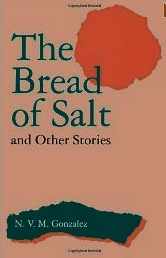
Most stories discussed here are available in the U.S. in this book.
Mindoro and Beyond, then, begins with the semiautobiographical “On the Eve,” about a young man’s decision to become a writer, and the book ends with an historical essay on Philippine storytelling, followed by an often whimsical glossary of Philippine terms. As “On the Eve” begins, Greg Padua is a proofreader for Commonwealth Publishing Co. His father is a salesman. Says Padua: “As proofreader, with lines of type before my eyes, or galleys in my hand, my commitment was to the present. It is now rather easy to see things in this light. I stood for the text of the day, Father the pages of tomorrow.” As he moves toward the literary life, however, he realizes, as he says, that “I was transgressing my commitment to the present, that I was in fact making a dubious step to the future, a territory of promises….” One Mr. Campo, as the editor of a company named “Commonwealth” might be expected to do, rebukes Padua’s poetic ambitions. Padua quits his job, as well as his nighttime study of law, and as the story ends is handing his father a folder of his short stories and poems. His father is uncomprehendingly silent, and Padua tells us: “The Chinese fiddle across the street began once more to wring its heart out. Father and I had changed places.” Very early in the story Padua had listened to that fiddle and told us: “My untrained ear could not grasp the melody, which resembled tortured cries and yearnings; but I imagined that it told some enchanting story inspired by the exotic aroma of narra wood and the unarticulated patience of the lives round and about….” It seems as if, in this 1970 story, Gonzalez were summarizing the inspiration, mission, and pattern of growth of virtually his entire literary output. The stories in Mindoro and Beyond, which are grouped in six sections, may in fact be seen as growing in melodic complexity and evocativeness, “On the Eve” comprises Part One. In Part Two are pieces from the late thirties, some of which are more sketches than full-bodied stories. As melodies they are simple, with a folk songlike depth and transparency. In Part Three, given the growing complexity of Gonzalez’ handling of time, the stories begin to resemble a kind of frozen music. And the music darkens. One critic has pointed out that “The Sea Beyond,” which ends Part Three, shows how man, though he may overcome the evil in nature, cannot overcome the evil within himself. Part Four consists of the long story “Serenade,” which ends with the main character, Pilar, contemplating her new piano, “a brooding presence that made the moment alive once more with the music that Pilar knew by heart—‘Love and Devotion,’ ‘Flower Song,’ ‘Poet and Peasant’—music with which she must learn to woo the world into being less harsh and, perhaps, less rude.” (The songs here are highly appropriate to themes which span Gonzalez” entire work.) In Part Five, tensions between and within individuals begin merging more noticeably with the theme of tensions between cultures, especially the culture based more upon the Philippine peasant as opposed to one based upon the Americanized, Hispanized “city.” Yet Part Five ends with “The Wireless Tower,” which paradoxically images both a total breakdown of communication (the tower, a radio tower, has been struck by lightning) and a celebration of the light and dark sides of life—both personal life, and, one presumes, cultural life as well. It is by striving to understand the inextricable entanglements of light and dark, good and evil, victory and concession, that communication might one day be restored. Yet this must surely be the hardest of human tasks.
“Dear Greg” (Greg Padua?), begins “The Tomato Game,” the first story in Part Six: “You must believe me when I say that I’ve tried again and again to write this story.” Two of the six stories in Part Six take place in America, and this setting accentuates virtually every conflict that has appeared thus far in the book. Clearly Gonzalez has had to struggle hard for the momentary victories afforded by art. “As in myth,” the writer in “The Tomato Game” says, “the signs were all over. The wooden bridge, the fork of the road, the large track all around us which earlier had been a tomato field, the rich crop as indicated by the harvesting machine to one side of the field, a menacing hulk…You can see how hard I try.”
This passage puts us in direct contact with Gonzalez’ effort to re-vision history by creating alternate mythic possibilities. Here the mechanical harvester, so devastating to the manual labor in which Filipinos played so large a part, is reshaped into a sign of technology’s inability to eliminate the human factor. It does a bad harvesting job, finally. It is also linked metaphorically to certain unscrupulous Filipinos who engage in bride-selling schemes. Their victim this time is an elderly Filipino who, though victim, rises in character above his conniving compatriots. His generosity, patience, and nobility clearly link him to those people and ancient qualities celebrated in A Season of Grace. It has been Gonzalez’ aim to foster such links through art; and he has realized that one of the greatest obstacles to establishing a nourishing relationship with the past is that that past is, in Robert Frost’s words, so “unstoried, artless, unenhanced.” Or, perhaps, it is just wrongly storied. The problem with the main character in “In the Twilight,” the last story in the book, is that he has lived so long remembering a key incident in his life incorrectly. He literally has the wrong story. A fiddle player in his youth in the Philippines, he is now, in America, “Dan,” a jazz saxophonist. The character through whom he inadvertently learns the truth was a Philippine guerrilla. Now he is a security guard—Union Carbide, night shift—hoping for U.S. citizenship in three years. Such transformations are jarring; they seem too forced for a story otherwise so delicately crafted. Yet such changes, especially in music, seem common among Filipinos in America. “In the Twilight” is a somber echo of “On the Eve,” but even amid darkening sounds and shadows Gonzalez seems to suggest that a more accurate memory of the past would help his people define who they are as a people and thus be less prone to such far strayings and cultural pessimisms. His message is still Recuerdo. But facts take us only so far: we live in a world of contending stories, of myth and counter-myth. What a writer ultimately says is, Remember my vision of our past. This is the great artist’s privilege and obligation. “Unhappily, the spiritual welfare of this country depends upon the fate of its creative minds,” wrote Van Wyck Brooks of the American situation in 1918. “If they cannot grow and ripen, where are we going to get new ideals…Discover, invent a usable past we certainly can, and that is what a vital criticism always does.” Thoughts like these reach obsessive proportions in the Third World, for there artists and critics face baldly redemptive and recreative relationships to native pasts which have been pressed so hard, sometimes so nearly annihilated, by the colonial experience. Fortunately for the Philippines, Gonzalez’ vision—even in its twilight, somber hues—is strong, complex, and daringly hopeful.
—This is the end of the essay. Read Part 1.—
♦ Go HERE for a list of all writings on the Philippines.





 On March 19, 2012, we heard that North Central College was once again named to the President’s Higher Education Community Service Honor Roll by the Corporation for National and Community Service.