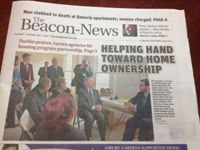
 In 2016 Emmanuel House was named one of the “Top 100 Most Innovative” social change organizations in the world. On April 6, 2018, it held by far its most successful fund raiser, a Gala at the Aquaviva Winery in Maple Park, IL. But in between these two important events many plans were already in motion, plans that would lead towards a merger of Emmanuel House with its long-time partner The Joseph Corporation, the organization that had long done the financial literacy and counseling portion of Emmanuel House’s home ownership program. In fact, the merger was already pretty much official at the time of the Gala, and on May 15th, 2018, hundreds of people came to the Paramount Theater in Aurora to hear the first public announcement of the merger…and to learn the organization’s new name: The Neighbor Project. Watch a short Video of the event Here, and read the first newspaper article about The Neighbor Project, Mary Wilson’s piece in the Daily Herald, which has been followed by more newspaper and radio stories since.
♦♦♦ Go to The Neighbor Project’s website, and to an intro video, which I was privileged to narrate (it’s also on TNP’s website). But there’s no better intro than executive director Rick Guzman’s short talk at the TNP 2020 virtual gala, “Every Person’s God-Given Ability to Contribute.” A gala highlights video will give you even more info and some inspiring stories.
On the Emmanuel House main page on this site, I speak of helping 20-30 families disrupt their cycles of poverty, but of being poised to double, triple, or quadruple that amount, with 100 families now in sight. (As I revise this post in early 2021, less than three years after the merger, it’s not helping 100 families that’s in sight: it’s now over 3,000 families and individuals clearly in sight.)
“I’m so glad it’s your voice on the new video,” said Hayley Meksi, Emmanuel House’s wonderful executive director for the past six years. She steps away from us for a season to go live in Albania near her husband Lorent’s parents. Hayley and Lorent have been among the greatest supporters of Emmanuel House from the very beginning, sacrificing their talents, time, and money to keep us going. We look forward to their return.
At the Paramount, Denny Wiggins, Joseph Corporation’s retiring director, said, “With Rick Guzman at the head of The Neighbor Project, we can’t fail.” So Rick now returns full time to grow the vision he and his wife Desiree had when they founded Emmanuel House nearly a dozen years ago as a living memorial to Bryan Emmanuel Guzman, Rick’s youngest brother.
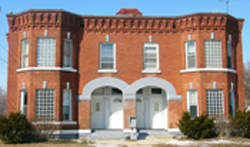
The first five Emmanuel House apartments were here at Bryan House.
Rick and I spoke about the possible merger many months ago, and he asked me then what I would think if a name change was a possibility. Of course, we had gone through one already. Everything started as Bryan House. I said my preference was to keep Emmanuel House, but that I wouldn’t want to hold things up over a name. Since Rick was moving everything into the Joseph Corporation’s much more expansive office building and combining staffs, it seemed best to him and others to start with a new name, too, rather than favoring one organization over the other.
Besides, Bryan House (pictured above left) will always remain Bryan House. The name is literally etched in stone by the front doors. And all houses we added after Bryan House will remain Emmanuel House houses, and there’s even more to come that will bear the Emmanuel House name. “I have the commitment of our Board and those around us that we will find ways to memorialize the Emmanuel House name…We’re already planning a pretty significant expansion of apartments and so one easy way would be for there to be an Emmanuel House development,” Rick wrote the family in an email right before the big May 15th event.
In my post about the Gala I mentioned above, I hinted heavily that we were going to say goodbye to some very precious things, but not to the values Emmanuel House stood for. Of course, I’ve thought of what Bryan would have said. I’ve had conversations with him in my head, and I can clearly hear him say this: “Name change, huh? Tell me, Are we going to get better at doing what we’re doing?” “Yes,” I answer. “Oh, then call it anything you want.” He’d say that, I’m sure, with all the ease and good humor he brought, and continues to bring, to our lives.







Coffee, Ambien, Race
Caffeine speeds us up, Ambien slows us down. Fast or slow, in America race is always there, much as we still spend huge amounts of energy denying it, trying not to face it. Is Starbucks’ closing of 8000 stores “facing it”? Yes, in a way, but Roseanne Barr’s follow-up tweet blaming Ambien for the racist tweet she aimed at “vj” shows how deep racism goes. Sanofi Aventis, the company that makes zolpidem tartrate (Ambien), quipped that its drug had several side effects, but racism wasn’t one of them. There are formidable social, cultural, and economic structures in place to keep racism going strong for decades to come, but Barr’s “excuse” shows that all these together might not equal the strength of those implicit, Ambien-deep biases that might keep it going for much longer than that.