At the Band Festival

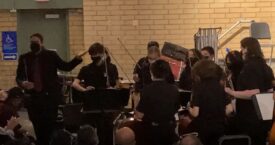
What a joy it was to be able to attend several performances during one day of the Orchestra and Band Festival of the Riverside Unified School District in California this late March 2024.  The 8-minute Video below shows two performances. First, the Gage Middleschool band, conducted by my son Aaron, playing Randall Standridge’s “Fields of Clover.”  Aaron has taught in the RUSD for over 20 years, creating a deep, lasting legacy—which brings us to the second performance in the video below: the Poly High School band, directed by Arwen Hernandez, playing Ralph Vaughn Williams’ “Rhosymedre.”  “We have to see this,” Aaron said, “because these are my Covid Kids.”  It’s a magnificent performance (as is “Fields of Clover”) showing how much you can grow through difficult times.  Ralph Ellison, author of the great novel Invisible Man, called the Blues a “technique of survival,” an idea that can be extended to most, if not all, of the arts.

It goes well beyond survival mode, however.  It elevates our humanity in profound ways. Elsewhere on this site, in “Beauty in the Time of Pandemic,” I write again about Aaron and another one of his groups that helped build community in the midst of our Covid crisis.  In “Art, Rhythm, Intuition, and Social Change” I write about how art helps produce some of the most fundamental characteristics of great leaders.  Here I just wanted to say how beautiful it all was, and how profoundly it must have affected all those students playing in the Gage and Poly bands to have created such beauty together.  I just wanted to say how meaningful if was for everyone there, both the teachers and the audience, to experience that beauty together with those students.

We’ve had a small place in Sedona, Arizona, for well over 20 years.  There are crystals everywhere, and salt baths, and studios for taking pictures of your aura.  Most of all there are vortexes, special places on the earth where the universe’s cosmic energies align in special ways.  The Great Pyramids is a vortex spot.  Machu Pichu is too. And Sedona supposedly has more of these than any place on earth.  I was once up on Bell Rock—a mountain our family calls Bryan’s Mountain—when an Italian man asked me, “Is this the vortex?”  Yes, I replied, and he burst into tears, sobbing, “I knew it. I knew it.”  I’ve gotten somewhat adjusted to Sedona’s New Age loopiness, and don’t necessarily disbelieve, but when people ask me about cosmic alignments, I usually say, Well all of this could also be explained by beauty.  Sedona is just beautiful.  The beauty both stuns you and gives you a sense of peace and oneness.  On his first visit, my brother Joe, who had suffered insomnia for years, woke up his first morning there at 9:00 a.m. profoundly rested. “What the hell just happened?” he said.  Could have been vortexes, but for sure it was beauty. In my over-40-year career in college teaching I often asked my students why they were there in the first place.  A great education gives you many things, I would say, but to access its real depth ask yourself two questions: Do I have a greater hunger for beauty? Do I have a greater passion to serve.  Beauty in the widest sense, and serving, too, because these are deeply interrelated.  So justice is beautiful, and serving to help turn injustice to justice is beautiful.

Beauty is in the eye of the beholder, the old saying goes, which doesn’t mean that the beautiful is totally relative just because it’s deeply personal.  For me the two pieces below were beautiful not just as music, but also because I got to see one of my sons conduct and got to see his legacy in the high school band later that afternoon.  He’s a beautiful conductor as well, fluid and graceful, and I especially liked when his left hand flashed fully open to coax a swelling, blossoming sound from his band.  More than that, his daughter Grace, our granddaughter, helped highlight their band’s performance when she played the opening clarinet duet in “Fields of Clover” with first clarinetist Desiree Vargas.  She’s just in 7th grade but is in advanced band already and loves it so much she wants, she says, to be a music teacher like her Dad.  What a beautiful moment when, at the end of “Fields of Clover,” he has both Desiree and Grace stand. He tries to get his French Horn player to stand, too, but that student, says Aaron, is usually off in his own world, and Aaron just smiles and takes a bow for everyone.

Posted in Family, Music & Meaning, Music & Media Podcasts | Tagged , | Leave a comment

The Neighbor Project Recieves $2 Million Grant

Note:  In addition to the honor reported below, read about how The Neighbor Project’s precursor, Emmanuel House, was named one of the Top 100 Most Innovative social change organizations in world in 2016, and how executive director Rick Guzman was recognized as the Emerging Leader of the Year in 2023.  These and many other honors and accomplishments mark The Neighbor Project as one of the finest organizations of its kind in the world.


The VIDEO below shows around 15 minutes of a 34 minute news conference announcing another momentous event for The Neighbor Project (TNP): receiving a $2 million grant from Yield Giving, the organization of billionaire philanthropist MacKenzie Scott.  I urge you to watch a video of the entire press conference because what’s been left out may be as important as what’s been left in.

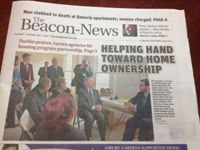
The story took up much of the front page of Tribune-owned Aurora Beacon and was widely covered in Chicagoland media. Go to the Yield Giving website for more coverage, as well as this group’s philosophy on giving and who to give to. Yield Giving was established by MacKenzie Scott.

TNP’s executive director Rick Guzman announces the award and details the selection process before turning things over to four staff members who read some of the criteria for the award and some comments from peer reviewers who graded TNP on how well they met those criteria. I fade out after David Blancas, Chief Equity and Operating Officer, opens his remarks on how peers graded TNP on equity.  During her portion of the news conference Cynthia Rica, Networked Savings Program Manager, read a review which said every community should have a program like TNP.  Miguel Rivera, Director of Property Management and Real Estate, read a review saying, “It was really a pleasure to read this application” because of the talent and deep knowledge of the staff.  So in the interest of time only Jerria Donelson’s remarks were fully included. Jerria has been with TNP for a long time, even during the years when it was just Emmanuel House. She read comments asking how well the community was represented in TNP organization, included those who had been in its programs.  Jerria was a graduate who has risen to a manager position, Homebuying Counselor Program Manager.  She’s brought other family members and friends into TNP’s programs. It was a moving tribute from a long-time friend.  “The Neighbor Project has brought generational wealth into my family,” she said.

Rick Guzman’s comments were marked by five words: “gratitude,” “responsibility,” “leverage,” “investment,” and “partnerships.”  “We can’t afford to lose a penny,” he says.  “We don’t just plan to double this money’s effects but to grow it exponentially.” He’ll do it partially by investing in the partners that helped get TNP where it is today, partners like The Community Fund, the City of Aurora, and The Dunham Foundation.  His gratitude to them glowed. “We literally would not exist without the Dunham Fund. It was the Dunham Fund that suggested Emmanuel House and The Joseph Corporation merge [to form The Neighbor Project], then gave us a grant that put us on a firm financial footing.” In giving thanks for partners and saying a substantial part of this $2 million was going to be invested in them, Guzman also talked about the programs it has started with those partners. For example, with the Community Fund there is now a Closing the Gap program, aimed at giving extra help to bridge people into home ownership, and in particular aimed at closing the immense racial wealth gap between whites and blacks.

Again, what’s been left out may be as important as what’s been left in, so you’re urged to watch the video of the entire news conference.  You may also look at TNP’s full, written press release on The Neighbor Project website, or Here on this site.

MacKenzie Scott

In his thank you’s Rick acknowledges his wife Desiree, who co-founded Bryan House with Rick nearly two decades ago as a living memorial to Rick’s youngest brother Bryan Emmanuel Guzman. He acknowledges his step-mom, Linda, my wife.  And me, too: “his greatest cheerleader.” In the toast ending the conference he thanks TNP’s newest donor, MacKenzie Scott.

This award is the third major award for the Emmanuel House / The Neighbor Project organization. In 2016 Emmanuel House was named one of the “Top 100 Most Innovative” Social Change Organizations” in the world.  In 2023, Rick Guzman received the “Emerging Leader Award” from the national Neighbor Works organization.  And now this.  The Neighbor Project is now consistently regarded as one of the finest organizations of its kind in the nation, but one of Guzman’s favorite lines is that it’s an organization that wants to “flip the script.”  For all its honors it’s the people it serves that are the real heroes, the real leaders helping to create real wealth and stability for the marginalized in our society.

  I also left out of the video below Rick Guzman’s “90-second elevator speech,” which was a requirement of the grant application.  It is essentially a shortened version of his 2023 TNP Gala talk which I posted on this site under the title “The Affordable Housing Crisis.” Watch it for an important take on what’s wrong with “affordable housing.”

Posted in Family, Music & Media Podcasts, Social Change | Tagged , , , | Leave a comment

Li-Young Lee: Furious Versions

This article is part of two series: one on Chicago writers, the other on the many people I brough to North Central College during my time as director of its Cultural Events program.

Born in Jakarta, Indonesia, in 1957 to Chinese parents, Li-Young Lee eventually settled in the U.S. with his family, first in a small Pennsylvania town, then in Chicago.  The stormy and fascinating saga of these moves—having in large part to do with his father’s incarceration as a political prisoner in Sukarno’s jails—is recounted in Lee’s memoir The Winged Seed (1t995), which was recently adapted for the stage by David Mura.  Because of these early experiences with flight, Lee’s poetry, even as it seeks to find images strong enough to rest on, seems always to convey the feeling of continual searching, especially for the father, that extends into the past, permeates the present, and marks out uncertain roads into the future.  One of the featured poets in Bill Moyer’s beautiful Power of the Word series, and one of 34 poets celebrated in Moyer’s Power of the Word, Ll-Young has become one of the preeminent poets of his generation.  His first book, Rose (1986) won the 1987 Delmore Schwartz Memorial Poetry Award. His second book, The City in Which I Love You (1990) won the Lamont Prize from the Academy of American Poets, and his subsequent five other books (and counting) have also been richly honored.

David Starkey and I put Lee’s “Furious Versions” in our book Smokestacks and Skyscrapers: An Anthology of Chicago Writing, investing eleven full, and precious anthology pages to it.  It was more than worth it: beginning with the lines “These days I waken in the used light / of someone’s spent life, to discover / the birds have stripped my various names of meaning entire: / the soarriw by quarrel, / the dove by grievance….” and containing a remarkable meeting “in Chicago, Little Chinatown,” where “who should I see / on the corner of Argyle and Broadway / but Li Bai and Du Fu,” those ancient great writers he describes as “two poets of the wanderer’s heart.”

“Wandering” may be too light a word to describe “Furious Versions,” though that’s what it does, furiously, seamlessly, attempting to understand, perhaps reclaim, those names stripped of meaning.  I think often of Li-Young.  We were close for a while before wandering away from each other.  I had him speak at a national conference I held in Chicago at the Blackstone Hotel. The room he spoke in had elaborate filigreed cove moldings. “I kind of feel I’m on the inside of a wedding cake,” he began, “which is fine because frosting is my favorite food.” I brought him several times to North Central College, once to read, then to teach a series of workshops on poetry, where I heard him say once: “The more I try to write poems the less I know about how that’s done.” He called me up once, saying, “I’ve been asked to give a commencement speech. Richard, what exactly is that?”  It may have been at the University of Massachusetts, and after I talked about such speeches for a minute, he exclaimed, “God, to I have to give advice!”  I said that since they’d invited a poet to speak, I thought reading poems would be appropriate. “I can do that?” he replied.  And at his home in Chicago, a three-flat where his mother and his brother’s family also lived, I had dinner. I loved Donna, his wife, whose twin sister had married Li-Lin Lee, Li-Young’s brother.  At dinner we discussed their new enterprise. Li-Lim, a painter would paint and Li-Young would write words, a poem, over the painting.  “The paintings have been done a while,” Li-Lin said, and standing up and reaching over the table to knock on his brother’s forehead, he said, “Where are the words, Li-Young, the words?”

These always came hard for Li-Young, who—as the magazine cover and quotation to the left from a Poetry Foundation article suggest—were always tied up with some connection to God. Any person is many things at once. Any scene is many things at once. Once he was telling me about another thing feeding his insomnia.  “I was thinking, Richard,” he said. “who is Donna, really? What does she mean?”  What is the right word and context of words around it that can make it mean all the things it could mean all at once. Language is multi-vocal, and somehow this multifariousness, this richness of meaning relates to the richness of God, so that searching for the meanings stripped from his names by the birds is a search to restore richness, to speak and see the multiple ways God speaks and sees and is.  Me speaking about me is truly not enough.  The “I” that speaks with God and like God is after much bigger things…and smaller things, too.

Posted in Chicago Writing, Faith, Writing | Tagged , | Leave a comment