The following was a talk given in 2003, in Scottsdale, Arizona, for the 9th Annual National Conference of the Asian Studies Development Program, an initiative of the East-West Center, Univesity of Hawai’i, Manoa. READ PART 2.
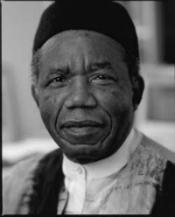
Chinua Achebe
The “empty center” refers to the classic struggle of writers from the “Third World” to define their cultural identity, to fashion out of their pre-colonial, colonial, and post-colonial worlds something that is as much theirs as England’s, France’s, or the United States’. Chinua Achebe most succinctly stated the problem, borrowing phrases from Yeats to tell us “The center cannot hold,” and “Things fall apart.”
Of all former colonies perhaps the Philippines has had the most trouble grasping the elements, the outlines, of a central cultural identity it could call its own. It has been under full Western domination longer than any other emerging nation, and also most clearly in love with its imperial parents, especially the U.S. One of the major planks of its first independent political party, the Partido Federalista, was eventual annexation to the United States. One of our most prominent writers, Nick Joaquin, sometimes held the hopeful view that colonialism had given Filipinos the mere form of their existence, and that the content was still something genuinely theirs. But the journalist P.C. Morante represented the feelings of the majority of Filipino writers when he wrote:
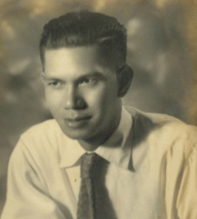
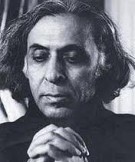
Nick Joaquin
“In myself I am often at a loss to account for the genuine native. To be sure I have the physical quality of my race; but I feel that the composition of my soul is thoroughly soaked with the alien spirit…a great number of my people…are aware that even their virtues are borrowed…my thoughts and ideals, even my complexes and inhibitions–all this seems to revolve around a foreign pattern that is easily recognizable as intrinsically of the West.”
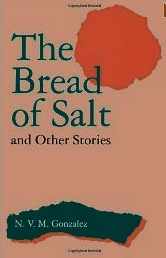
Perhaps it is not so much an empty center as a “haunted” center, and I was reminded of it again when I recently assigned three Filipino short stories from Shawn Wong’s anthology Asian American Literature: Carlos Bulosan’s “The Romance of Magno Rubio,” Bienvenido Santos’ “Quicker With Arrows,” and Jessica Hagedorn’s “The Blossoming of Bong Bong.” Here I want to trace the perennial and even growing presence of this empty center and speculate on its relationship to style. Though these three authors are among the Philippines’ best writers of English literature, they trace what I could refer to as fairly typical themes and styles of Philippine writing. I will end my thoughts speaking briefly about another one of our writers, NVM Gonzalez, who seemed to resist these typical trajectories both thematically and stylistically.
First, as for the theme of the empty or haunted center. The three stories I mentioned range from the late forties (Bulosan’s) to the mid-nineties (Hagedorn’s). The first, Bulosan’s “The Romance of Magno Rubio” is narrated by Nick, a college-educated Filipino working as a farm laborer and book keeper of their crew on a California pea farm. Magno Rubio is one of the crew.
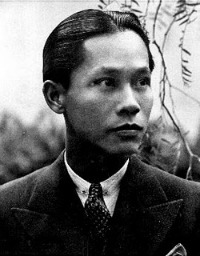
Carlos Bulosan
Small (he’s 4′ 6″), ugly (with a coconut head, turtle neck and ugly teeth), illiterate—Magno has found the address of a girl in a magazine and writes to her. Her name is Clarabelle: 5′ 11″, hefty, living in the Arkansas mountains, and despite the fact that he has never seen her, Magno says he’s in love. In fact, being illiterate, he has never actually written her himself, and the opening sequence of the story centers on how Magno has paid exorbitant fees for others to write for him. “I thought education is meant to guide the uneducated. Did some educated man lie about this thing called education…?” he asks Nick. Though the effects of education continues to be a powerful theme, it is Magno’s blind love for an American woman that remains central. From the beginning you can tell the woman’s goal is to take as much advantage of Magno as possible. She makes up stories to get him to send her money, and when she finally shows up to marry him we know it’s with the goal of cleaning out in person what she couldn’t through the mail. Yet in the end when Magno realizes what his blind love has led to, his response is that they’d better get back to the bunkhouse before all the chicken’s gone. It’s enough that his love for an American girl has given his life purpose and direction, even if it is finally empty. It’s so symbolic of the Filipino love for America!
In Bienvenido Santos’ story “Quicker with Arrows” the stakes are even higher for the central character, Val, also madly in love with an American girl, Fay. The story, filled with images of the atom bomb and Hiroshima, takes place just before the end of World War II. The problem: Val sees himself so caught between his Filipino identity 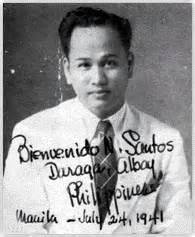 and his love for Fay that he both clings to her and is afraid to be seen with her. This tension paralyzes him, leads to a cowardice that, among other things, makes him ask Fay to hide in his bedroom when Filipino friends drop by his apartment, and finally drives the American girl away, even though he eventually proposes to her. Perhaps Santos intended the backdrop of the Hiroshima bomb to parallel the bomb Fay drops on Val, so to speak, although the symbolic structure of the story has always seemed confusing. The story’s title indicates that arrows would be quicker than an atom bomb, which makes little sense to me. Moreover, Val’s cowardice and indecision make Fay’s decision seem almost generous because she has endured so much. But we are clearly many steps beyond Magno Rubio’s reaction to his being robbed by an American girl. Here the attraction to an American girl is much more real and deep, and so is the resulting questioning of identity, the self reproach, the symbolic sense that the close ties between Filipinos and Americans will tend towards varieties of devastation.
In Jessica Hagedorn’s “The Blossoming of Bongbong” personal dissolution seems complete, as if the main character had started from some ground zero atomic blast and gone downhill from there. The story begins:
“Antonio Gargazulio-Duarte, also fondly known as Bongbong to family and friends, had been in America for less than two years and was going mad. He didn’t know it, of course, having left the country of his birth, the Philippines, for the very reason that his sanity was at stake. He often told his friend, the painter Frisquito, ‘I can no longer tolerate contradiction. This contry’s full of contradiction. I have to leave before I go crazy.'”
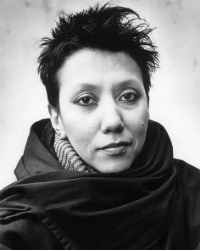
Jessica Hagedorn
First he stays with his sister Carmen, whose husband works for Bank of America while she herself enrolls in an Elizabeth Arden beauty course hoping to become a fashion model or go into merchandising. The symbols keep rolling down 10th Ave.! The story’s loose plot follows Bongbong’s desultory wanderings trying to find a place, hooking up with a woman here and there who will let him stay, reading books like Verta May Grosvenor’s Vibration Cooking, and finally winding up with Charmaine and her roommate Colelia, who live in an apartment in San Francisco’s Fillmore district with six cats that always smells like piss and incense. Colelia is all mixed up, perhaps because she’s the only other person Bongbong has ever met who has also read Verta May’s book Vibration Cooking. The story is punctuated by letters back to Friquito. Here’s the first one:
“Dear Friquisto,
Everyone is a liar. My sister is the biggest one of them all. I am a liar. I lie to myself every second of every day. I look in the mirror and I don’t know what’s there. My sister hates me. I hate her. She is inhuman. But then, she doesn’t know how to be human. She thinks I’m inhuman. I am surrounded by androids…I’m glad I never took acid…I wish I was a movie star.
Love,
Bongbong”
The story ends with this letter and this last line:
“‘Frisquito,
Just two things. The power of flight has been in me all along. All I needed was to want it bad enough.
Another is something someone once said to me. Never is forever, she said.
Love…’
He didn’t sign his name or his initial, because he had finally forgotten who he was.”
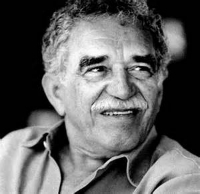
Gabriel Garcia Marquez
Here we arrive at the empty center of my paper’s title, and here also I want to turn to the question of style. “The Blossoming of Bongbong” moves clearly within the orbit of what I have called the “international style.” This style is based largely on the magical realism of, say, Gabriel Garcia Marquez, with nods towards writers like Borges and Nabokov. In a recent New Yorker I found this little aside. The magazine sprinkles these like word cartoons in random corners of its pages. Under the title “This Changing World,” these two sentences from the Louisville (Ky.) Voice-Tribune newspaper: “Michael was invited by the conference head, Sister Mary Margaret Funk who played ‘Amazing Grace’ on her saxophone at the conference. She had been to Tibet where she was chased by a tiger.” This sums up the central qualities of this style nearly as well as the opening line of Marquez’s 100 Years of Solitude: “Many years later as he faced the firing squad, Colonel Aureliano Buendia was to remember that distant afternoon when his father took him to discover ice.” This “international style” is, first of all, funny—mainly due to its use of what seems to be non-sequitur. What does playing “Amazing Grace” on the saxophone have to do with being chased by a tiger in Tibet, for example? Yet there is a connection after all, isn’t there?—just as there is between firing squads and ice. The style moves non-linearly, evoking the future, present, and past in a seamless, disordered jumble that nevertheless resolves itself because the feeling of circular motion strikes us as somehow complete, closed in a way linearity never is. Most of all, there’s the juxtaposition of magic and realism, sense and non-sense, gritty detail and speculative image, as when Marquez tells us the “angel” in his story “A Very Old Man With Enormous Wings” kicks up debris composed of “chicken dung and lunar dust.” It’s especially this nearly dead-pan, non-astonished narrative attitude towards the juxtaposition of chicken dung and lunar dust, vibrators and cookbooks, “Amazing Grace” and Tibetian tigers.
This style has become the prominent style of international literature in large part because it bridges so many cultures, and also because in the combination of magic and realism, it provided and still provides a flexible model that both speaks to the West while subverting the West’s overweening realism and materialism, as well as the West’s hunger for stable centers. The circling style often rotates around a supremely unstable, even absent, center. Along with NGO’s, trading blocks, multinationals, and world music, this style is one of the most important achievements of globalization.
♦ Read PART 2. Go HERE for a list of all writings on the Philippines, including an article and video on the Filipino “Concert King and Queen” and the Filipino affinity for Western music.
♦ Go to World Writers, the Teaching Diversity main page, or the “Third World” lead post.



 The song and video below is in memory of three friends: Nedra Groggins-Sage, Ahkkmand Sage, and Mike Feldmann. About 10 years ago Nedra put together a band for Friendship United Methodist Church and hired Dan Guzman as lead guitarist. Linda and I followed Daniel there to hear the music and just stayed. I got to play lots of keyboard for this extraordinary group of musicians.
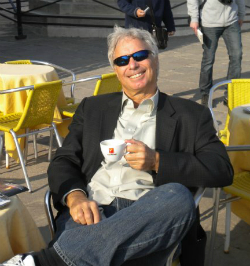 And now Nedra and husband Akkhmand are gone. And Mike Feldmann, too. He moved years ago, but in early July Daniel brought the shocking news that Mike, always so fit, had died suddenly earlier this year. If anyone played perfectly on this song, it was Mike. That’s him in your right speaker, with a delicate rhythm guitar that’s rock-solid on. He was also the band’s gear head, and set Daniel up with his first great guitar, amps, and speakers.