
Climbing Bryan’s Mountain, 2022

I hadn’t been up on Bryan’s Mountain (Bell Rock) since June 14, 2020, something I explained in my 2021 entry in this series called “Climbing Bryan’s Mountain.”  There had been our pandemic, then a year of extreme fire danger, but now on Thanksgiving Day 2022, over 2 years and 5 months later, I was back, this time with 12 others.  It was our Thanksgiving reunion in Sedona, AZ, with Rick’s family, Aaron’s, and Daniel’s. The picture above is of me and Linda with the five Guzman grandchildren: from left, Grace, Josie, Micah, with Adderly and Julian, the youngest ones, in front.  Because of being in a wheelchair, Kari had to stay a level below, but 12 of us made it up to Bryan’s Tree. The picture below shows (from left) Linda, me, Grace, Aaron, Micah, Rick, Josie, Desiree, Daniel, Julian, Tara, and Adderly—a string of names representing the most precious parts of my world.

I wondered whether Bryan’s Tree would be alive at all, given the extreme drought of 2021 which took down hundreds of thousands of trees. But there it was, looking more bedraggled than I remembered, but still vital. This time, too, as the pictures show it held another surprise: the large yucca in front, which had always given it such a unique look, had sprouted, sending its century plant stalk way up in the air.  So the plant will eventually wither completely away, giving the whole complex of plants around Bryan’s Tree a wholly different look.  Change. Always change.  As it will be for each of us who showed up for this reunion.

We had a great time, even an “epic time,” a phrase I kept hearing during our week together.  “That’s an epic shot,” I’d hear of a picture, or an “epic scene,” I’d hear when the grandkids got to dancing or singing together.  Our time, though, was shadowed by sickness, as Grace, our 11-year-old granddaughter, had come to Sedona sick and couldn’t fully participate in many things. Then her Dad, Aaron, got sick, so much so that I canceled my flight back to Illinois, sent Linda back lugging our two big suitcases herself, and drove them the 400 miles back to their Riverside, CA, home.  I caught their germs too. As I write I’m still dragging, just coming out of coughing and blowing my nose all the time, which is way better than Aaron’s fate. He wound up in a Riverside ER twice, though the second time asked to be picked up to avoid the 6-hour wait.  When I left he was barely coherent.  Now his wife Kari is going through a version of their sicknesses.  Back here in Illinois, Josie, Rick and Desiree’s daughter, is a little under the weather, but not too bad, while Julian, Dan and Tara’s son, seems a little puny but also not too bad.  All in all, it was a fairly good escape from illness.

And the time was more than worth it. A few times in the entries I’ve posted in “Climbing Bryan’s Mountain,” I’ve spoken of wanting to climb the mountain up to his tree with all the grandkids. Liam and Maddy, on Linda’s side of the family, had already been, as had Grace, and now all seven have been there. None of the grandkids ever met their Uncle Bryan in the flesh, only in the memories their parents and grandparents share with them and each other so often.  “Would he have loved us?” Micah once asked.  Yes. It’s one of the biggest things they will have missed out on in their lives, the wonderful, embracing love of Bryan Emmanuel Guzman.  Some of them carry the imprint of his name in theirs—Micah Breanne, Grace Emmanuelle, Julian Bryan—and now they’ve all stood by his tree on his mountain and looked out at the incredible beauty from there. It’s a place and a scene which has sustained me over the years. May it be so for them and all of us who gathered there Thanksgiving Day, 2022.

In 2007 Rick and Desiree started Bryan House (which became Emmanuel House, then The Neighbor Project) as a living memorial to Bryan. In 2016 Emmanuel House was named one of the “Top 100 Most Innovative” social change organizations in the world.

Posted in Family | Tagged , , | Leave a comment

St. John…Coltrane

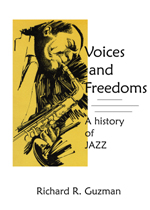
The Video/Audio below is an excerpt from the 13th show of my radio series Voices and Freedoms: A History of Jazz, based on my 1976 book of the same name.  It’s the only episode that doesn’t begin with the series’ theme song, “Afro Blue,” because it’s about the artist who recorded that song, John Coltrane. The 16-part series played across the nation for five years in the late 70’s/early 80’ and holds its relevance—or is even more so—today than it was back then. The excerpts present about 6 to 10 minutes of the original 30-minute broadcasts. The link above takes you to information about the book and our plans to re-release it and provide access to the full-length original shows. Go HERE for a complete list of shows and links to all excerpts.


This episode of Voices and Freedoms may be my least favorite, though it focuses on one of my favorite—and one of the world’s favorite—jazz musicians, John Coltrane. He transcended jazz, so even those who know little about the music seem to know about Coltrane.  I suppose my frustration with this show comes in part because he was such a colossal figure to deal with well in the original 30-minute show format.  The excerpt below is the talkiest of the excerpts because there was so much to say about him as a musical pioneer and spiritual quester that I had to cut much of the music I played to try to keep the excerpt under 9 minutes. I failed. I couldn’t get it down under 9:30.

Though the show and the excerpt below are still well worth listening to, in retrospect they fail to capture why so many people enjoyed Coltrane’s music so much.  My focus on the technicalities of his musical genius and how these challenged some of the fundamentals of jazz led me to play some of his most avant garde stuff, which could be hard to listen to.  It left out some of the most eminently listenable and exciting fruits of his experimentation: songs like “My Favorite Things,” and even “Afro Blue,” the great song that served as the theme song of the entire series.  Instead of beginning with it as I did for every other show in the series, this episode is the only one that begins with me just speaking. Ironically, I silenced some of Coltrane’s most exciting music right from the start.  I also don’t even mention some of his most popular music, songs from his great Ballads album, for example: “Say It (Over and Over Again),” “You Don’t Know What Love Is,” “Too Young to Go Steady,” “All or Nothing at All,” “I Wish I Knew,” “What’s New,” “It’s Easy to Remember,” and “Nancy (With the Laughing Face”—these standards done so beautifully, with Coltrane’s signature sound—still searching, but with his often tortured musical explorations now muted by a reflective glow of sad tenderness and familiarity.

Luckily, I do mention what is perhaps his masterpiece, A Love Supreme, but don’t explore as much as I should have how this and his other more overtly spiritual music led him to become a cultural icon of spirituality.  There’s even a church named after him and centered around his spiritual quest: the Saint John Coltrane Church, where he is referred to as St. John Will I Am Coltrane.  It’s been going for over 50 years, and the graphic at the top of this post is the church’s main icon of Coltrane.

Perhaps most of all, while I do speak of his spirituality as a quest to overcome the overwhelming materialism of the West, I do not mention another thing he sought freedom from: race.  I mention race so much in both the shows and my book Voices and Freedoms that I wonder why I left it totally out here. My connection between jazz and race is one reason I say the series is even more relevant now than it was when it first played across the nation.

On September 15, 1963, a bomb exploded at the 16th St. Baptist Church in Birmingham, Alabama. Four young girls attending Sunday School that morning were killed. Coltrane responded with one of the great anthems of the Civil Rights Movement, his haunting song “Alabama.”

This, I know, has been a strange introduction to this excerpt and the whole original show. They’re still well worth listening to, as I said, but what strikes me now is how much of Coltrane they did not capture. Great spiritual figures often elude our efforts to capture their essence, and this proved frustratingly so on this show. It’s perhaps a sign not just of my failures but of how transcendent a figure John Coltrane really is.

Go to the Diversity Training and Teaching main page.

Posted in Jazz History, Music & Meaning, Music & Media Podcasts | Tagged , , , | Leave a comment

On Not Thinking About What’s Missing

This is a short follow up to The Neighbor Project’s 2022 gala, held this past September 17th.  The “Starry Night”-themed evening gave us some wonderful food, a beautiful evening, and an encore performance from Gerald McClendon, aka The Soul Keeper.  In terms of fundraising, it was the most successful ever, with over $180,000 raised (and still counting).  And it also placed more emphasis than ever on the “stars” in The Neighbor Project staff and board, in its supporters, and especially in the people who enter its programs and strengthen not only their own financial positions but also the financial positions of the neighborhoods they live in.

Executive director Rick Guzman gave another wonderful video presentation, which you can see in the VIDEO BELOW.  He began with the stars on the staff and one of the stars on the Board of Directors, Avis Patterson Miller, who had a street named after her for her years of dedication to her East Side Aurora neighborhood. (See the picture above left.) The highlight of the presentation, as always, however, is when Rick returned to a theme central to the vision of the organization: the priority placed on program participants themselves.  In “Flipping the Hero Script,” the video talk he gave at last year’s gala, he made them the heroes of the stories The Neighbor Project staff and supporters were just helping them write.  For me, the highlight of this year’s talk was when he said that, “Unfortunately, community transformation is often thought of in terms of what needs to be brought into a neighborhood, what’s missing, what are deficits.”  The Neighbor Project is different because it thinks in terms of assets, what’s already there. And what’s there are the people who already live in the neighborhood.  That’s another way of saying the line that ends The Neighbor Project’s intro video, a video I was privileged to narrate.  That line went, “We’re taking back the city’s greatest asset: the people who already live there.” *  This year the gala’s theme made them the main stars of a Starry Night, a glitzy way of re-saying something similar.  I think the 2020 gala presentation said it best.  There Guzman spoke of “Every person’s God-given ability to contribute,” and how paying attention to otherwise marginalized and vulnerable populations would make those people into the real leaders the community needed, the people who would be the real drivers of change.

*  See that intro video Here or about halfway down the landing page of The Neighbor Project’s website.  See the original announcement for the 2022 gala.

Posted in Social Change | Tagged , | Leave a comment