
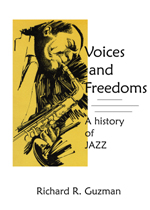

The Video/Audio below is an excerpt from the 4th show of my radio series Voices and Freedoms: A History of Jazz, based on my 1976 book of the same name. The episode is about Early Jazz, the importance of New Orleans in Jazz’s birth, and the will to survive the often brutal mechanisms of racist culture. The 16-part series played across the nation for five years in the late 70’s/early 80’ and holds its relevance—or is even more so—today than it was back then. The excerpts present about 6 to 10 minutes of the original 30-minute broadcasts. The link above takes you to information about the book and our plans to re-release it and provide access to the full-length original shows. Go HERE for a complete list of shows and links to all excerpts.
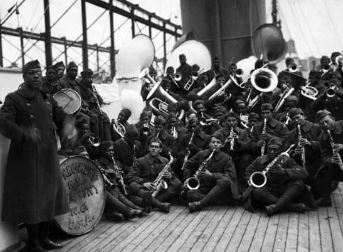
James Reese Europe’s military band (see last paragraph below)
I wish I could pronounce the “ou” combination like Australian and some English and Canadian folks do, especially in the word “out,” but it escapes me no matter what I seem to try. And the same goes for New Orleans. So below in the excerpt of Show #4 on Early Jazz and New Orleans there’s a twinge of regret every time I hear myself say “New Orleans” so crisply, with that bright “e” sound not present in the lovely drawl of those who can say the name of that iconic town correctly. It doesn’t make much sense to say the Blues originated in this or that town, and while Jazz certainly was born in several important locations, New Orleans was so special that it does make some sense to call it jazz’s birthplace.
It was, for one thing, a heavily Catholic town with a creole essence that made the blending of races and cultures seem normal and gave those Creoles greater freedom to move through many more levels of society. There was a greater economic laissez faire, too, that gave even slaves greater freedom, at least in their off hours. And when soldiers who served in military bands returned from the Spanish-American war and sold or hocked their instruments, these fell into the hands of blacks who had previously been confined more to string instruments, and the brass bands and marching bands that formed soon turned out the music that shortly became jazz.
When the U.S. took over, so much changed, especially as intense segregation ramped up during the Reconstruction period after the Civil War. In many ways, though, even these horrendous times couldn’t stop the new music from fermenting and growing.
 In the show below we don’t begin with New Orleans, though, but with the tremendous musical activity of the late 19th Century: military bands, brass band novelty tunes, jug bands, minstrelsy, Cake Walk music, and, especially Ragtime. But perhaps most important we talk about the appropriation of Black culture, that phenomenon—ongoing and powerful to this day—the template of which was set in this time period just as jazz was born. We spend some time on minstrelsy because it was through this music and entertainment and the very process of minstrelization that dominant white culture both embraced black culture and took it over while shutting blacks out, stereotyping them and using myriad ways to keep them “in their place.” Musically, minstrelsy began that supremely ironic situation where blacks had to conform to white standards of the music they had created. Later, Ragtime’s popularity once again put blacks on the losing end. Because the music was fairly easy to write down and its rhythms were easier because of their closeness to marching band music, it was easier for whites to play and quickly spread, especially after the perfection of piano rolls and the player piano. Soon it often seems that Ragtime was a white music blacks only participated in, or, at best, a black music that only reached perfection in white hands.
Ragtime was also much less vocal. At the beginning of this post there’s a picture (above left) of James Reese Europe’s military brass band (Reese stands at far left). The band caused a sensation in Europe because of the tremendous vocal qualities of its music. There are stories of people inspecting their instruments to see if they were the normal. They were. But the musicians playing them and the importance of the Blues and of the human vocal sounds of the Blues were not normal. Once again, the vocal quality of jazz—its obsession with human voices—made the difference in its instrumental sound. More than that, it once again testified to the survival of the human urges for freedom, equity, and dignity. Voices and Freedoms. Both were so hard to keep alive in the earliest days of jazz.
♦ Go to the Diversity Training and Teaching page on this site.


Juneteenth Now More Than Ever
It’s Fall 2022 in earnest now. For a couple of nights we’ve draped towels over our outdoor flower pots to protect against freezing temperatures, hoping to make the blooms last just a little longer. And we look back with nostalgia on Summer, here specifically at Juneteenth 2022, and even a few months further back when it seemed Americans really did want to talk seriously about race. Those days seem nostalgic, too. These days we need Juneteenth more than ever, so the VIDEO below shows a few seconds—98 of them—of one of the oldest celebrations in my state: the Aurora, Illinois, celebration.
In my article on last year’s Juneteenth celebration in Aurora, which explains the holiday in more detail, I also spent some time looking at the famous Johnson brothers’ song “Lift Every Voice and Sing,” known as the Black National Anthem, and the video below does begin with a few words from it. It may be possible for some people, mostly white, to embrace just the good-timey Juneteenth celebration, but most Blacks—a growing number of them—can’t help but embrace the entire heritage: walking the way that has been watered with tears, with the blood of the slaughtered, with hopes that have died unborn. This way continues to be walked every day still by Blacks and other people of color. It would do well for everyone to embrace these realities, too. As is always the case, these sorrowful realities make joy more vibrant, alive…and real. These sorrowful realities, once faced, makes possible the deep, true development of all our humanities, and this, in turn, makes meaningful community and oneness possible.
I’m also writing this just as we’re beginning, after a Summer hiatus, to do our Becoming the Beloved Community (BBC) anti-racism workshops again. I hope you enjoy the video below, but it is fairly shallow. For deeper videos look at some of the videos listed at the BBC link just above. Without embracing all of the heritage, we’re left with just fairly shallow good times. These days we do need even those kinds of good times, yes, but we should be hungering for much more.
♦ This article and video is part of a series on Juneteenth. Go to the LEAD POST Here.