The event described below is part of a series of initiatives of the Anti-Racism Taskforce of the Northern Illinois Conference of the United Methodist Church. See below for details.
The color of concert music is white. Its gender: male. So goes the popular perception. To start a conversation on t.....continued>
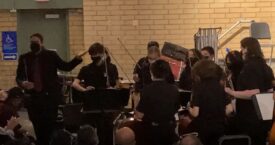
Below is a 3:30-minute video of a small but momentous occasion. My son Aaron—a wonderful musician and talented teacher and conductor—leading the Gage Middle School orchestra, Riverside, California. He’s been teaching there for 20 years and thousands of students. When he first got to Ri.....continued>
We celebrate the Church’s “birth” on Pentecost Sunday, the day the promised Holy Spirit arrived. This year we celebrated on May 20th, a Sunday where at my church—one of the most diverse in America—its large Filipino group took charge of the service. The VIDEO below sh.....continued>
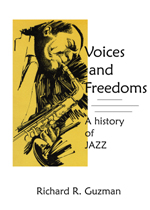
This is the first of 16 short excerpts from my radio series Voices and Freedoms: A History of Jazz. Based on my book of the same name, the series (and book) were produced at the University of Virginia in the nation’s Bicentennial Year. The show, syndicated by the Intercollegiate Broadcasting.....continued>
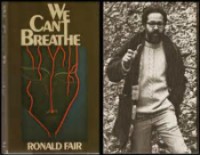
May 2020 Update: Another “I-Can’t-Breathe” incident. I could not watch the video of the police killing of George Floyd in Minneapolis on May 26, 2020. But I heard it while my wife described to me what she was seeing: a police man with his knee on the neck of an already-subdued bl.....continued>
“CBS” (COOL BLACK SICKNESS) a song DAN GUZMAN co-wrote and performs with Brad Hoskins. Fat Cats, Moses in the desert with the Great I Am, bleeding seas, and things tumbling from the sky. Apocalyptic dread. Cool grooves. It not only sounds good—it&#.....continued>
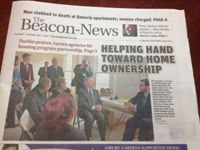
Update: IN APRIL 2018, EMMANUEL HOUSE MERGED WITH LONG-TIME PARTNER ORGANIZATION THE JOSEPH CORPORATION TO BECOME The Neighbor Project. THIS INCREASED THE NUMBER OF FAMILIES SERVED FROM AROUND 25 AT THE TIME OF SENATOR DURBIN’S VISIT TO NOW, IN 2020, A NUMBER APPROACHING 3000. WATCH A VIDEO.....continued>
The music VIDEO below is of one of my earliest compositions, “Lay Your Head Down.” It’s my take on the 23rd Psalm: He leads me by still waters, restores my soul, anoints me so that my cup overflows. Its tone and form, though inflected only slightly that way, pay homage to the blues. It was written during a time of struggle, and many have told me it was a balm in their dark times, too—one of the deepest compliments any piece of music can ever hope to have.
This was recorded live sometime in the late ’70’s in a service at the University Baptist Church in Charlottesville, Virginia. It has a lovely, though cavernous, sanctuary; and on this Sunday morning the echo was strong. I’m on vocals and piano, and organist Robert Smith adds a ghostly organ version of an accompaniment I originally wrote for violin.
Many have asked why I hadn’t posted it on this site years ago. It occurred to me the other day that in these difficult times posting it now would be appropriate.
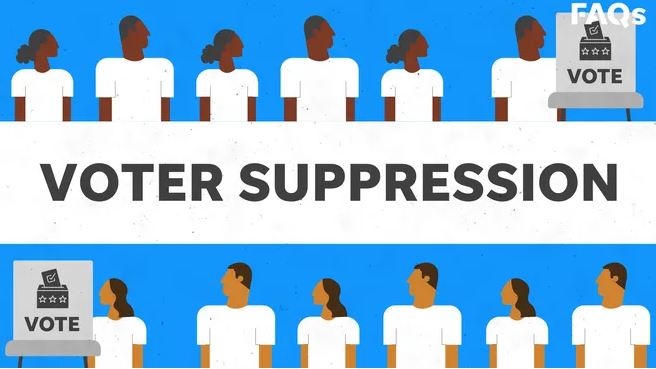
The VIDEO BELOW stitches together excerpts from four clips: first, on the infamous “Bloody Sunday” incident, then three on Voter Suppression from 2010 to 2020—a decade which has seen voting rights seriously rolled back from its high point in 1965’s Voting Rights Act, an Act inspired by the courage of Civil Rights Leaders like the late John Lewis, whom we lost on July 17, 2020.
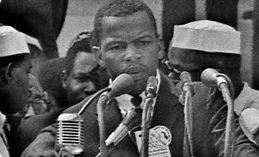
On March 7, 1965, Lewis was one of the leaders of peaceful protestors who, as they crossed the Edmund Pettus Bridge in Selma, Alabama, were viciously attacked by state troopers, county sheriffs, and a horse-mounted posse. Many were injured, including Lewis, whose skull was fractured. The incident became known as “Bloody Sunday,” and the shock and outrage of many of those watching TV coverage was one factor in the passage of the Voting Rights Act later that year on August 6th. About 19 months earlier, on August 28, 1963, John Lewis, then just 23, had been the youngest speaker at the famous March on Washington.
The Pettus Bridge was named for Edmund Winston Pettus, a former Confederate brigadier general, leader of the Alabama Ku Klux Klan…and U.S. Senator. This year, ten days after Lewis’ death a bill was introduced proposing to name the Voting Rights Advancement of 2019 (H.R.4) after John Lewis. It passed the House, but though nearly every Republican in the Senate paid tribute to Lewis—known widely as “The Conscious of Congress”—only one GOP Senator voted for the bill, and it was defeated.
John Lewis speaking at the 1963 March on Washington. He was just 23.
H.R.4 sought in part to remedy the damage done by a 2013 Supreme Court decision in Shelby County vs. Holder which struck down Section 5 of the 1965 Voting Rights Act. Details are in the VIDEO below, which also explains that within 24 hours of this decision three states began enacting suppressive voter ID laws. The situation has gotten worse since then, though there have been legal victories attempting to counteract voter ID laws and other tactics meant to suppress voting, especially by people of color, the poor, and other marginalized groups.
In April 2016, for example, the United States District Court for the Middle District of North Carolina ruled that the state’s new voter ID laws did not place unconstitutional obstacles between the state’s residents and their voting rights. However, three months later, on July 29th, a three-judge panel for the United States Court of Appeals for the Fourth District overturned that ruling. Here’s a paragraph of the decision, written by Judge Diana Gribbon Motz. It contains the now famous phrase which I’ve italicized, bolded, and underlined.
“In response to claims that intentional racial discrimination animated its action, the State offered only meager justifications. Although the new provisions target African Americans with almost surgical precision, they constitute inapt remedies for the problems assertedly justifying them and, in fact, impose cures for problems that did not exist. Thus the asserted justifications cannot and do not conceal the State’s true motivation. ‘In essence,’ as in League of United Latin American Citizens v. Perry (LULAC), 548 U.S. 399, 440 (2006), ‘the State took away [minority voters’] opportunity because [they] were about to exercise it.’”
Those cures for problems that did not exist include voter fraud, which does exist, though in vanishingly small numbers—perhaps, according to one study, 31 in 1 billion votes: 0.000000031%! Still, many Americans believe fraud is “rampant.” “Dirty Tricks: 9 Falsehoods That Could Undermine the 2020 Election,” a piece from the Brennan Center for Justice, is a good summary of false notions about the integrity of elections.
Voter suppression tactics are often presented as rational, commonsense actions to “protect the integrity of elections,” but it becomes clearer each day that racism is at the root of them. The title of Grace Panetta’s article for Business Insider seems to say it all: “Black Americans still face obstacles to voting at every step of the process.” This piece is a good summary of those obstacles, obstacles that dishonor the legacy of John Lewis and everyone who has placed the Right to Vote at the center of their fight for Civil Rights for everyone.
____________________
Other Resources. After watching the VIDEO below, dig deeper. First, three pdf’s of longer reports on partisanship, voting and democracy: 1) From the Economist Intelligence Unit — “Democracy Index 2019,” which calls the U.S. a “Flawed Democracy,” ranking it just the 25th best democracy in the world. Though the link to Voter Suppression is not as strongly made as it could be, given the evidence cited, there is a significant indictment of partisan politics. 2) From the Bipartisan Policy Center — “The 2018 Voting Experience,” which definitively cites race as the major demographic factor in voter suppression. And 3) From the Brennan Center for Justice — “The Challenge of Obtaining Voter Identification,” giving exhaustive details on seemingly reasonable laws which actual target specific populations to take away their voting rights. Finally, a Short Summary of the article above and the video below used for a Voter Registration Drive.
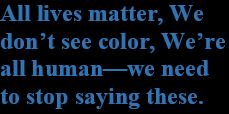
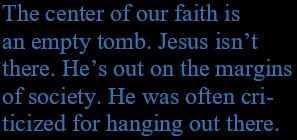
Like so many churches these days, mine’s been on Zoom and Facebook Live for months. The VIDEO below shows a sermon I preached, online, in mid-June, focusing on three phrases to stop saying as we attempt to fight back against racism in the U.S. The three are in the text box to the left. As I have said over and over, Americans would rather talk about anything but race—anything—and these are perhaps the big three avoidance phrases of the many we use. Some are hostile, and profane, and ultra racist, but these three sound “noble.” I based most of this sermon on comments I made at the Laity Convocation of the United Methodist Church (Northern Illinois Conference) on February 8, 2020, weeks before the pandemic shut us down (or in), weeks before the murder of George Floyd. I’ve detailed them in “Unpacking Racism: “Noble” Sentiments That Keep Us From Talking About Race.”
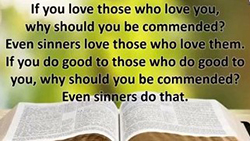
The scripture for this sermon is Luke 6:32-33, Jesus’ conclusion to his announcing the “Golden Rule” and issuing three of his hardest challenges, which he links to that Rule: Love your enemies; Be kind to those who mistreat you; Turn the other cheek. One of these days I’ll explore that linkage, but this morning—though I said this was no time for sound bites—all I had time for were sound bites! So I focused on what Luke 6:32-33 implied about embracing our differences. We love to talk about “embracing our common humanity,” but that’s one of those feel-good things to say that usually doesn’t lead anywhere, largely because it’s practically impossible to do without first accepting our differences.
My 9-year-old grand daughter Grace makes a quick appearance. I’ve been saying a lot lately that IF we work hard to fight racism, we may see a less racist U.S. in 40 to 100 years. Afterwards, several people stayed on line to talk about what I had said. Gene Paquette, husband of the woman who read the scripture (she goes by “Muffy”) said that it was hard to hear that timeline: 40 to 100 years. I always capitalize and bold that IF. In “Walmart, Pence, and Politics As Usual” I commented on what so far is not a lot to show, policy-wise, for all the protests we’ve had. Even IF we manage to start seeing a significant turnaround in the shortest time I’ve envisioned, 40 years, Grace will be nearly 50. I won’t see it, but hoping she and other young grand kids do, that should keep all of us working hard.


 The music VIDEO below is of one of my earliest compositions, “Lay Your Head Down.” It’s my take on the 23rd Psalm: He leads me by still waters, restores my soul, anoints me so that my cup overflows. Its tone and form, though inflected only slightly that way, pay homage to the blues. It was written during a time of struggle, and many have told me it was a balm in their dark times, too—one of the deepest compliments any piece of music can ever hope to have.