


This is PART 2 of a talk I gave in 2004 at a humanities conference in Prato, Italy. For more context on that talk as well as its eerie relevance to some of the crises we face today—including the world-wide pandemic—read the full introduction to it at the beginning of PART 1. I re-publish this here now (it was first published in a journal whose cover is below) partly as a reflection on Christmas, still perhaps the pinnacle of our consumption frenzy. Part 2 below begins by discussing the third element in my argument about the imaginative nature of consumption today. That’s Time, the first two elements being History and Aesthetics, discussed in Part 1. This talk is a rather academic effort, though I try at the end to suggest ways to make it more relevant to high school seniors. For a different, more humorous, decidedly less academic take on consumption during this season, go to “Meeting Frank Capra: A Holiday Tale.”
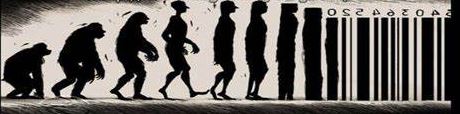
3. TIME: The polyrhythms Appadurai speaks of occur in a radically linear and open-ended time frame which reinforces insatiability. Nothing has to end, really. Large-scale innovations in lending, says Appadurai,
…have created an open-ended rather than cyclic climate for consumer borrowing: they have linked borrowing to the long, linear sense of a lifetime of potential earnings and the equally open-ended sense of the growth value of assets such as houses, rather than to the short and inherently restrictive cycles of monthly or annual income…the small periodicities of consumption have now become contextualized in an open, linear sense of the very rhythm of consumer life. (81-82)
In small, low-tech societies consumption, according to Appadurai, is governed by “interdiction,” a list of do’s and don’t’s related to bodily need and seasonal availability and “combining cosmology and etiquette in special ways” (71). As society becomes more complex, interdiction is overtaken by “sumptuary law” which regulates consumption according to the tension between the aristocracy and an ascending bourgeois class, a situation which commenced in Europe sometime in the 15th century. The consumer revolution of the 18th century in Europe sees a shift from sumptuary law to fashion, and as advertising—fashion’s closest attendant—grows more and more powerful, the laws of fashion allow consumers to become increasingly disengaged from social/historical processes as such. They are drawn, instead, more easily into a world of imagination and fantasy, a world in which the structures of time move to the more linear, open-ended flow of commerce rather than history. Such an atmosphere calls forth the supremacy of the imagination, not only in the sense of daydreaming and fantasizing, but also in the sense of having to continually create landmarks, islands of stability, in an essentially unbounded flow of time and goods.
At this point we may see clearly how the three areas marked out for study converge. For this open-ended sense of time converges with the end of history, which “used to” structure time epochally, emphasizing beginnings and endings, but is now muted, unable to clearly mark any endings at all. Finally, the aestheticizing of sensation, or hedonism, leads to insatiability—perhaps the most spectacular of all forms of open-endedness.
* * * * * * * * * * *
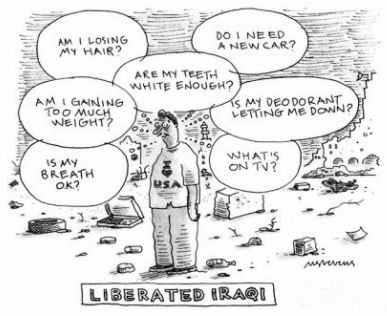
Somehow the ideas developed in the three areas above have to be brought down to something understandable and certainly more immediate to a high school senior taking Consumer Education. We first need to help students understand how history, aesthetics, and time have converged in particular ways to create the conditions under which consumption becomes the major imaginative activity of our time. Each section marked for study may generate questions, pieces of literature and art, a good movie or TV program that may engage students and help them connect consumption practices to ideology. For example, the end of history idea may be directly related to the United States’ current entanglements in Iraq, and certainly the entire war on terrorism. With all this present turmoil, can liberal democracy truly be said to be that dominant? What are the main ideas of liberal democracy anyway, especially as related to the free market? Even cartoons can help focus discussion. A recent New Yorker cartoon by Mick Stevens, for example, shows a vaguely Middle-Eastern man looking confused and bug-eyed, wearing an “I love U.S.A.” tee-shirt, and standing in the midst of the rubble of a bombed out city. Emanating from his head are bubbles showing his thoughts: “Is my breath OK?” “Am I losing my hair?” “Do I need a new car?” “Is my deodorant letting me down?” “What’s on TV?” “Am I gaining too much weight?” “Are my teeth white enough?” The caption reads: “Liberated Iraqi” (28).
The area of aesthetics is easier to approach, simply because commercials are ubiquitous and, more often than not, better than the shows they sponsor. More important, virtually all ads are better than the products they advertise. Exploiting this gap between representation and reality is a key way to explore the aestheticizing of hedonism.
 The area of time offers the most ironic area of exploration; for while contemporary time has been made linear and open-ended, almost infinite, our day to day sense of time has become cramped. In the midst of infinity, we feel we have less time than ever. This is due in large part to the demands of liberal democracy and advertising, so we see these three areas converging once again. In the midst of this open-endedness we also seem to hunger more for closure—not, it is important to note, for finality, but for smaller kinds of endings now that the end of history, consumerist insatiability, and an open-ended time have corroded larger, cultural senses of endings. Over twenty years ago, Frederic Jameson remarked that one of the main features of post-modernity was “…the disappearance of a sense of history, the way in which our entire contemporary social system has little by little begun to lose its capacity to retain its own past, has begun to live in a perpetual present and in a perpetual change that obliterates traditions” (125). But even in the midst of this, I sense a longing for tradition. True, this longing for tradition often comes in the form of nostalgia. As Appadurai and many other have noted, “The effort to inculcate nostalgia is a central feature of modern merchandizing,” and it is a special kind of nostalgia that teaches consumers “to miss things they have never lost” (76-77). The hunger for tradition also finds an outlet in a fascination with antiques, or with what McCracken and others have called “patina,” as in “the patina of age.” In his wonderful book Lost in the Cosmos, Walker Percy essentially sees the open-endedness of postmodern life creating an empty or “nought” self. “Consider to what extent an ‘antique’ is prized,” he says in one of the many thought experiments that end each chapter,
…because it is excellently made and beautiful and to what extent it is prized because it is an antique and as such is saturated with another time and another place and is therefore resistant to absorption by the self…and thus possesses a higher coefficient of informing power for the nought of self. (25)
Still, nostalgia might be fruitfully exploited. In The Sense of an Ending Frank Kermode notes the tension between a “World Without End or Beginning” (one of his chapter titles) and the continuance of apocalypse, of some kind of definitive ending, not only as a theme but as a condition of writing, especially of fiction writing. “Novels,” he writes,
…no matter how much they shift time, put slices of it layer on layer in search of intemporal concord, are always in some way bound to what Sartre calls its ‘manifest irreversibility.’ Their beginnings, middles, and ends, however refined, however distorted from the paradigm, will always join it somewhere. (174)
 Earlier in his study he speaks of “complementarity,” borrowing a concept from Quantum Physics to explain how older paradigms are incorporated into—made complementary to—newer ones, though the old ones may not longer fit the “facts” of contemporary times (59-64). He calls a fiction that undertakes such incorporation a “concord-fiction” (59). “In the middest,” as Kermode calls our uncertain immersion in time, “we look for a fullness of time, for beginning, middle, and end in concord” (58). So here I call for a “complementarity” that incorporates older senses of endings into our newer sense of open-endedness, not in an effort to revive an apocalyptic sense of ending, but to revive smaller periodicities—the day to day, week to week rhythms of beginning and ending, action and rest, accumulating and divesting, that often get lost in the shuffle of open-ended time. Of these “smaller” periodicities, we could single out here the rhythm of human contact versus aloneness, for it seems that in our present day we actually spend more time alone, or in pseudo-contact with others via various forms of technology, than we ever have.
Earlier I quoted words at the beginning and end of a longer passage from Gabriel Garcia Marquez’s One Hundred Years of Solitude. In the midst of being bewildered by the things of the First World, one of things the residents of Maconda encounter is the phonograph, which also causes as much of a stir as movies and street lights. But, writes Marquez, “from so much and so close observation they soon reached the conclusion that it was not an enchanted mill as everyone had thought…but a mechanical trick that could not be compared with something so moving, so human, and so full of everyday truth as a band of musicians” (211-12).
Each of the three areas above provides, that is, an occasion for the exercise of irony. The freedoms of liberal democracy that also imprison us. The aestheticizing of things that makes representation more real than actuality. The open-endedness of time that makes us feel more bereft of time than ever. Developing such a sense of irony would be the second most important goal of a broadened Consumer Education course.
The first goal would “simply” be to highlight the imaginative activity that is consumption in our time. The three areas above set the stage, but finally students need to be encouraged to see consumption symbolically. Jacque Lacan, in his famous (or infamous) “Seminar on the ‘Purloined Letter,’” says, “…the subject must pass through the channels of the symbolic” (337). Moreover, the subject, the person, moves through life according to the rhythm of deplacing signifiers. Again, Lacan: “the displacement of the signifier determines the subjects in their acts, in their destiny, in their refusals, in their blindnesses, in their end and in their fate…everything that might be considered the stuff of psychology, kit and caboodle, will follow the path of the signifier” (338). We must do some fancy translation here, but if we think of the various things persons buy because they think these things are “them”—whether clothes, CD’s, cars, arts, whatever—then discard them when they “no longer are them,” we have a record, a personal history, of what they imagined themselves to be and what they imagined themselves becoming.
 One of the most practical projects I see resulting from these preliminary notes on consumption would be to adapt as many of Walker Percy’s aforementioned “Thought Experiments” from Lost in the Cosmos to thought experiments for Consumer Ed students. Lacan’s “path of the signifier” is one of the main trails Percy is trying to follow. In the chapter “The Self as Nought (II),” subtitled “Why Most Women, and Some Men, are Subject to Fashion” he sees the acquiring and discarding of goods following a six-stage process. The last two are these:
Fifth stage: Gradually the new style becomes everyday, quotidian, rendered neutral. No matter how exotic it is, like a morsel to which an amoeba is attracted and which it surrounds and takes into itself, it is devoured and becomes part of the transparent flowing substance of the amoeba.
Sixth stage: After a sufficient lapse of time, the husk or residue of the new style is excreted and becomes an oddity, a slightly shameful thing but still attached, like the waste in the excretory vacuole of the amoeba. (28)
Excretory imagery notwithstanding, there is also a magic in how the things we consume form us. The “magic” in my title comes partly from the magical-realist style of Marquez and others that has become, in my view, one of the hallmarks of Third World style in the age of globalization. At the end of history our super-heated practices of consumption infuse everyday reality with a kind of magic. At least in our marveling at technology and our enjoying of a surfeit of “the finest things” in life, we are not quite sure, as Marquez says, “where the limits of reality lay.” But the term magic also acknowledges the mysteriously inextricable hold things have over us. Lacan puts it this way in one of his most elegant passages:
What could be more convincing…than the gesture of laying one’s cards face up on the table? So much so that we are momentarily persuaded that the magician has in fact demonstrated, as he promised, how his trick was performed, whereas he has only renewed it in still purer form: at which point we fathom the measure of the supremacy of the signifier in the subject. (331)
Of course Percy, and perhaps Lacan, see such processes negatively, a means to evade, or cope with, the essential emptiness of the self. But that revelation, if it is true, can wait until some more basic imaginative connections are made first. Consumption as an imaginative form of self-making. What do your excreted purchases say about how you imagined yourself, and what do your future “needs and wants” tell you about how you imagine your destination? Beyond this there is the looming shadow of a world of have’s and have-not’s. What I am proposing here is a program aimed at the privileged. Super-heated consumption practices, on the other hand, work upon those not so privileged in some of the same ways they work upon high school seniors in Naperville, Illinois. The lag time between want and fulfillment is one big difference, and while most current models of globalization seem aimed at making that lag time equally small for all people, these preliminary thoughts aim at making the lag time more equal in the opposite direction. Thomas Friedman wrote “A Manifesto for the Fast World.” In the end, perhaps what I’m proposing here will lead to an ironic manifesto for a slower world. Considering consumption imaginatively can be an exercise in slowing down, cooling down, that may lead us more efficiently than intellectual hectoring to a more responsible style of consumption in the future.
WORKS CITED