

I gave the following talk in 2004 at a conference held at the Monash University Centre, Prato, Italy. (Prato is Tuscany’s second largest city, less than 11 miles from Tuscany’s largest, Florence.) I publish it now partly because it speaks about the “end of history” thesis, a thesis that its author, Francis Fukuyama, a “Neo-Con” star, has moved further away from. Neo-Con ideology promoted free-market capitalism and aggressively pushing American democracy across the globe because it believed liberal democracy and market capitalism had essentially vanquished every other ideology there was. But today, even after Joe Biden’s defeat of Donald Trump in Election 2020, liberal democracy seems under very heavy siege, and the flight from globalization back into a more isolationist, rigid, xenophobic nationalism is far from over. We cling to the latter as a populist political ploy, which doesn’t quite stand up against the reality of global economics. Our businesses and manufacturing processes remain strongly global, inextricably entwined no matter how we might want it otherwise. And consumerism rages on. It’s stronger than ever, and a growing danger to the liberal democracy that spawned it. It feeds our environmental crisis, and possibly—as you’ll read below—causes the “boredom” that may be one of the root causes of today’s unrest. I also mention, eerily, how it might take catastrophic events to curb our over-heated consumerist culture. Though some edges of the following argument aren’t as sharp as before, overall the ideas, I think, remain as crucial today as when I first spoke them over 16 years ago.
 Years ago John Fischer wrote an article titled “Survival U: Prospects for a Really Relevant University,” proposing that every discipline in his dream school should focus on ecology. Today Democrats could use it as a primer for their “Green New Deal.” But ecological problems stem in large part from the rate we’re consuming the world, and the afflictions of affluence may be signs of one of the truly central plagues of our time: the growing centrality of a consumerist vision of life and our inability—especially in the West, but increasingly everywhere—to control our rates of consumption. We gobble up raw materials, finished goods, even images and ideas themselves at an ever increasing pace. It’s a problem for our earth, for our pocket books, for our moral and ethical lives, but could we begin to curb it more effectively if we saw it first as a problem of imagination?
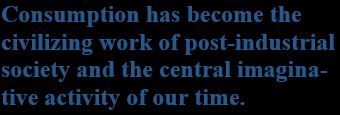
The analysis and critique of “The Afflictions of Affluence”—as Robert Samuelson titled one of his Newsweek articles—has become a growth industry, and popular books like John De Graaf’s Affluenza and rafts of scholarly work approach the issue from an impressive range of angles. Here I’ll lean most on anthropologist Arjun Appadurai, who has called consumption the central imaginative activity of our time. What I’d like to do is less grand than proposing a whole university curriculum. I want to propose a revision to just one course—the Consumer Ed course many seniors have to take before they graduate high school—a revision that would place imagination at the center of Consumer Ed concerns. And I want to propose this for just one particular school district in one particular town.
Naperville, Illinois, is 29 miles due west of the “Loop” in Chicago, and in the middle of DuPage County, one of the richest in the United States. It has often been identified as a “bell weather” town; for what happens in Naperville, so many have said, is a sign of what will be happening in suburbia across the nation. Here, as throughout Illinois, every high school senior is required to take a course called Consumer Education. As presently constituted, the course focuses mainly on being a savvy buyer, on understanding how to balance a check book, and on how interest rates work. I have had much experience in Naperville public school policy, having helped to bring in a foreign language requirement and a diversity plan to Naperville’s schools, the fourth largest system in Illinois.
 In re-visioning and broadening the goals of this course, it would be tempting to jump straight into an ecological, even a Puritanical, ethic which calls for a simpler lifestyle and the substantial curbing of consumerist practices. Eventually this curbing must happen in some way. But a jeremiad is less likely to succeed if the objects of it do not know that there is a deep problem to begin with. That we label some consumptive practices as “conspicuous” does not mean we understand them in any conspicuous way whatever. Much less do we understand that most of our consumption is already conspicuous, not just the province of the super wealthy. Also, our economy presently depends on high levels of consumption, and globalization—which further heats up consumptiond—is such a juggernaut, that it would be naïve to assume that any calls to drastically cut our consumption would have any widespread effect. It may be that some massive terrorist activity, some crash on the scale of the 1929 market crash, some environmental or health catastrophe (such as the ones projected in the films The Day After Tomorrow or Outbreak) will be the only things that can finally change us. We hope, however, that scenes of such wide-spread destruction and misery can be avoided, and that the humanities can help avert them. This is all the more important to the humanities because the humanities themselves have been deeply involved in raising the level of consumption to its present super-heated state.
In his review of Virginia Postrel’s recent book The Substance of Style: How the Rise of Aesthetic Value Is Remaking Commerce, Culture, and Consciousness, Tom Carson writes:
“Nine tenths of the critical writing about commodity could be anthologized under the title Killjoy Was Here; whether the point of view is Marxist alienation or post-structuralist hauteur, it’s a given that the critic is monkishly immune to the gratifications involved. Yet that’s just why, tested against everyday life as most people experience it, the bulk of all this intellectual hectoring is inhumane rubbish—contemptuous of desires that aren’t necessarily as unworthy or manipulated as charged.” (115)
I’ll attempt to situate myself somewhere between intellectual hectoring and consumer apologetics, the main charge Carson levels at Postrel. The program I outline here attempts to raise awareness of the role of consumption at a more basic level than economics and the vagaries of buying. It takes as its starting point—its thesis—that consumption is now the major imaginative activity of our time. As Arjun Appadurai writes, “…consumption has become the civilizing work of postindustrial society” (81). We need to understand how it got this way and how the humanities can set new directions in our understanding of how our patterns of buying and consuming power the way we imagine not just an individual identity, but an entire world. This initial attempt at constructing an alternative syllabus for the Consumer Education course marks out three areas of study: history, aesthetics, and time. The confluence of these three can provide a context for understanding the rise of consumption as the major imaginative activity of our time.
1. HISTORY: What is the particular nature of history at this moment? Half of the title for this paper comes from Hegel, through French philosopher Alexandre Kojeve, with an “end point” in Francis Fukuyama, who wrote The End of History and the Last Man. We have arrived, says Fukuyama, at the historical moment when the contest between political and ideological systems has resulted in the triumph of liberal democracy. Notwithstanding the competition represented by fundamentalist Islam, for example, or arguments as to the particular forms liberal democracy could or should take in specific situations, this triumph is such that no one now considers any other ideological system truly viable. “This is not the place to rehearse Hegel’s gargantuan narrative,” writes Michael Valdez Moses. “It is enough to suggest that the conclusion at which Hegel arrives, that history culminates in the universal recognition of human freedom, is implicit within the political ideology that has come to dominate the modern world” (8). Freedom of the individual and freedom of the marketplace—which seem to have become inextricably entwined—are thus our highest socio-political goals, no matter how free individuals and markets may in reality be. But the results of this are obviously not completely healthy. Fukuyama ends his essay “The End of History?” (out of which the book grew) in a wonderfully ambiguous way:
“The end of history will be a very sad time. The struggle for recognition, the willingness to risk one’s life for a purely abstract goal, the worldwide ideological struggle that called forth daring, courage, imagination, and idealism, will be replaced by economic calculation, the endless solving of technical problems, environmental concerns, and the satisfaction of sophisticated consumer demands.” (178)
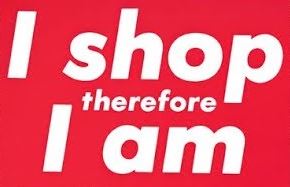 He forecasts a “prospect of centuries of boredom” that may serve “to get history started once again” (178). Though we may quibble with the big argument, it seems that Fukuyama’s “replacement” list is extraordinarily accurate. He believes that this list is less “lofty” than what it replaced. What he misses is that imagination—and possibly daring, courage, and idealism as well—now have new targets, that these targets are those things on his replacement list, and that the last thing on the list—“the satisfaction of sophisticated consumer demands”—dominates the whole list. While there may be a growing cynicism with the crassness of economic calculation, a growing frustration with the complications of technology, and a continuing apathy towards the environment—consumerism remains often intolerably exciting. Though we all know that money can’t buy happiness, we rarely act that way; for things that money can buy so often take on magical properties. This is certainly true in stories involving the reaction of “Third World” societies encountering “First World” things. In One Hundred Years of Solitude Gabriel Garcia Marquez writes that
“Dazzled by so many and such marvelous inventions, the people of Maconda did not know where their amazement began. They stayed up all night looking at the pale electric bulbs fed by the plant that Aureliano Triste had brought back when the train made its second trip…It was as if God had decided to put to the test every capacity for surprise and was keeping Maconda in a permanent alternation between excitement and disappointment, doubt and revelation, to such an extreme that no one knew for certain where the limits of reality lay.” (211-212)
But such a magical ethos is as certainly “First World” as it is “Third World,” not only when we marvel at the latest thin screen high definition TV, or the burgeoning power of our cell phones, but also when we partake in the growing appreciation of fine food and wine, or the growing sophistication of design which transforms more and more tract homes into Swedish spas or Italian villas. The historical landscape we now inhabit is a landscape transformed by globalization into a marketplace of goods that has replaced the marketplace of ideologies because there are, so the theory goes, so few ideologies left to buy, or buy into. It’s not necessary to “buy” every detail of the End of History view to use it as a hook to focus attention on the particular demands of liberal democracies—and liberal market places. In our time, one could ask, where else is there for the imagination to turn but consumerism? An increased awareness of the central imaginative role of consumption might hopefully, and ironically, lead to answers other than consumerism in the long run. As it turns out, that turn towards consumerism was prepared for long before globalization became a juggernaut and arose from a movement that had—again, ironically—an anti-materialist base, some of which might still be recaptured.
2. AESTHETICS: Long before the supposed “end of history” one of the key changes that prepared the way for modern consumerism was the aestheticizing of hedonism which began with the Western Romantics. “Neither the first Romantics, nor their successors…, ever intended to grant legitimacy to modern consumerism or to that spirit of self-interested hedonism upon which it is based,” writes Colin Campbell in The Romantic Ethic and the Spirit of Modern Consumerism (207). In fact, says Campbell,
“…the first Romantics initiated that form of mass culture critique so characteristic of modern intellectuals, in which the unrestrained pursuit of profit and personal gain is seen as the primary factor which acts to prevent people from experiencing that spiritual enlightenment which is their birthright.” (207)
However, what the Romantics did initiate, according to Campbell, is the “ideology” of art, and in particular “a new artist class” (208). The Romantic visionary faith that impelled them to try to heal souls cursed by the over-rational and over-material turned to art as the major way of renewal; for the arts of music, painting, poetry, drama and the like offer a diversity of means and stimuli than other “entertainments” engaged in by traditional hedonists. It shifts the emphasis from seeking sensation to seeking emotion because sensation leads more quickly to satiety. The arts, in other words, are better at avoiding boredom. They also shift individual attention inward towards aesthetic appreciation and taste, and away from the outward, more “worldly” concerns of ideology, religion, politics, and the like. It sounds foolish to say one has a “taste” for communism, Catholicism, liberal democracy, but the appreciation of food, design, and, art, of course, is all about “taste.” In Romanticism, as Campbell says, there may have been “…a repudiation of utilitarianism, but not materialism, for luxury, in the form of exquisite, rare and beautiful objects…actually symbolizes the aesthetic attitude” (200). All this sets the stage for a more inward, mental hedonism, and the growing importance of daydreaming as a form of self-making. It moves actual consumption to another level. “That the imaginative enjoyment of products and services is a crucial part of contemporary consumerism is revealed by the important place occupied in our culture by representations of products rather than the products themselves,” says Campbell (92). This emphasis on the arts, and the fact that the seeds of modern consumerism germinated amid such things as the growing popularity of books (novels in particular), marks the humanities as a major contributor to the spirit of modern consumerist culture.
Grant McCracken describes how significance today flows basically from a “culturally constituted world” of meaning through systems of advertising and fashion into consumer goods, and from there via rituals of possession, exchange, grooming, and divestment into the individual consumer (71-72). The new hedonists’ connections to the larger culture are thus interdicted by consumer goods, which literally shrink larger perspectives to the goals of advertising, leaving an individual freer to become, as Campbell says, “an artist of the imagination” (78). The mystery of modern consumerism, remarks Campbell, is its “…endless pursuit of wants… its insatiability” (37). This is surely because it is now as much, or even more, an imaginative as an actual activity. The labor of modern consumerism, says Appadurai,
“…is not principally targeted at the production of commodities but is directed at producing the conditions of consciousness in which buying can occur…We are all housekeepers now, laboring daily to practice the disciplines of purchase in a landscape whose temporal structures have become radically polyrhythmic. Learning these multiple rhythms (of bodies, products, fashions, interest rates, gifts, and styles) and how to integrate them is not just work—it is the hardest sort of work, the work of the imagination.” (83)
____________________
End of PART 1. Discussion of the third element, Time, begins PART 2 of this essay, which also contains the Works Cited list.