Welcome to the International Hotel – Part 1

This is Part 1 of the first draft of the beginning of a chapter in one of my book projects: this one on the various fates of radicalism in the U.S.  It’s three short stories, each followed by an essay deconstructing them.  This essay follows the first story—the book’s first chapter—loosely based on my uncles Felix and Paul.  This explains the opening line below: “That’s how I imagined it.”  Now I’m telling what I “know” about the “facts” behind the short story.   Besides my uncles’ stories—and mine—I also speak a lot about the struggle to save San Francisco’s International Hotel in the late ’70’s, a struggle some place on par with the Delano grape boycotts.  Afterwards, READ PART 2 of this draft.  Also, read another part of this project, an essay titled “The Accidental Radical.”

_______________ 

Felix Ayson (on right), in LA circa 1920.

Felix Ayson (on right), in LA circa 1920.

That’s how I imagined it.  Here’s what I know for sure.  First, my Uncle Felix E. Ayson was my Mother’s uncle, my Mother’s maiden name being Cristeta A. Ramirez, “A” for Ayson.  For all the time I knew him, from when I was three until he died 27 years later, Uncle Felix was very hard of hearing, wearing big hearing aids in both ears.  His smile, his misting eyes, his habit of lacing his speech with downward-sloping “now’s”—I remember all those, too, distinctly, as distinctly as I remember the phone call he made to our house in Hayward, California, in late April 1964.

Because of his deafness, I could hear him clearly as he shouted through the phone when my Mother answered.

“Auntie is dead…”

“What are you talking about?”

“Auntie is dead.  She was killed in…”

But I couldn’t make out any more because now my Mother was shouting back, “What are you saying?  Don’t talk crazy!”

He wasn’t crazy.  He carried the newspaper obituary in his wallet the rest of his life.

“AYSON – In Fredricksburg, Texas, April 20, 1964.  Etta L. Ayson, beloved wife of Felix E. Ayson, sister of Alphonse C. Synigal from New Orleans and Hearley J. Synigal from New Iberia, La.  Rosary, Sunday, April 26, at 8 p.m., at Bayview Mortuary, 5187 Third St., San Francisco.”

It was stuffed between a business card written in Chinese on one side, and a health insurance card, on the back of which was written: “To open turn to Right two whole turn Stop at 9….”

At the funeral he kept murmuring “No, No, No,” mixing it with his “now’s,” and I will always remember how he said, “I want to say more sweet words,” rubbing the fingers of his right hand gently together in the direction of Aunt Etta’s casket as if those words might conjure something up.   When that casket was being lowered, he did jump into the ground with it.  I was 15, not quite part of the adults, who exploded into action, rushing forward, legs pumping, arms thrusting in to pull him out, shouting, “What are you doing! Are you crazy! My God, My God!”  I saw them fanning him as he slumped in a dead faint on a graveside chair.

Then I didn’t see Felix Ayson for nearly five years, and no one I knew seemed to know where he went.

__________

March protesting evictions at the International Hotel, SF

One of many marches protesting evictions at the International Hotel, San Francisco, late 1970’s.

In October 1968 the tenants of San Francisco’s International Hotel received their first eviction order, an order that kicked off a 10-year struggle to save the hotel before it was completely demolished in January 1979.  During that time there were at least five eviction orders, each one fought over with stays and counter-orders to lift the stays.  Suits and petitions and appeals and injunctions at every possible legal turn ran up and down every judicial level—Board of Permit Appeals, State Court of Appeal, even the State Supreme Court—and significantly occupied three San Francisco Mayors: Alioto, Moscone, and Feinstein.

The owner of the hotel, Milton Meyer and Company, backed initially by the city, proposed an ambitious high-rise/parking complex, but the eviction was unpopular from the beginning.  By December 1968 opposition from Assemblyman John Burton and the San Francisco Human Rights Commission had already halted the initial action.  On March 20, 1969, even the Ford Foundation got involved, guaranteeing the owner up to $25,000 a year in rents (about twice what it had been collecting), a move that must have emboldened the elderly Filipino tenants who, later that week, told the Department of Public Works that they wouldn’t leave the hotel even if ordered.  “If the hotel is demolished,” they said, “it will be over our bodies.”   By early 1970 students from the State University of San Francisco and the University of California, Berkeley, and seemingly every radical group in the Bay Area were deeply involved in the cause to help a group of mostly elderly Asian and South Asian people keep their home.  “Save the International Hotel: I Am Old, I Am Poor, I Am Tired, I Don’t Want to Move.”  So read printed broadsides made and distributed by the Berkeley students.  It had become a modern-day David-and-Goliath saga.

The other side literally did have a kind of Goliath.   Imposing six-foot-four-inch Judge Ira A. Brown consistently sided with Four Seas Investment Corporation when it bought the International Hotel in October 1974.  In April 1976 he even directed a deadlocked jury to render a verdict in favor of Four Seas—and why not?  Four Seas, and before them Milton Meyer, had full legal rights to do what they wanted.  But something larger, almost mythical, was being contested.  Even Richard Hongisto and James Denman, the sheriff and undersheriff charged with executing the eviction orders, refused to cooperate.  “Laws in our society,” Hongisto said, “are written to protect people with property and money,”  and  “I get a real sense of being on the wrong side of the fence…I see elements of class struggle here.”  On December 20, 1976, both were charged with contempt of court for refusing to carry out the eviction.  Though they later made attempts to serve eviction notices, on January 10, 1977, they were both sentenced to five days in jail and fined $500 each for again failing to evict.

How conservative is the U.S.?  Presumably liberals and progressives led the way to electing Barack Obama, but maybe it was really the essentially conservative middle frightened off by ultra-conservatism just enough that it suppressed, for a moment, its raging fear of socialism—that “S” word (not to mention the “C” word), which, as I write the first draft of this essay in summer 2009, is being used to shout down rational debate about the President’s attempts to reform healthcare.  Our fear of socialism seems cartoonish to most of the rest of the world, but that’s been us practically forever.  Even amid the radical atmosphere of the Bay Area in the 1970’s, the fear of socialism raged.  Bad enough that elderly residents had led in forming the International Hotel Tenants Association (IHTA).  Soon the KDP—the Katipunan ng mga Demokratikong Pilipino (Union of Democratic Filipinos)—long the voice of the Filipino left was taking a leading role, too.   Socialists!  Commies!

On July 29, 1976, Mayor George Moscone—two years and four months before Dan White would assassinate him and his old nemesis Harvey Milk—presented a plan for non-profit ownership of the International Hotel.  The city would use eminent domain to acquire the hotel, use Housing Authority funds to compensate the owners at fair market value, then turn the hotel over to be operated by a non-profit run by its elderly tenants, which would then pay back the Housing Authority.  It was novel—it smelled of socialism—to use eminent domain to acquire private property to then convert into public housing.  But supposing the plan would go through in the first place, why then should the present I-Hotel tenants get to cut ahead of the many, many other poor already in line for low income housing?  Those groups and those representing them weren’t quiet about that injustice.  As is often the case, the “oppressed” weren’t exactly united.

In his article “Reactivating the Spirit,” Glen Jermyn Andag puts “the steps leading to the downfall of the International Hotel” in the same league with other  key American struggles like the Civil Rights Movement, the Delano Grape Strikes led by Caesar Chavez, the steps leading to Nixon’s resignation, and the Vietnam War protests.  Still, in retrospect, partially because of its historic positioning in the midst of Ronald Regan’s governorship of California and on the verge of America’s Reagan Era, defeat seemed inevitable, and on August 6, 1977, the International Hotel was boarded up two days after San Francisco police stormed the building and cleared out its last 40 remaining elderly tenants and 100 of their most militant supporters.

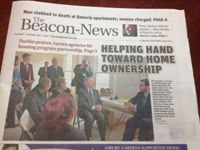
On August 7, 1977, this article appeared on the first and last page (1 and 20) of section one of the San Francisco Chronicle.  On the front page, a picture of a policeman swinging an axe into a door; on the back, a nearly 1/3-page picture of an elderly Filipino tenant, flanked by two young supporters, being escorted out.  He looks calm.  The caption describes his supporters as weeping.  The byline lists George Snyder and Birney Jarvis.

Front page of the SF Chronicle reporting on International Hotel evictions

The Explosive Clash Between Cops, Protesters

“The International Hotel was finally boarded up yesterday after riot-garbed police and sheriff’s deputies cleared the red brick building in the 800 block of Kearny street of about 40 elderly tenants, including their long-time spokesman Felix Ayson, and possibly 100 of their militant supporters.

“A crowd of sympathizers on Kearny street estimated at between 2000 and 3000 persons attempted to block the eviction operation but finally pulled back as deputies stormed into the building.

“One person was arrested during the early morning confrontation and five were treated at Harbor Emergency Hospital for minor injuries and released.

“Sheriff Richard Hongisto, who earlier spent five days in jail for failure to enforce an eviction order, claimed he was the first officer inside the embattled hotel yesterday.

“‘It was the most distasteful job I’ve had since I’ve been in office,’ he said.

“The sheriff, wielding a sledge hammer, knocked down some of the doors to tenants’ rooms and said he found elderly Asians crying.

“‘They didn’t want to leave.  They were being uprooted.  They didn’t want to leave,’ he said.

Mayor George Moscone, later in the day at City Hall, reminded newsmen that his administration had supported the protracted legal efforts of the tenants to halt the eviction.

“‘In a tragic and devastating historic situation,’ said the mayor, ‘things (the eviction) were done as well as could be.’

“The eviction had been planned for 12:30 a.m., an hour when traffic would be at a minimum and just after the midnight change in police shifts, meaning a maximum number of officers would be available for duty.

“But word of the eviction hour had leaked to the hotel tenants and, by 11 p.m. Wednesday, a crowd of sympathizers estimated at 2000 persons had gathered in front of the hotel.

“They chanted slogans, listened to a truck-mounted rock band, sang songs and listed to amplified updates on suspected police movements.

“Shortly before 3 a.m., police blocked off Kearny street between Washington and Jackson streets.  The action was about to begin.

“Police riot squads, wearing jump suits and helmets with face masks, moved into position for the assault with their black riot sticks held at the ready like bayoneted rifles.

“Nearby, a squad of 11 horse patrolmen unlimbered their nightsticks and soothed their prancing mounts while demonstrators standing 12 deep in front of the hotel locked arms and braced for the assault.

“Police Chief Charles Gain, wearing three generals’ stars on the epaulettes of his Eisenhower jacket, watched the increasingly tense situation from the eighth floor of the nearby Holiday Inn….”

Sheriff Richard Hongisto wielding a sledge hammer at International Hotel eviction

The policeman swinging the axe is not Richard Hongisto, but there is one picture of this steady opponent of eviction finally giving in to his official duty and breaking down a tenant’s door.  His face seems to bear the marks of chagrin, and he swings a sledge hammer perfunctorily, with none of the energy the deputy on page one displays.  Nevertheless, the picture will haunt him the rest of his life, both personally and politically.  The decade-long battle to save the building at 848 Kearny Street was over.

Felix Ayson naturalization certificate

Felix Ayson’s naturalization certificate. He is pictured in his U.S. Army uniform.

Built in 1907 after the original building was demolished in the famous 1906 quake, it had provided housing for decades, some of it transient, for many Asian and Southeast Asian men.  Some of those thrown out on that August 4th day were American World War II veterans.  The elderly Filipino man was one.  Felix Ayson—Yes, my Uncle Felix.  He had been “their long-time spokesman” all along.

Read PART 2 of this essay.

A draft of another part of this book project is “The Accidental Radical,” also on this site.

  Go HERE for a list of all writings on the Philippines.

Posted in Family, Social Change | Tagged , , , , , | 2 Comments

The Chicago Literary Hall of Fame

Don Evans, founder of the Chicago Literary Hall of Fame

CLHOF Founder, Don Evans

In mid-2009 Donald Evans, a Chicago writer, called me with an idea: a hall of fame for Chicago’s literary greats.  Because of two of my books—Smokestacks and Skyscrapers (with David Starkey) and Black Writing from Chicago—Don wanted me to be in the first group of consultants and nominators.  Of course, I said yes, and Don still does me the honor, though dubiously deserved, of constantly referring to me as one of the great historians of Chicago writing.  You can see the whole group of inductees Here on the Chicago Literary Hall of Fame website, and from there explore the growing list of events, workshops, celebrations, and other resources the organization has to offer.  I’ve been privileged to give the speech inducting several Chicago writers, including Fenton Johnson and Marita Bonner.

I wrote most of this post shortly after the fourth induction ceremony, held in late November.  It was perhaps the warmest ceremony of all, owing to the wonderful speeches by those accepting awards on behalf of  the inductees.  So far you have to have passed on to be inducted—a Chicago Literary Hall of Fame logorequirement that may be dropped in the future—and we’ve been lucky to have family members accepting most of the CLHOF awards.  Shortly after the fourth ceremony I mailed a book to California for my grand daughter Grace’s Christmas present: Oz, The Complete Collection, Volume 1, containing the first three books about Dorothy and the land of Oz by L. Frank Baum, the first children’s author inducted into the Chicago Literary Hall of Fame.  Volume 1—which the other grandkids (Micah & Josea, and Liam & Maddock) also got—contains The Wonderful Wizard of Oz, The Marvelous Land of Oz, and Ozma of Oz, the latter about Dorothy making a return trip.  Grace wasn’t going to be three until the following April, so it was a gift for the future, where someday she’ll  read the dedication:  “For Grace, Best wishes from the land of Oz. — Robert Baum.”

Robert Baum and Blue Balliet at the Chicago Literary Hall of Fame 4th Induction Ceremony

Robert Baum and children’s author Blue Balliett, who spoke about L. Frank Baum and introduced his great grandson, Robert.

Robert, who accepted the award, is L. Frank Baum’s great grandson.  In fact, look left and you’ll see he looks rather like the Wizard of Oz in the movie!  He and his wife Clare, both former L.A. school teachers, now tour to appear in many Oz events and have developed a show, Frank and Maude, about his great grandfather and grandmother.  In a warm acceptance speech Robert told about how his great grandfather got the inspiration for one of Dorothy’s iconic companions.  A traveling salesman at the time, he was setting up a store window with a can of the oil he was selling and other store items close at hand: a metal funnel, for example, and some furnace pipe, and a hatchet!  And how did Oz get to be Oz?  L. Frank Baum tried his stories out on neighborhood kids as he worked on them, and one day he was launching into the story of a little girl in a strange land when one of the kids said, “Hey, what’s the name of this place?”  Baum looked around, spying his two-drawer filing cabinet, the first drawer labeled A-N, the second O-Z.  The Land of An, didn’t have quite the ring.

The following year, one of my friends and obviously a great poet, Carolyn Rodgers, was inducted. You can read about that Here, and find links to more about her.  From the magic words of a great poet like Carolyn to a writer who created a magical land, that’s the range of inductees in the Chicago Literary Hall of Fame, an organization I’ve been proud to be a part of.

Go to the Chicago Literary Hall of Fame website.
Go to a list of Chicago writers on this site.
Go to a list of Black writers on this site (most are from Chicago).


Posted in Black Writers, Chicago Writing, Writing | Tagged , , , , , , , , , | Leave a comment

Frank Lloyd Wright: The Idea of a Temple

Frank Lloyd WrightThe Imperial Hotel (Tokyo), The Guggenheim Museum (New York), Wingspread and the Johnson Wax Administrative Building (Racine, WI), Robie House (Chicago), Taliesen and Taliensen West (Spring Green, WI, and Scottsdale, AZ), Falling Water (Mill Run, PA)—the list of important buildings goes on and on and on for Frank Lloyd Wright (1869-1959), America’s greatest architect.  Born in Richland Center, Wisconsin, his work in Chicago with Louis Sullivan (whom he referred to as his “Dear Master”) and his Prairie Style marked his first radical innovations in both the structural methods and the aesthetics of modern architecture.  He never stopped innovating.

His writing style wasn’t as innovative, a throwback, almost, to 19th century intellectual prose which was often florid and handled literary decoration poorly.  Nonetheless, I included Frank Lloyd Wright in Smokestacks and Skyscrapers: An Anthology of Chicago Writing not only because of his close ties to Chicago, but also because he so often managed to transcend his writing style through sheer audacity.  I included an excerpt from his autobiography which recounted the building of another landmark: Unity Temple in Oak Park. “I cannot see the ancient institutional form of any church,” he wrote, “as anything but sentimental survival for burial.”

Exterior of Frank Lloyd Wright's Unity TempleTo the building committee he says, “Let us abolish, in the art and craft of architecture, literature in any symbolic form whatsoever.  The sense of inner rhythm deep planted in human sensibility lives far above all other considerations in art.  Then why the steeple of the little white church?  Why point to heaven?”  So Unity Temple didn’t.  Its windows were set so high that on the outside it looked windowless, almost fortress-like with the massive, concrete facade it presented on its street side.  Inside, however, it glowed with the warmth of a Frank Lloyd Wright buidling, many people calling it his perfect “jewel box.”  His high windows, as he wrote, “flooded” the  side Interior of Frank Lloyd Wright's Unity Templealcoves “with light from above to get a sense of a happy cloudless day into the room.”  “The Temple as a forum and good-time place…yes.  As a religious edifice raised in the sense of the old ritual?  No,”  he contended, and so the struggle between Wright and his client began.  But Wright, as he often did, would prevail, and throughout this section of his autobiography one can see him deftly maneuvering spiritual concerns, new techniques of construction (here concrete slab), and ways of handling light together into one of his most beautiful articulations of the idea of organic architecture.

Frank Lloyd Wright also had strong opinions about Chicago culture.  In a 1918 article read to the Women’s Aid Organization, his love/hate relationship with Chicago burned brightly.  “Chicago is the national capital of the American spirit,” he would say, but he goes on to deride Chicago culture, calling it “dirt,” something merely “stuck on” to its grinding, materialistic inner core.  Yet in another place is says, “Eventually, I believe Chicago will be the only beautiful great city left in the world.”  It could be redeemed by real art.  He felt that art—architecture especially—could begin to transform that inner core so that it could become truly organic—that is, one with nature again, and flooded again with spiritual light.  “I believe in God,” he famously said, “only I spell it ‘Nature.'”


Go to a list of Chicago Writers on this site.
Read “Frank Lloyd Wright, Alice Walker, and the Necessity of Beauty”
Watch the video “Come Together Wright Now
 For FLLW and music, go to Did Frank Lloyd Wright Listen to Fats Waller?
Go to Jim Nedza’s DesignSlinger blog on Chicago architecture
Go to Don Gunning’s FLLW website
Go to the Frank Lloyd Wright Trust’s website

—Links go live when material becomes available—

Posted in Arts, Chicago Writing | Tagged , , , , , | Leave a comment