Yesterday I had my last online video class with students who were studying “The Long 18th Century” with me this term. Online because of the world pandemic, because of which there won’t be any traditional graduation ceremonies, or much else traditional for many weeks or months yet. So I thought it appropriate to publish this sermon I gave at North Central College’s Baccalaureate, the afternoon before its 2007 Commencement. I gave the basics of this address several times, though I asked people to request it of me only every four years, so everyone who might have heard it would have graduated. Every time it was a little different, and this time especially, as I gave it only six months after I had lost my youngest son, Bryan Emmanuel Guzman.
Thank you, Jordan.* Earlier today I had the pleasure of introducing Jordan DeRenzo at the College Scholars luncheon. Her senior thesis, a collection of original poems and photographs inspired by the liturgical hours is beautiful, something we’re very proud of. I’ve carried it around all day today, and will do so tomorrow as well, so come up and let me show you a few pages of it. I also got to introduce the luncheon’s main speaker, Jeremy Gudauskas, whose thesis I directed eight years ago. It consisted not only of an essay, but also of two films on homelessness. He was a very good film maker back then, and is better today. He’s stayed close to my family, helping to commemorate with his films, some of the happiest times and also the saddest time in our family’s history.
This term I also worked with a masters student, Greg Thrower, whose thesis is called “Transformational Foolery in 20th Century America.” He’s developing a wonderfully skewed idea that certain comedians actually play a crucial role in clearing a cultural path so that real social change can happen. He’s paired Will Rodgers with Franklin D. Roosevelt and the New Deal era. He’s paired Moms Mabley with Martin Luther King, Jr., and the Civil Rights era. But I want to come to the main idea of my remarks this evening by focusing on the way he’s paired the comedian Don Novello with some of the significant changes in the Catholic Church. If you know him at all, you know Don Novello as Father Guido Sarducci, the supposed gossip columnist of Il Salvatore Romano, the supposed gossip newspaper of Vatican City. Working with Greg Thrower, I got to see again, via YouTube, one of my favorite comedy routines: Guido Sarducci’s “Five-Minute University.” All graduates ponder many things at times like these, and one of these may be how much debt you’ve piled up going to college. Statistics shows that it’ll be well worth it in the long run, but in the short run it’s probably a little overwhelming. So here’s Father Guido Sarducci, who’s going to charge you just $25 to attend his Five-Minute University. His idea is that it will take about five minutes to teach you everything you’ll actually remember about college five years after you graduate.
So he boils foreign language down to: “Como esta?” And you answer “Muy bien.” Economics boils down to “Supply and demand.” For business all you have to remember is, “You buy something, then you sell it for more.” For philosophy it’s, “If a tree falls in the forest and nobody’s there, does it make a sound?” You answer, “Yes—but it all depends….” And so on, but only for about four minutes, because the Five-Minute University also includes a one-minute graduation ceremony, picture snap, and refreshment time. (Watch it at the link in the caption above.)
Struggling to get that first job everybody sooner or later thinks about the phrase, “It’s not what you know, but who you know.” Of course, while the Five-Minute University is one of my favorite comedy pieces, I think what you learn in college is crucial and does pay off. Still, I want us to think seriously for a moment about that phrase.
In a few hours, as you leave this college, you’ll take a lot of what you learned with you, and you’ll have your books and notes to remind you, but you’ll be leaving behind many, or all, of your friends—perhaps never to see them again. And those friendships, the persons you’ve known have enriched you as much as what you’ve learned. Probably more.
I hope you’ll look kindly on your professors, too, and hope you’re richer not only for what we’ve tried to teach you, but for knowing us as persons. We’ll certainly miss you as persons we’ve gotten to know, not just as students we had to teach. The most challenging part of teaching isn’t conveying what we know. It’s embodying what we know, so that persons emerge from behind the knowledge coming out of our mouths. You often catch parents saying, “Do what I say, don’t do what I do,” because it’s always easier to say words than to live up to them. That’s something we all fall short of doing. And over and over I’ve had the experience of struggling to convey facts and ideas, only to have my students remember something else: my enthusiasm or lack of it, something funny I said, something that moved me so deeply I could barely get the words out. It’s not what you know, it’s who you know. That holds true for the friends you’ve made here, and the professors you’ve known.
And it holds true for your relationship with God, though I need to qualify that a lot before I go on.
 I love the song “What A Friend We Have in Jesus,” but there’s obvious flaws in thinking of God too much as your personal friend. There’s obvious flaws in thinking about God at all because we think with words and concepts and God is beyond any word, any concept whatever—beyond the dualities of existence or non-existence, beyond any concept of magnitude, even infinity. Yet we’re stuck using these tools, hopefully with care, to try to understand the ultimate things of our lives. I tend to treat with varying degrees of suspicion anyone who says God spoke to them, telling them to do this or that—though I’m sure this occasionally happens. Our “friendship” with God, this situation of being able to know who God is in a personal way needs to be approached with the greatest care and humility and never with pride. It is the greatest mystery of human existence, and we will never be able to comprehend it.
The great Indian writer Raja Rao used to criticize the West, saying, “To know God the West must make God more and more human.” Rao used the traditional Hindi term “The Absolute” to refer to God, but knew God to be beyond this concept too. He also accepted that there was somehow a mystical connection between the Absolute and the human and proposed the term “Abhuman”—a combination of “Absolute” and “human”—to signify that. I’ve often thought “abhuman” was as clumsy a term as any other, and not fitting for the poetic writer Raja Rao was. My favorite way he phrased our relationship with God is this: In one of his novels, a character says, “Sometimes the longing for God is so great that you weep, and that weeping has no name.” The poet of Psalm 8 phrases it this way:
Lord, our Lord, how majestic is your name in all the earth. You have set your glory above the heavens…When I consider your heavens, the work of your fingers, the moon and stars, which you have set in place, what are mere mortals that you are mindful of them, human beings that you care for them.
The popular astronomer Carl Sagan devised what he called the “Cosmic Calendar” to give us a more tangible feel for our place in the universe. What if, he imagined, the entire time of the universe could be reduced to a calendar year beginning at midnight January 1st and ending midnight December 31st? On what date, at what time do human beings make their appearance? As it turns out, humans make their appearance in the universe on December 31st, 30 seconds before midnight. That’s how small we are in relationship to the universe and certainly to what is beyond it.
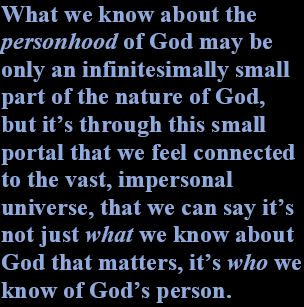
What we know as the personhood of God may be only an infinitesimally small part of the nature of God, but it’s through this small portal that we feel connected to the vast, impersonal universe, that we can say it’s not just what we know about God that matters, it’s who we know of God’s person. I believe this mystery is eventually at, or near, the heart of all religious traditions, each in its unique way. This is a controversial statement which would take at least a whole class, and probably more like another four years of classes, just to begin to understand.
I believe that much of the trouble in today’s world comes from people acting more on what they know about God, or think they know, rather than on who they could know God to be.
Ultimately, to know who God is is to know God as love, as ahimsa, as metta, as karuna. “Love is the key,” said Martin Luther King, Jr., “that unlocks the door to ultimate reality.” God can also be known as the God of peace, of shanti, both personal and social peace.
In the interest of time, I know you will allow me to dodge a closer scrutiny of this mystery of personal knowledge of God for now, and let me end on the most personal of notes.
As many of you know I recently lost my youngest son, Bryan, who died in an accident just days after his 21st birthday. Tomorrow it will be just six months since his death, and my sadness has deepened with each passing day. A couple of days after his death, my oldest son, Rick, and his wife, Desiree, came up with the idea of Bryan House, a transitional housing program for refugee families torn apart by war and politics. It will be a living memorial to him. On behalf of our family, let me thank you for your personal and emotional support during this—the hardest time of my life—and for supporting this living memorial to Bryan. I will take a contemporary shortcut to explaining Bryan House further by asking you to find out details by visiting the website bryanhouse.org.** I can tell you now, however, that a possible sight for Bryan House has already been found, and your response has been so great that there’s a thought of opening two houses, not just one, in the near future. Let me also invite you to a great day of fun on June 23rd, from 9:00 a.m. to 3:00 p.m., as Community Christian Church holds its first annual Promise Fair. There’ll be music, food, a big vendor’s market, an even bigger yard sale, and a great silent auction with all proceeds going to Bryan House. Again, check out details on the website. It’s gotten so big we could use some volunteers to help set up the fair. Contact me if you can help or know some who can. In just a little while, Bryan House will begin to help transform the lives of dozens of refugee families and hundreds of people.
I know you will understand when I say that, as his father, my sadness is so great, my mourning of him still so incomplete, that I myself would trade all this good to have Bryan back. I also know, however, that social change often comes as a consequence of death. We’re inspired to strive for a better world not just by what we know, but who we know. Bryan was so beautiful, as a person and as a spirit. Now his beauty will lead to the beauty of a better life for many, many others—though it still breaks my heart to see his face on the Bryan House logo that has become so familiar to so many people.
Our bodies and spirits are entwined in strong, complex ways that don’t come apart easily. On the morning of December 9th, when I entered the room at Northwestern Memorial Hospital where his body lay, it took me just a few minutes to realize that though his body was lifeless, Bryan’s spirit was still with us. I kept inviting those who came to see him to come closer, to talk to him and touch him, because, I said, “It’s still Bryan. He won’t be this way for long.” And I myself kissed him over and over and over. After a long time, the hospital staff asked people to leave but allowed me to stay with him until they came to take him away. Those staff members who were going to take him away got delayed, so I was with him alone for a long, long time. Only my wife remained in another room ready to drive me to pick up the car he had driven to the lake front that morning. I understood well the physics, the chemistry, the biology, the what of death before me, but I also still felt Bryan’s person, I still knew him and felt he knew me, and I still treasure every second of that time alone with him. When I sank again and again into my deepest grief his soul said clearly to mine, “Dad, this is OK. This is OK.” But more than he and I, I also felt the presence—the person—of God there, caring for us two mere mortals, keeping us—despite the cold fact of death—connected to the universe as persons. Bryan and I felt loved.
It’s not what you know, it’s who you know. I say this to you today not to engage you in some academic thinking exercise, but as a personal witness to this mystery, hoping we all experience this knowledge in our own lives everyday with our friends, our colleagues, and with our God.
* Jordan DeRenzo’s introduction has became incorporated into the short bio I have used for years. She’s now Jordan Finzel.
** Bryan House became Emmanuel House, which, when it merged with long-time partner The Joseph Corporation, became The Neighbor Project. All these organizations are dedicated to building economic and community stability through home ownership. Bryan House started by serving 5 families, Emmanuel House 25, The Neighbor Project over 100—all a great living memorial to Bryan Emmanuel Guzman. In 2016 Emmanuel House was named one of the “Top 100 Most Innovative” social change organizations in the world.
♦ Go HERE for a complete list of sermons, like “Pentecost Means No ‘Supremacies,'” “Sacred Doing,” and “Theology and Race.”


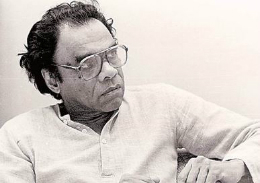 Born in Mysore, India, Attippat Krishnaswami Ramanujan (1929-1994) is considered by many to be India’s finest modern poet writing in English, though he went far beyond English, his other writings as poet, scholar, playwright, philologist, folklorist, and translator ranging over five languages: English, Kannada, Teluga, Tamil, and Sanskrit. His books of original poetry in English are The Striders (1966), Selected Poems (1976, Second Sight (1986), and The Black Hen: Complete Poems (1995). His Collected Poems (1995) won India’s highest literary award, the Sahitya Akademi Award in 1999. In 1976 the Indian government honored him with the title Padma Shri, its fourth highest civilian award, and in 1983 he received a MacArthur Fellowship, the so-called “Genius Grant.” Though he taught at Harvard, Wisconsin, Berkeley, Carleton, and Michigan, his home base was the University of Chicago, where he helped develop the South Asian Studies Program and became the William E. Colvin Professor in the departments of South Asian Languages and Civilizations, Linguistics, and the Committee for Social Thought.
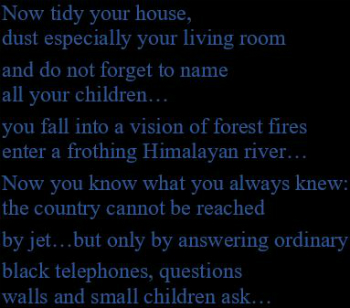 His wonderful “Sonnet” begins: “Time moves in and out of me / a stream of sound, a breeze,” but is also like “an electric current / that seeks the ground….” And this movement also comes with “misplaced leases and passports,” while “excuses and blame swirl through the night / and take me far away from home.” The excerpt from “Chicago Zen” at left brings you face to face with “what you always knew: / the country cannot be reached.” Not by jet, and not even, as the poem says near its end, “with a clean valid passport, / no, not even by transmigrating / without any passport at all….” And even if you kind of get “there,” fear and paranoia might rule the day, so that in his poem “Take Care” he advises people to “Smudge your windows / Draw the blinds” because “All tall buildings / use telescopes.” “In Chicago,” the poem ends, “do not walk slow, / Find no time / to stand and stare. / Down there, blacks look black. / And whites, they look blacker.” As much as travel and migration give us freedom to move, they also restrict our feelings of being at home, feeling rooted and secure. And in a poem like “Death and the Good Citizen” the speaker wishes to be truly “biodegradable,” thus participating in the flow of life into death into life, but cultural customs themselves interdict this flow making it a “struggle to be naturalized,” especially “Abroad”—in a strange land, that is—“where they’ll lay me out in a funeral / parlor, embalm me in pesticide, / bury me in a steel trap, lock / me so out of nature / til I’m oxidized by left- / over air….” We long for free travel, free migration, free flow in the proverbial circle of life, but find restrictions, walls, blockades everywhere: in the material world, in culture, politics, and in our own minds.