
The Racial Wealth Gap

Every time I see a headline like the one below—“Racial Bias Among EMTs?”—I’m almost never surprised any more.  I have a big stack of reports from the Chicago Tribune detailing facts that black people, especially, get the poorest health care and education and job opportunities, are stopped unfairly by police and go to jail in hugely disproportionate numbers, also unfairly, are more harshly punished in school, etc. etc. etc.  I like using the Trib because it leans conservative—way conservative, some would say—so the reports can’t be accused of liberal bias.

RaceEMTs2

Racism persists for very deep reasons.  James Baldwin has written about its roots in our symbolic reaction to the color black itself, and to our inability to deal with the real complexities of our humanity.  Less deep than these, though, are reasons most may not see because—unless you’re black—your chances of experiencing, say, unequal treatment from EMTs is so much lower you’ll probably never experience it at all.  Many whites will also tend to look at blacks as a whole and see large numbers of them living in the poorest neighborhoods, holding the lowest jobs, achieving at levels far below others.  They will tend to think that its been some years since Emancipation, why have blacks made so little progress.  One answer is institutional or systemic racism—attitudes and policies baked into the normal ways we do things every single day—which keep blacks from really accessing the opportunities they need.  This may also be difficult to understand if you’re not on the receiving end of it.

Blacks-Homes2Now, however, more and more people are becoming aware of growing income inequality and the growing wealth gap in the United States.  Bill Clinton’s colorful campaign strategist James Carville coined the slogan “The economy, stupid!” and dollars and cents seem to get through to people quicker than anything else.

There are any number of YouTube videos on the Racial Wealth Gap: lectures, interviews, animations, even one which attempts to explain it in 60 seconds.  I invite you to check these out.  But for me, the best video comes not from YouTube but Netflix.  The very first episode in its series Explained is a 16-minute film on “The Racial Wealth Gap.”

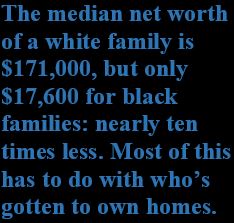
Near the beginning the film notes that the median white household’s net wealth is $171,000, but only $17,600 for black households—nearly 10 times less.  And since, on average, two-thirds of a family’s wealth comes from their home, home ownership is this short film’s central concern, a concern very prominent on this website.

When Rick and Desiree Guzman started a foundation, Emmanuel House, to honor the memory of Rick’s youngest brother, Bryan Emmanuel Guzman, its focus was on getting the working poor out of poverty through education, community involvement, equitable development—all these, yes—but mainly through home ownership, which adds a wealth and stability that makes all those other things more possible.  When Emmanuel House merged with long-time partner The Joseph Corporation, it became The Neighbor Project and increased its capacity by over 10 times to get people into their first homes, or stay in the homes they were already in.

In another post,  “The Racial Wealth Gap and Home Ownership,” I detail how the short Netflix film mentioned above presents the black family’s fight to gain equal housing opportunity, and thus begin building wealth.  It’s a fight of titanic proportions and titanically unequal odds. First of all, blacks start over 350 years behind whites, legally speaking, but still continue struggling to be let in to the housing market even to this day. This enormous inequality recently led the City of Evanston, IL, to begin a reparations program, again centered on home ownership.  Lack of good home ownership opportunities are the single greatest driver of the racial wealth gap.

  Go to another article on Income Inequality, “Graphic Inequality,” and two follow-up articles mentioned above: “Home Ownership and the Racial Wealth Gap” and “Reparations,” both focusing on building wealth through home equity.

  Watch my sermon “Searching for Prophets,” which touches on issues related to income inequality and the wealth gap.

Posted in Social Change | Tagged , , , , | Leave a comment

Ralph Ellison: Survival Blues

EllisonDuring my long career, I’ve been lucky to meet many writers. Somewhere in the mid-70’s, for example, I met Peter Matthiessen shortly after I’d read his great non-fiction book The Snow Leopard and used it in one of my classes.  I had him sign the mass market paperback of his gripping adventure novel At Play in the Fields of the Lord, a novel made into a movie in the early 90’s.  I loved his double take when he asked my name, and I said just “Guzman,” the name of one of the book’s notorious characters.  After Gwendolyn Brooks, Raja Rao, N.V.M. Gonzalez, and Haki Madhubuti, however, the writer I think of as the most luminous meeting of all is probably Ralph Ellison.

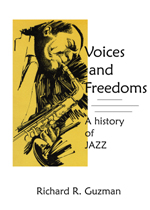
Here, after all, was the author of Invisible Man, a book many have considered the Great American Novel.  Again, it was the mid-70’s and I myself was working on my first book, a decidedly smaller project, Voices and Freedoms: A History of Jazz.  Ellison, a jazz musician himself, had written a couple of iconic pieces on jazz, and that—not, incredibly, Invisible Man—was what I wanted to talk with him about.  In particular, I asked him about a very public feud he’d had with LeRoi Jones (later Imamu Amiri Baraka) after he had reviewed Baraka’s book Blues People in 1963, a book highly touted because it was the first book about jazz written by a black person.  Though the feud was some dozen years old, it seemed to me that for Ellison it had happened just last week, such was the irritation that rose in his otherwise calm, sensitive voice and demeanor.

In his review of Blues People—later included in Ellison’s magnificent essay collection Shadow and Act—he accused Baraka of being too ideological, imposing an agenda on jazz and blues that robbed the music of its excitement, and, most of all,  a sense of men living in the world—of enslaved and politically weak men imposing their values upon a powerful society through song and dance.  Though I love Blues People and still think it one of the most important statements on blues and jazz, one must concede this paradox: it doesn’t always convey a strong sense of what blues and jazz are really like. Also, Ellison says, Baraka often makes rigid distinctions, like between country and classic blues, calling one “folk music” the other “entertainment.” Both kinds can function both ways: it depends on how one wants to use them. Most startlingly, Ellison says Baraka exaggerates the repressive nature of slavery.

Ellison-TheBluesBlacks, said Baraka, could not hope to grow up and be anything but slaves, but Ellison replies that this is too general, that as much as they were slaves, they also saw themselves as jockeys, butlers, farmers, cooks, and they had relationships as males and females, mothers and fathers. Of course, slavery was a vicious system, he says, but “…not (and this is important for Negroes to remember for the sake of their own sense of who and what their grandparents were) a state of absolute repression.”  Ellison is adamant. He feels Baraka has missed the art, the aesthetic, of the blues. And it is this aesthetic aspect, rising above the social and political, that made the music a technique of survival.  “For the blues,” writes Ellison, “are not primarily concerned with civil rights or obvious political protest; they are an art form and thus a transcendence of those conditions created within the Negro community by the denial of social justice.  As such they are one of the techniques through which Negroes have survived and kept their courage during the long period when many whites assumed, as some still assume, they were afraid.”

This fear is what the Invisible Man transcends, moves around, moves through, during the course of the novel, as he shifts shapes, courting visibility here, invisibility there as situations change.  And he’s funny, outrageous.  In a recent piece on Leon Forrest, I quote him saying that, after considering some transcendent moments of Gospel Music, he now understands what the old folks were saying: that to make it through this world you need “shit, grit, and mother wit,” things abundant in the Invisible Man’s daily arsenal.

Invisible Man, a memorial to Ralph Ellison, Riverside Park, NYC.

Invisible Man, a memorial to Ralph Ellison, Riverside Park, NYC.

And there’s this aspect of black people actually “living in the world” with each other.  In a scathing, deep review of another iconic black work, Richard Wright’s Native Son, James Baldwin says that’s what’s missing about the main character, Bigger Thomas.  Because the novel is so ideological, so stuck to the sociological plane, Baldwin says, “…a necessary dimension has been cut away; this dimension being the relationship that Negroes bear to one another, the depth of involvement and unspoken recognition of shared experience which creates a way of life…which has led us all to believe that in Negro life there exists no tradition, no field of manners [to sustain them]…But the fact is not that the Negro has no tradition but that there has as yet arrived no sensibility sufficiently profound and tough to make this tradition articulate.”

Until Ralph Ellison.

The quote above comes from Baldwin’s essay “Many Thousands Gone,” in Notes of a Native Son.  In his “Autobiographical Notes,” the first essay of this seminal collection, he says, “…in the advent of Ralph Ellison, one sees the beginnings—at least—of a more genuine penetrating search.  Mr. Ellison…is the first Negro novelist I have read to utilize in language, and brilliantly, some of the ambiguity and irony of Negro life.”  Now in a world more and more of us realize is still deeply racist, still deeply oppressive of black people, that field of manners, that sense of irony and ambiguity, that sense of blues as survival needs to be invoked more strongly than ever.

  Go to a List of Black Writers on this site, and to the Teaching Diversity main page.

Posted in Black Writers, Writing | Tagged , , , , , | Leave a comment

Leon Forrest’s Divine Days

LForrest2In the Afterword to my book Black Writing from Chicago, the first person I apologize for not including is Leon Forrest.  I wrote: “First and foremost, I will immediately agree with anyone who believes omitting Leon Forrest is unforgivable.  Chair of African-American Studies at Northwestern from 1985 to 1992, he authored four celebrated novels: There Is A Tree More Ancient than Eden (1973), The Bloodworth Orphans (1977), Two Wings to Veil My Face (1984), and the monumental, 1132-page Divine Days (1992).  I tried to create a montage of passages centered on the mythic Sugar Grove character in Divine Days, finally admitting to myself that even 30 pages could not adequately convey the deep, quickly flowing multi-levels of a style so thick with myth and allusion.  Its book jacket accurately dubs Divine Days a “Ulysses of the South Side,” and, indeed, the novel opens with quotes from Homer, the Gospel of John, Joyce, and Dostoevsky.  A 1993 issue of Callaloo was devoted to essays on Forrest’s four novels.  I also recommend Relocations of the Spirit (1994) a collection of his essays, mostly on life in Chicago.”

I was, however, able to include an essay from Relocations of the Spirit—“Souls in Motion”—in a previous book, Smokestacks and Skyscrapers (1999), which I co-edited with my friend David Starkey.  There I wrote, in part:  “Born in Chicago, Leon Forrest [1937-1997] was long associated with Northwestern University’s African American Studies program, and gained an almost reverential following for his dedication to, research in and contributions to black culture in the Chicago area and throughout the nation…Harvard University professor Henry Louis Gates, Jr., referred to [Divine Days] as the War and Peace of African American Literature.  Forrest’s fusion of American myth, autobiography, black history, and religious doctrine and obsession creates an almost too-rich palette of shifting scenes, overlapping selves, and multi-voiced meditations not dissimilar to two other writers to whom he has sometimes been compared: James Joyce and William Faulkner….”

LForrestDDaysI chose the essay “Souls in Motion” for Smokestacks and Skyscrapers as a way to get to Forrest’s own obsession with the “divine day,” Sunday.  Much of the piece takes up this divine day at several Southside Chicago churches:  West Point Baptist, Mount Pisgah, First Church of Deliverance, Christian Tabernacle, and more.  He wonders over the artistry of the pastors, the titanic structure of the black sermon, the interplay of pastor and choir, the Word and the music, winding up at Antioch Missionary Baptist where he witnesses a rendition of “Move Mountain,” a song floating through the essay like a refrain and a witness to the mountains black people have had to move.  The soloist, Paula Williams, “…puts power behind the phrases that celebrate the will of the individual—not only those that honor spiritual fiber but also the lines rooted in the secular ruggedness of grit and guts.  Now I know what the old folks meant when they told me that to make it in life you needed ‘grit, shit, and mother wit’.”  It is close to Christmas, and later that Sunday, in a calmer mood now, Forrest feels “a renewal of faith and intellect” as he reflects on the Pastor’s “anchoring interpretation for all of us who must stand alone before that mountain of ascendancy.”

That ends the piece, but what I remember most, and Forrest, too, calls a “memorable exchange” is his conversation, quoted at length, with Rev. Morris Harrison Tynes, pastor of Greater Mount Moriah Baptist, a man “…who believes all things happen for a deeper purpose.”

Forrest-TynesThe conversation turns to a tragic Chicago incident: the murder of high school basketball star Ben Wilson by three young black men, an incident that still resonates with shock throughout the city 35 years later.  You could look at those three, says Tynes, in two ways: as misguided children of God needing sympathy, love, and forgiveness; or as people who just need to be strung up.  But there is a third way.  “…I believe the finality of death,” he says, “would be to them a blessing. They would be released from the agonizing shame and frustration that they will have to go through for the rest of their lives.  As they get older they will see the dimension of what they’ve done, more than they do now in their little 19-and-20-year-old minds.  And if they are in prison they are going to have a long time to think about their deeds.  And the awesome dimension of that may turn them into saints.”  Perhaps.  But here Forrest does what’s typical for him.  He puts us before words that loom like a mountain—hard, mysterious, inviting us to move them, ascend them, perhaps even cross over them somehow.

  Go to a list of Black Writers written about on this site, and to the Teaching Diversity page.

Posted in Black Writers, Writing | Tagged , , , , | Leave a comment