
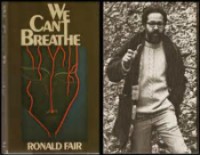


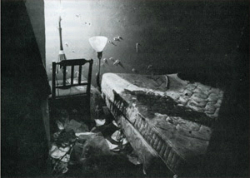
 One of the most infamous incidents in Chicago history occurred at 4:45 a.m. December 4, 1969. At that moment Chicago police entered Black Panther headquarters at 2337 West Monroe, starting a one-sided gun battle that killed Panther leaders Mark Clark (1947-1969) and Fred Hampton (1948-1969). Indeed, “assassinated” or “murdered” are now the terms more commonly used, and the picture of the bloody bed where he lay and the bullet-riddled wall behind (at left) has become another icon for state terror against Blacks. 1969 saw eleven Southside youths killed in police skirmishes, a dozen Panthers killed or wounded, and over 100 Panthers arrested—numbers which echo eerily and tragically as I post this over 46 years later. Subsequent research has shown that much of this was under the direction of the FBI, which tracked and harassed Panther leaders and carried out a concerted effort to beat down the Panthers’ “militarily.”
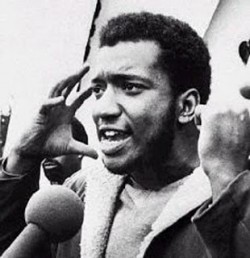 Hampton’s most famous words—“You Can Murder a Liberator, But You Can’t Murder Liberation”—come from his famous speech of the same name, which I excerpted in my book Black Writing from Chicago. In large part, Hampton defends and extols the leaders of the Black Panther Party, Huey P. Newton in particular. “It was Huey P. Newton who taught us how the people learn,” he says. “You learn by participation.” He speaks of Panthers unjustly harassed and jailed, but finally he feels their movement and what it stands for is bigger than any person, leader or not. “So what do we say?” he asks. “Don’t get the pigs offa us cause we can stand em. We jail Mickey White, we should let em murder Bobby Hutton, we should let em run Eldridge Cleaver out of the country. Why? Because you can jail a revolutionary, but you can’t jail the revolution. You can run a freedom fighter around the country but you can’t run freedom fighting around the country. You can murder a liberator, but you can’t murder liberation.”
Liberation is neither abstract or merely rhetorical because, says Hampton, “…when you’re armed with rhetoric and rhetoric alone a lot of times you get yourself hurt,” or begin to think talk is real action. Among the real actions he’s most proud of is the Breakfast For Children Program. “Our Breakfast for Children program is feeding a lot of chi1dren and the people understand our Breakfast for Children program. We sayin’ something like this—we saying that theory’s cool, but theory with no practice ain’t shit…We have a theory about feeding kids free. What’d we do? We put it into practice. That’s how people learn. A lot of people don’t know how serious the thing is. They think the children we feed ain’t really hungry. I don’t know five year old kids that can act well, but I know that if they not hungry we sure got some actors. We got five year old actors that could take the academy award.”
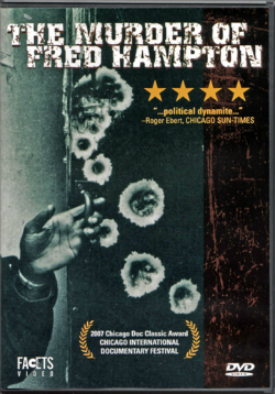 Five thousand people attended Hampton’s funeral, where he was eulogized by such black leaders as Ralph Abernathy and Jesse Jackson, who said: “…when Fred was shot in Chicago, black people in particular, and decent people in general, bled everywhere.” Hampton’s assassination has been commemorated in much literature, notably in Haki Madhubuti’s “One-Sided Shoot-out,” which ends: “our enemies scope the ways of blackness in three bad / shifts a day. / in the A.M. their music becomes deadlier. / this is a game of dirt. / only blackpeople play it fair.” Hampton, who started as a Youth Council leader for the NAACP before founding and chairing the Illinois Black Panther Party, was known as a restrained, articulate organizer. However, his most central speech, as well as several interviews he gave to Chicago papers in the late 60’s, show that his frustration with obstacles to reform—as well as everyday brutality against Blacks—drove him to accept violence as often necessary, especially for self-defense. In 1990 a “Fred Hampton Day” was declared in Chicago. His son, Fred Hampton, Jr., also gained notoriety as a political prisoner. He was released in September 2001 after nearly ten years in jail and intense protest by the International Campaign to Free Fred Hampton, Jr., and the Democratic Uhuru Movement.
♦ Go to the Black Writing from Chicago page, and to a list of Black Writers on this site.
♦ Go to the Teaching Diversity main page.


Clarence Page: America’s “Anxious Class”
Trump’s most recent flap—in a campaign seemingly based on one flap after another—is his ever so slow refusal—which still doesn’t seem a really clear refusal—to denounce the support of David Duke, the KKK, and white supremacist followers. The crux of Page’s essay is the relationship between class anxiety and racism.
Even though written in the mid-90’s the essay seems even more relevant now, 20 years later, especially here: “Today it is easy to see more clearly than ever that behind middle-class anger, whether it is directed against blacks or taxes, is a greater problem afflicting the group Secretary of Labor Robert Reich called the ‘anxious class.’ They are the vast numbers of Americans who see and feel a growing divide between rich and poor, skilled and unskilled, the secure and the insecure in post-industrial America. They have been feeling increasingly nervous about the trend, which appears to be irreversible, and about the weak responses both major parties were making to it…This middle-class anxiety explains why party loyalty shrunk to record lows by the mid-1990s and the urge to find alternatives soared.” The last sentence explains not only Trump but the surprising success of Bernie Sanders, so that this election cycle features “radicals” on both the right and left as prominently as it ever has in American electoral history.
Maybe.
Clarence Page’s essay probes the intersection of race and class, and comes down, mistakenly I believe—even as powerful as the essay remains—on the side of class. It ends: “As long as race remains an American dilemma, as Gunnar Myrdal famously declared it to be in the early 1940s, it will play a salient role in American politics. Americans of all races need to learn who their real enemies are. It is not the members of other races. It is those who use race as a smokescreen to hide the nation’s deeper agonies over class and a dream of upward mobility that for too many members of all races appears to be rapidly slipping away.” But race isn’t just a smokescreen because race and class still remain so tightly joined. White supremacists, so often in the lower classes themselves, want blacks, other people of color or whatever orientation threatens their view of themselves, to remain firmly in a class apart—and preferably below. But, as I cautiously suggest above, things could be changing in ways that weaken race and class’ tight bond and finally confirm Page’s assertion that class, not race, is the real issue.
Page remains one of the country’s most distinguished journalists. He is the Washington-based senior correspondent for the Chicago Tribune, and spent many years working in print and TV journalism in Chicago becoming, in 1984, the first black on the Tribune’s editorial board. He is an essayist and panelist for PBS’s News Hour and a frequent guest on The MacLaughlin Group and other TV news programs. His writing appears in many newspapers and magazines including The Wall Street Journal, Washington Monthly, the Chicago Reader, New York Newsday, and The New Republic. Besides an Illinois UPI Award, an E. S. Beck Award for overseas reporting, and the 1987 McGuire Award for his columns on Constitutional rights, Page won a 1972 Pulitzer Prize as part of a Tribune task force on voter fraud, and the 1989 Pulitzer Prize for commentary.
♦ Go to a list of Black Writers on this site, to the Teaching Diversity main page, and to Black Writing from Chicago.